## Table: Entailment Forms Examples
### Overview
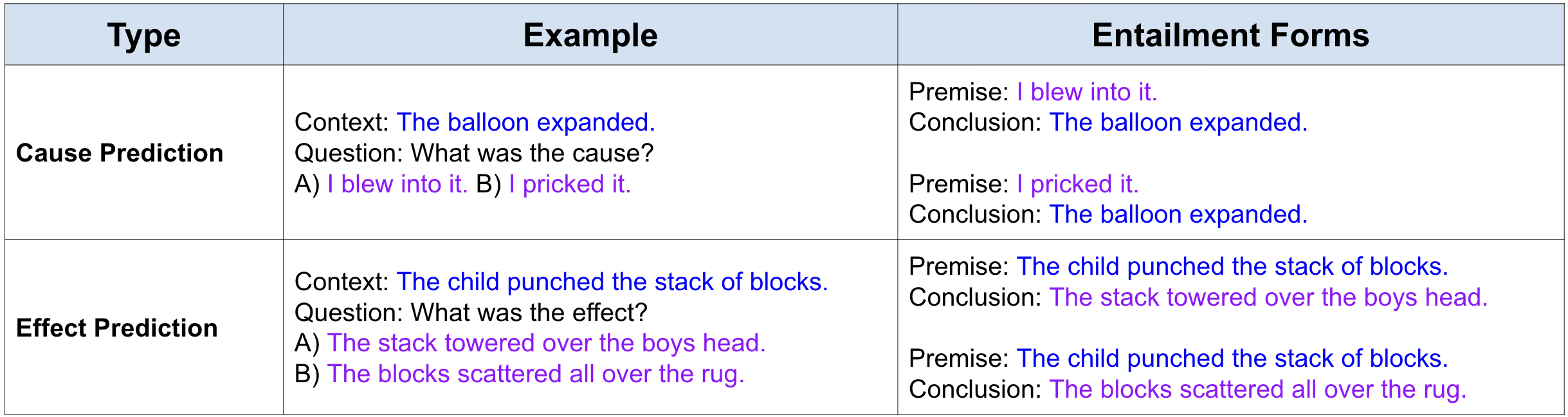
The image presents a table illustrating examples of entailment forms for cause and effect prediction. The table is divided into three columns: "Type," "Example," and "Entailment Forms." Each row provides a specific type of prediction (cause or effect), an example context and question, and the corresponding entailment forms (premise and conclusion).
### Components/Axes
* **Columns:**
* Type: Specifies the type of prediction (Cause Prediction, Effect Prediction).
* Example: Provides a context and a question related to the prediction type, along with possible answers.
* Entailment Forms: Shows the premise and conclusion related to the example.
* **Rows:**
* Cause Prediction: Illustrates cause prediction with an example involving a balloon expanding.
* Effect Prediction: Illustrates effect prediction with an example involving a child punching a stack of blocks.
### Detailed Analysis or ### Content Details
**Row 1: Cause Prediction**
* **Type:** Cause Prediction
* **Example:**
* Context: The balloon expanded. (in blue)
* Question: What was the cause?
* A) I blew into it. (in purple)
* B) I pricked it. (in purple)
* **Entailment Forms:**
* Premise: I blew into it. (in purple)
* Conclusion: The balloon expanded. (in blue)
* Premise: I pricked it. (in purple)
* Conclusion: The balloon expanded. (in blue)
**Row 2: Effect Prediction**
* **Type:** Effect Prediction
* **Example:**
* Context: The child punched the stack of blocks. (in blue)
* Question: What was the effect?
* A) The stack towered over the boys head. (in purple)
* B) The blocks scattered all over the rug. (in purple)
* **Entailment Forms:**
* Premise: The child punched the stack of blocks. (in blue)
* Conclusion: The stack towered over the boys head. (in purple)
* Premise: The child punched the stack of blocks. (in blue)
* Conclusion: The blocks scattered all over the rug. (in purple)
### Key Observations
* The examples are designed to illustrate how a given context and question can lead to different entailment forms.
* The color-coding (blue and purple) highlights the relationship between the context/question and the premise/conclusion.
### Interpretation
The table demonstrates how entailment forms can be derived from different types of predictions (cause and effect). It shows that a single context can lead to multiple possible conclusions, depending on the premise. The examples provided are simple scenarios that can be easily understood, making the concept of entailment forms more accessible. The use of color-coding helps to visually connect the different parts of the examples and their corresponding entailment forms.