\n
## Data Table: Entailment Forms Examples
### Overview
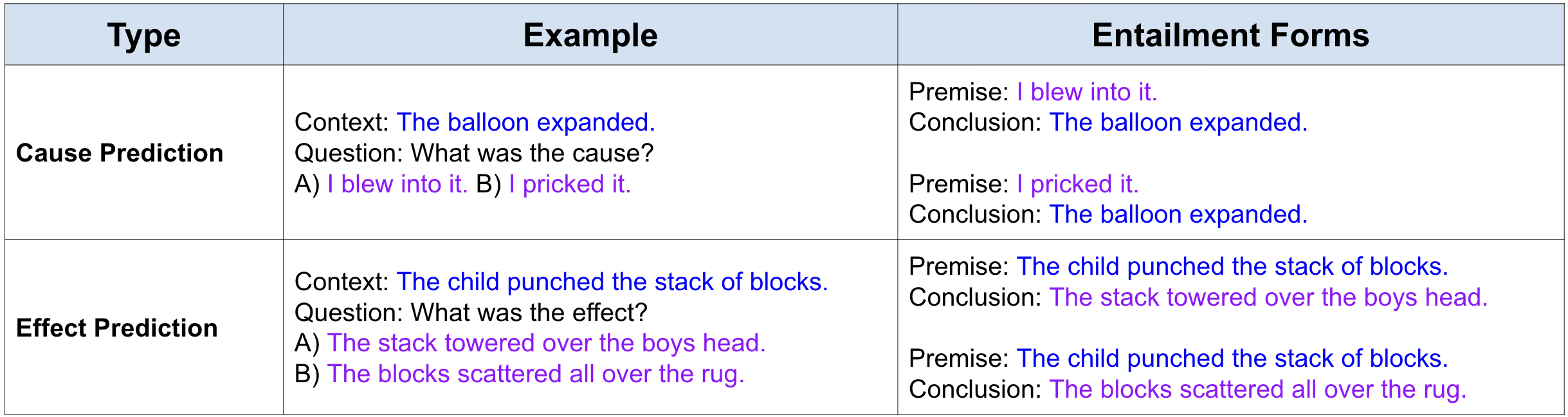
The image presents a data table illustrating examples of "Cause Prediction" and "Effect Prediction" types, along with their corresponding "Entailment Forms". The table has three columns: "Type", "Example", and "Entailment Forms".
### Components/Axes
The table has the following column headers:
* **Type:** Categorizes the prediction task (Cause Prediction, Effect Prediction).
* **Example:** Provides a context and question demonstrating the prediction type.
* **Entailment Forms:** Shows the premise and conclusion representing the logical relationship.
### Detailed Analysis or Content Details
The table contains two rows, each representing a different prediction type.
**Row 1: Cause Prediction**
* **Type:** Cause Prediction
* **Example:**
* Context: "The balloon expanded."
* Question: "What was the cause?"
* A) "I blew into it."
* B) "I pricked it."
* **Entailment Forms:**
* Premise: "I blew into it."
* Conclusion: "The balloon expanded."
* Premise: "I pricked it."
* Conclusion: "The balloon expanded."
**Row 2: Effect Prediction**
* **Type:** Effect Prediction
* **Example:**
* Context: "The child punched the stack of blocks."
* Question: "What was the effect?"
* A) "The stack towered over the boys head."
* B) "The blocks scattered all over the rug."
* **Entailment Forms:**
* Premise: "The child punched the stack of blocks."
* Conclusion: "The stack towered over the boys head."
* Premise: "The child punched the stack of blocks."
* Conclusion: "The blocks scattered all over the rug."
### Key Observations
The table demonstrates how different events can lead to the same outcome (in the case of Cause Prediction) and how a single event can have multiple possible effects (in the case of Effect Prediction). The "Entailment Forms" clearly show the logical connection between the premise and conclusion for each scenario.
### Interpretation
This table illustrates fundamental concepts in logical reasoning and natural language understanding. It highlights the complexities of inferring causality and predicting consequences. The examples demonstrate that a single effect can have multiple potential causes, and a single cause can lead to multiple potential effects. This is crucial for tasks like question answering, text comprehension, and building AI systems that can reason about the world. The table serves as a simplified model for how humans make inferences about events and their relationships. The inclusion of multiple possible conclusions for each premise underscores the inherent ambiguity in real-world scenarios.