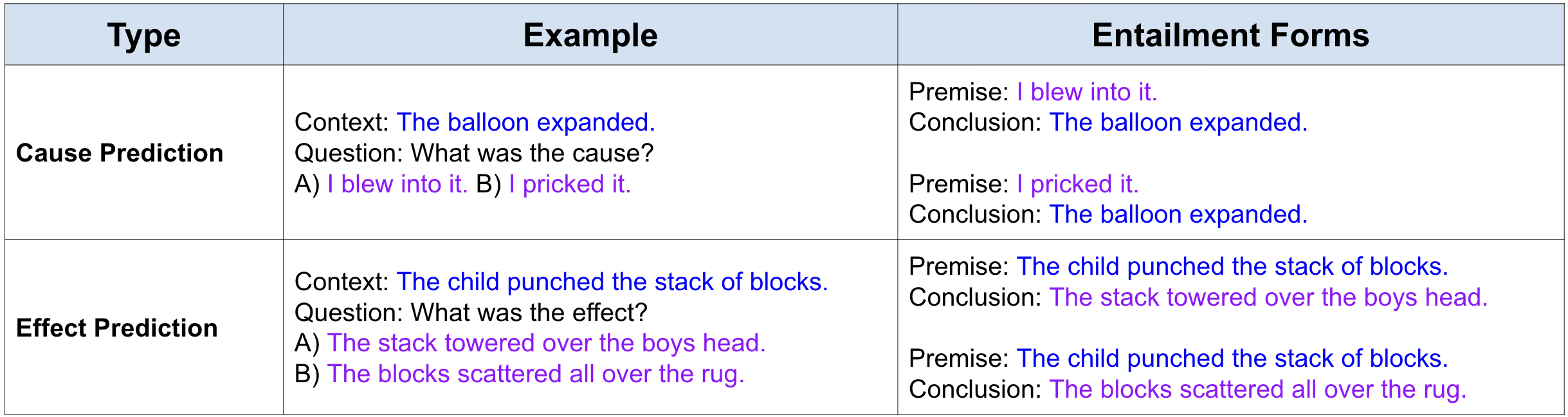
## Table: Cause and Effect Prediction Examples
### Overview
The table presents two types of logical reasoning tasks: **Cause Prediction** and **Effect Prediction**. Each type includes a contextual scenario, a question, multiple-choice options, and entailment forms demonstrating how premises lead to conclusions.
### Components/Axes
- **Columns**:
1. **Type**: Specifies the reasoning task (Cause Prediction, Effect Prediction).
2. **Example**: Provides a contextual scenario and question.
3. **Entailment Forms**: Shows premise-conclusion pairs for each option.
### Detailed Analysis
#### Cause Prediction
- **Context**: "The balloon expanded."
- **Question**: "What was the cause?"
- **Option A**: "I blew into it."
- **Option B**: "I pricked it."
- **Entailment Forms**:
- Premise: "I blew into it." → Conclusion: "The balloon expanded."
- Premise: "I pricked it." → Conclusion: "The balloon expanded."
#### Effect Prediction
- **Context**: "The child punched the stack of blocks."
- **Question**: "What was the effect?"
- **Option A**: "The stack towered over the boy's head."
- **Option B**: "The blocks scattered all over the rug."
- **Entailment Forms**:
- Premise: "The child punched the stack of blocks." → Conclusion: "The stack towered over the boy's head."
- Premise: "The child punched the stack of blocks." → Conclusion: "The blocks scattered all over the rug."
### Key Observations
1. **Cause Prediction** focuses on identifying the cause of an event (balloon expansion) with two plausible causes (blowing vs. pricking).
2. **Effect Prediction** explores outcomes of an action (punching blocks) with two possible effects (stack toppling or scattering).
3. Each entailment form explicitly links a premise to a conclusion, illustrating causal or consequential relationships.
### Interpretation
This table demonstrates how logical reasoning tasks can be structured to test understanding of cause-effect relationships. The **Cause Prediction** row emphasizes identifying antecedent events, while **Effect Prediction** highlights consequences. The entailment forms reveal that multiple premises can lead to the same conclusion (e.g., both blowing and pricking cause balloon expansion) or that a single premise can result in multiple outcomes (e.g., punching blocks leads to two distinct effects). The structure suggests applications in natural language processing, cognitive science, or educational tools for teaching logical deduction.