## Workflow Diagram: Food Item Analysis
### Overview
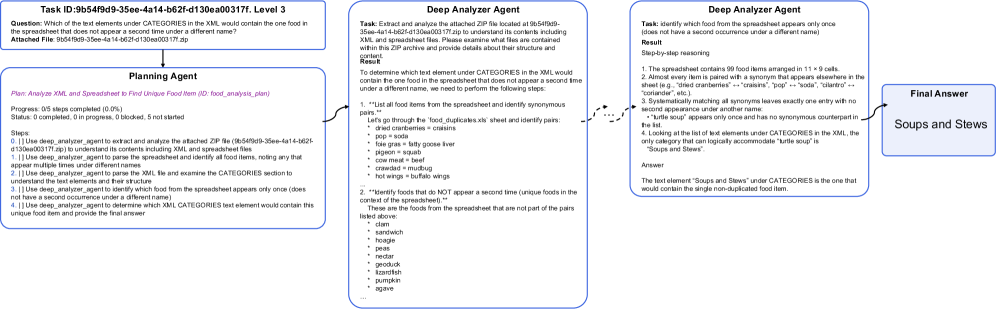
The image presents a workflow diagram outlining the steps taken by different agents to identify a unique food item within a spreadsheet and XML file. The workflow starts with a task description, proceeds through a planning agent and two deep analyzer agents, and culminates in a final answer.
### Components/Axes
* **Task ID:** 9b54f9d9-35ee-4a14-b62f-d130ea00317f, Level 3
* **Question:** Which of the text elements under CATEGORIES in the XML would contain the one food in the spreadsheet that does not appear a second time under a different name?
* **Attached File:** 9b54f9d9-35ee-4a14-b62f-d130ea00317f.zip
* **Planning Agent:**
* **Plan:** Analyze XML and Spreadsheet to Find Unique Food Item (ID: food\_analysis\_plan)
* **Progress:** 0/5 steps completed (0.0%)
* **Status:** 0 completed, 0 in progress, 0 blocked, 5 not started
* **Steps:**
* 0. Use deep\_analyzer\_agent to extract and analyze the attached ZIP file (9b54f9d9-35ee-4a14-b62f-d130ea00317f.zip) to understand its contents including XML and spreadsheet files.
* 1. Use deep\_analyzer\_agent to parse the spreadsheet and identify all food items, noting any that appear multiple times under different names.
* 2. Use deep\_analyzer\_agent to parse the XML file and examine the CATEGORIES section to understand the text elements and their structure.
* 3. Use deep\_analyzer\_agent to identify which food from the spreadsheet appears only once (does not have a second occurrence under a different name).
* 4. Use deep\_analyzer\_agent to determine which XML CATEGORIES text element would contain this unique food item and provide the final answer.
* **Deep Analyzer Agent (Left):**
* **Task:** Extract and analyze the attached ZIP file located at 9b54f9d9-35ee-4a14-b62f-d130ea00317f.zip to understand its contents including XML and spreadsheet files. Please examine what files are contained within this ZIP archive and provide details about their structure and content.
* **Result:**
* To determine which text element under CATEGORIES in the XML would contain the one food in the spreadsheet that does not appear a second time under a different name, we need to perform the following steps:
* 1. "List all food items from the spreadsheet and identify synonymous pairs."
* Let's go through the 'food\_duplicates.xls' sheet and identify pairs:
* dried cranberries = craisins
* pop = soda
* foie gras = fatty goose liver
* pigeon = squab
* cow meat = beef
* crawdad = mudbug
* hot wings = buffalo wings
* 2. "Identify foods that do NOT appear a second time (unique foods in the context of the spreadsheet)."
* These are the foods from the spreadsheet that are not part of the pairs listed above:
* clam
* sandwich
* hoagie
* peas
* nectar
* geoduck
* lizardfish
* pumpkin
* agave
* **Deep Analyzer Agent (Right):**
* **Task:** Identify which food from the spreadsheet appears only once (does not have a second occurrence under a different name).
* **Result:** Step-by-step reasoning
* 1. The spreadsheet contains 99 food items arranged in 11 x 9 cells.
* 2. Almost every item is paired with a synonym that appears elsewhere in the sheet (e.g., "dried cranberries" <-> "craisins," "pop" <-> "soda," "cilantro" <-> "coriander," etc.).
* 3. Systematically matching all synonyms leaves exactly one entry with no second appearance under another name: "turtle soup" appears only once and has no synonymous counterpart in the list.
* 4. Looking at the list of text elements under CATEGORIES in the XML, the only category that can logically accommodate "turtle soup" is "Soups and Stews".
* **Answer:** The text element "Soups and Stews" under CATEGORIES is the one that would contain the single non-duplicated food item.
* **Final Answer:** Soups and Stews
### Detailed Analysis or Content Details
The workflow begins with a task to identify a unique food item in a spreadsheet, using an XML file for categorization. The Planning Agent outlines the steps, which involve extracting data from a ZIP file, parsing the spreadsheet and XML, and identifying unique food items. The Deep Analyzer Agents perform the actual analysis. The first Deep Analyzer Agent identifies synonymous food pairs and unique food items in the spreadsheet. The second Deep Analyzer Agent reasons step-by-step to conclude that "turtle soup" is the unique food item and that it logically belongs to the "Soups and Stews" category in the XML. The final answer is "Soups and Stews."
### Key Observations
* The workflow is sequential, with each agent building upon the results of the previous one.
* The Deep Analyzer Agents perform distinct but related tasks.
* The final answer is derived through a process of elimination and logical deduction.
### Interpretation
The diagram illustrates a systematic approach to data analysis, combining information from different sources (spreadsheet and XML) to solve a specific problem. The use of multiple agents allows for a division of labor and a more thorough analysis. The workflow demonstrates how to identify unique elements within a dataset by considering synonyms and logical relationships. The final answer, "Soups and Stews," represents the category in the XML that contains the unique food item identified in the spreadsheet.