\n
## Diagram: LLM System Architectures
### Overview
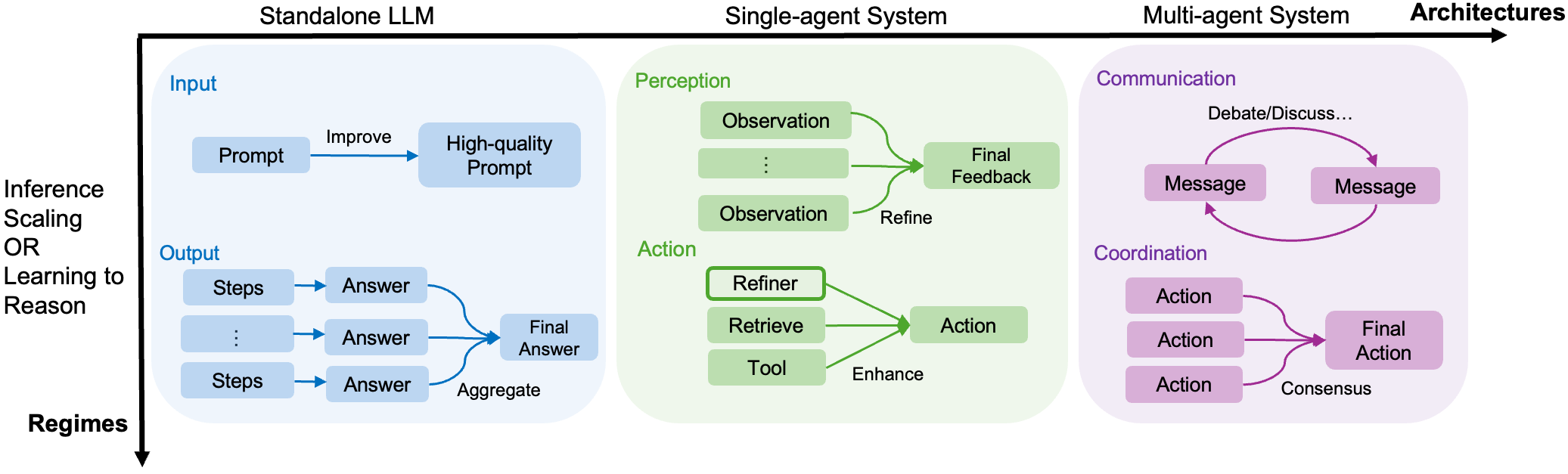
This diagram illustrates three different architectures for Large Language Models (LLMs): Standalone LLM, Single-agent System, and Multi-agent System. It depicts the flow of information and processes within each architecture, highlighting the key components and interactions. The diagram is organized horizontally, with the architectures presented from left to right.
### Components/Axes
The diagram is divided into three main sections, each representing a different architecture. Vertical labels on the left side indicate "Inference Scaling OR Learning to Reason" and "Regimes". A horizontal label at the top indicates "Architectures". Within each architecture, components are represented as rounded rectangles or ovals, connected by arrows indicating the flow of information. Key components include "Input", "Output", "Perception", "Action", "Communication", "Coordination", "Prompt", "Observation", "Refiner", "Message", and "Consensus".
### Detailed Analysis or Content Details
**1. Standalone LLM (Leftmost Section):**
* **Input:** A blue rounded rectangle labeled "Input".
* **Prompt:** An arrow labeled "Prompt" originates from "Input" and leads to a rectangle labeled "Improve".
* **High-quality Prompt:** The "Improve" rectangle outputs to a rectangle labeled "High-quality Prompt".
* **Output:** A blue rounded rectangle labeled "Output".
* **Steps:** Arrows originate from "Output" and lead to a series of rectangles labeled "Steps" (repeated three times).
* **Answer:** Each "Steps" rectangle outputs to a rectangle labeled "Answer" (repeated three times).
* **Final Answer:** The "Answer" rectangles converge into a rectangle labeled "Final Answer".
* **Aggregate:** The "Final Answer" rectangle outputs to a rectangle labeled "Aggregate".
* A downward arrow labeled "Regimes" originates from "Aggregate".
**2. Single-agent System (Middle Section):**
* **Perception:** A rounded rectangle labeled "Perception".
* **Observation:** Two rectangles labeled "Observation" are within "Perception", indicated by "..." suggesting more exist.
* **Final Feedback:** An arrow from "Observation" leads to a green rectangle labeled "Final Feedback".
* **Refine:** An arrow from "Final Feedback" leads to a rectangle labeled "Refine".
* **Action:** A rounded rectangle labeled "Action".
* **Refiner:** A green rectangle labeled "Refiner" is within "Action".
* **Retrieve:** A green rectangle labeled "Retrieve" is within "Refiner".
* **Tool:** A green rectangle labeled "Tool" is within "Refiner".
* **Enhance:** A green rectangle labeled "Enhance" is within "Refiner".
* An arrow from "Refiner" leads back to "Perception".
**3. Multi-agent System (Rightmost Section):**
* **Communication:** A rounded rectangle labeled "Communication".
* **Debate/Discuss...:** A rectangle labeled "Debate/Discuss..." is within "Communication".
* **Message:** Two purple ovals labeled "Message" are within "Communication", connected by a purple curved arrow.
* **Coordination:** A rounded rectangle labeled "Coordination".
* **Action:** Three green rectangles labeled "Action" are within "Coordination".
* **Final Action:** The "Action" rectangles converge into a pink rectangle labeled "Final Action".
* **Consensus:** The "Final Action" rectangle outputs to a rectangle labeled "Consensus".
### Key Observations
The diagram demonstrates a progression in complexity from the Standalone LLM to the Multi-agent System. The Standalone LLM is the simplest, with a direct input-output flow. The Single-agent System introduces a feedback loop for refinement. The Multi-agent System is the most complex, involving communication, coordination, and consensus-building among multiple agents. The use of color-coding (blue, green, purple, pink) helps to distinguish different types of components and processes.
### Interpretation
This diagram illustrates the evolution of LLM architectures towards more sophisticated systems capable of complex reasoning and problem-solving. The Standalone LLM represents the basic functionality of generating text based on input. The Single-agent System adds the ability to improve performance through self-reflection and refinement. The Multi-agent System introduces the potential for collaborative intelligence, where multiple agents can work together to achieve a common goal. The diagram suggests that the future of LLMs lies in the development of multi-agent systems that can leverage the collective intelligence of multiple models. The "Regimes" label suggests that the choice of architecture depends on the specific application and the desired level of performance. The diagram is a high-level conceptual overview and does not provide specific details about the implementation of these architectures. It is a visual representation of a design space, rather than a concrete blueprint.