## [Diagram]: Comparison of AI System Architectures
### Overview
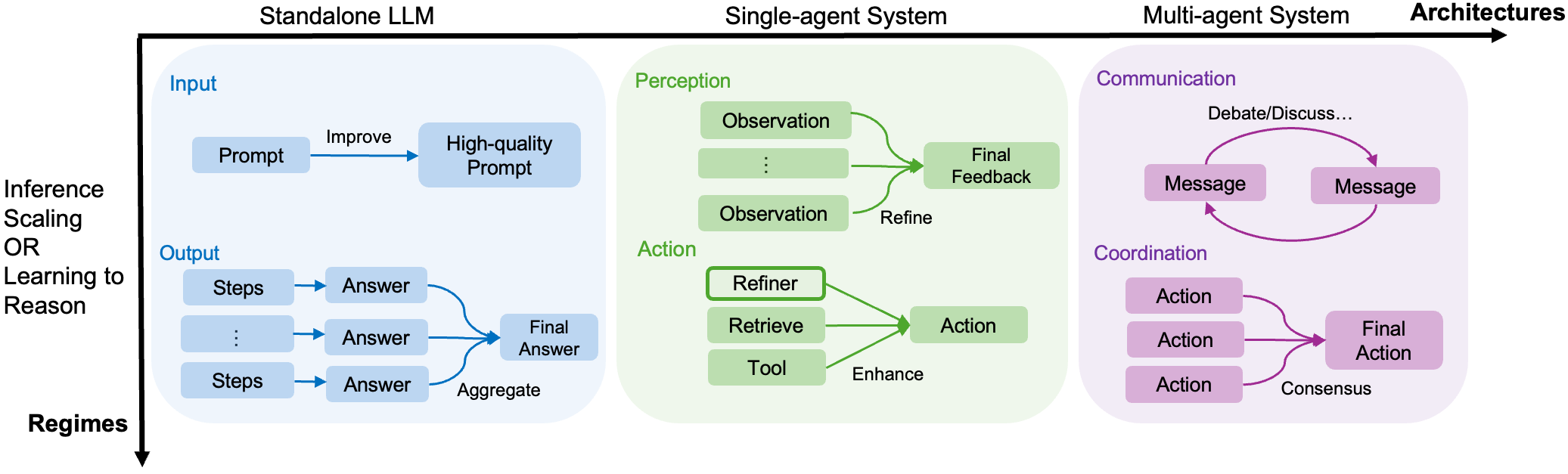
The image is a conceptual diagram illustrating three distinct architectural paradigms for AI systems, arranged along a horizontal axis of increasing complexity. The diagram is segmented into three colored regions, each representing a different architecture: Standalone LLM (blue), Single-agent System (green), and Multi-agent System (purple). A vertical axis on the left defines the overarching "Regimes" as "Inference Scaling OR Learning to Reason."
### Components/Axes
* **Horizontal Axis (Top):** Labeled "Architectures" with a rightward-pointing arrow, indicating a progression from left to right.
* **Vertical Axis (Left):** Labeled "Regimes" with a downward-pointing arrow. The text "Inference Scaling OR Learning to Reason" is positioned along this axis.
* **Three Architectural Regions:**
1. **Standalone LLM (Left, Light Blue Background):** Contains two sub-sections: "Input" and "Output."
2. **Single-agent System (Center, Light Green Background):** Contains two sub-sections: "Perception" and "Action."
3. **Multi-agent System (Right, Light Purple Background):** Contains two sub-sections: "Communication" and "Coordination."
### Detailed Analysis
**1. Standalone LLM Architecture (Blue Region)**
* **Input Flow:** A box labeled "Prompt" connects via an arrow labeled "Improve" to a box labeled "High-quality Prompt."
* **Output Flow:** Three parallel boxes labeled "Steps" each connect via an arrow to a corresponding box labeled "Answer." These three "Answer" boxes then connect via converging arrows labeled "Aggregate" to a single box labeled "Final Answer."
**2. Single-agent System Architecture (Green Region)**
* **Perception Flow:** Three vertically stacked boxes labeled "Observation" (with ellipsis "..." between the first and second) connect via converging arrows to a box labeled "Final Feedback." An arrow labeled "Refine" loops back from "Final Feedback" to the "Observation" boxes.
* **Action Flow:** Three vertically stacked boxes labeled "Refiner," "Retrieve," and "Tool" connect via converging arrows labeled "Enhance" to a single box labeled "Action."
**3. Multi-agent System Architecture (Purple Region)**
* **Communication Flow:** Two boxes labeled "Message" are connected in a circular loop by two curved arrows. The top arrow is labeled "Debate/Discuss...".
* **Coordination Flow:** Three vertically stacked boxes labeled "Action" connect via converging arrows labeled "Consensus" to a single box labeled "Final Action."
### Key Observations
* **Progressive Complexity:** The architectures evolve from a single, monolithic model (Standalone LLM) to a system with internal perception-action loops (Single-agent), and finally to a system with multiple interacting entities (Multi-agent).
* **Feedback Mechanisms:** The Single-agent system introduces a "Refine" feedback loop in its Perception module, which is absent in the Standalone LLM. The Multi-agent system introduces a "Debate/Discuss" communication loop.
* **Aggregation vs. Consensus:** The Standalone LLM aggregates multiple answers into one. The Multi-agent system achieves a final action through consensus among multiple agents.
* **Component Specialization:** The Single-agent system explicitly breaks down its Action module into specialized components ("Refiner," "Retrieve," "Tool"), suggesting a move towards modular tool use.
### Interpretation
This diagram presents a conceptual framework for understanding the scaling and evolution of AI systems. It suggests that moving from left to right along the "Architectures" axis represents a shift from **inference-time scaling** (improving a single model's output through better prompting or step-by-step reasoning) towards **learning to reason** within more complex, interactive, and potentially embodied systems.
* The **Standalone LLM** relies on the model's internal knowledge and reasoning capabilities, enhanced by prompt engineering and output aggregation.
* The **Single-agent System** introduces an external loop of perception (gathering observations) and action (using tools), allowing the agent to interact with and refine its understanding of an environment.
* The **Multi-agent System** adds a social or collaborative dimension, where coordination and communication (debate, consensus) between agents become the primary mechanisms for achieving complex goals.
The diagram implies that more advanced, robust, and capable AI systems may require architectures that incorporate environmental interaction, specialized tool use, and multi-agent collaboration, moving beyond the paradigm of a single, isolated language model. The "Regimes" axis ties this architectural progression to the fundamental challenge of whether AI improvement comes from scaling inference or from developing genuine reasoning capabilities.