## Diagram: AI System Architectures Comparison
### Overview
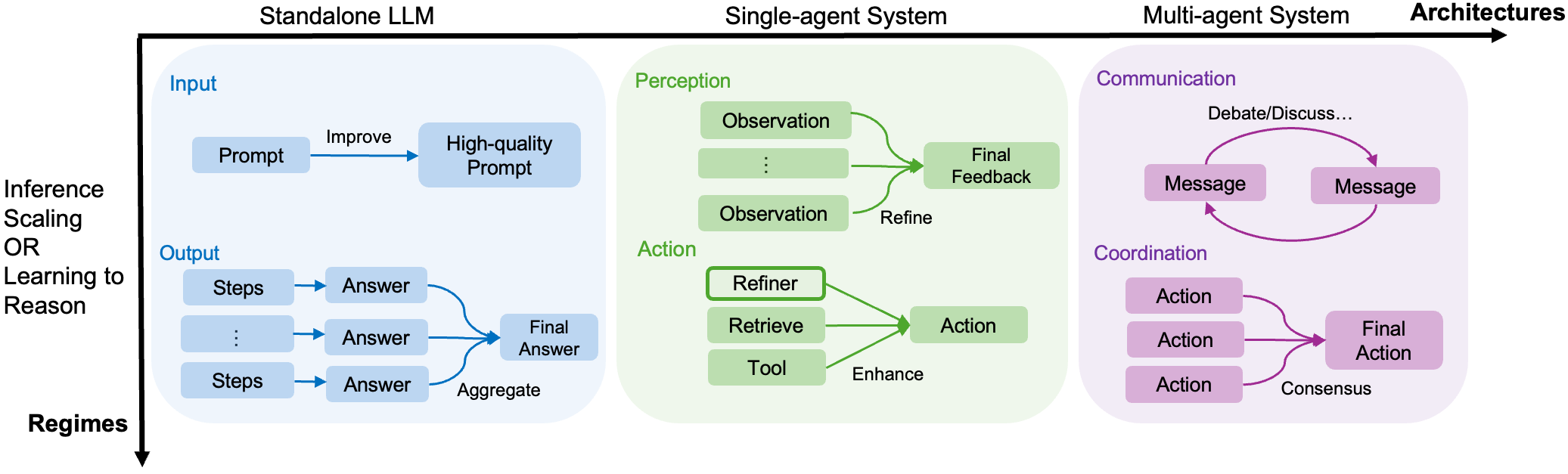
The diagram illustrates three progressive AI system architectures: **Standalone LLM**, **Single-agent System**, and **Multi-agent System**, arranged horizontally from left to right. Each architecture is represented by a colored box (blue, green, purple) with internal components and directional flows. The vertical axis is labeled **"Inference Scaling OR Learning to Reason"**, while the horizontal axis is labeled **"Architectures"**.
---
### Components/Axes
#### Vertical Axis (Y-axis):
- **Labels**:
- "Inference Scaling OR Learning to Reason" (bottom to top).
- **Positioning**:
- Spans the entire height of the diagram, with text aligned to the left.
#### Horizontal Axis (X-axis):
- **Labels**:
- "Standalone LLM" (leftmost), "Single-agent System" (middle), "Multi-agent System" (rightmost), "Architectures" (far right).
- **Positioning**:
- Text aligned to the top, with arrows pointing rightward.
#### Key Sections:
1. **Standalone LLM (Blue Box)**:
- **Input**: "Prompt" → "Improve" → "High-quality Prompt".
- **Output**: Multiple "Steps" → "Answer" pairs aggregated into a "Final Answer".
- **Flow**: Linear progression from input to output.
2. **Single-agent System (Green Box)**:
- **Perception**:
- "Observation" → "Final Feedback" (with refinement loops).
- **Action**:
- "Refiner" → "Retrieve" → "Tool" → "Enhance" → "Action".
- **Flow**: Cyclical refinement in perception and tool-enhanced action.
3. **Multi-agent System (Purple Box)**:
- **Communication**:
- "Message" ↔ "Message" (debate/discussion loop).
- **Coordination**:
- Three "Action" nodes → "Final Action" via consensus.
- **Flow**: Collaborative decision-making with iterative messaging.
---
### Detailed Analysis
#### Standalone LLM (Blue):
- **Input Processing**:
- Prompts are iteratively improved to high quality before generating outputs.
- **Output Aggregation**:
- Multiple reasoning steps ("Steps") produce answers, which are combined into a single "Final Answer".
#### Single-agent System (Green):
- **Perception Loop**:
- Observations are refined through feedback to improve decision-making.
- **Action Enhancement**:
- Tools are retrieved and used to enhance actions, emphasizing adaptability.
#### Multi-agent System (Purple):
- **Communication**:
- Messages are exchanged iteratively to resolve conflicts or debates.
- **Coordination**:
- Multiple agents propose actions, which are consolidated into a single "Final Action" via consensus.
---
### Key Observations
1. **Complexity Progression**:
- Standalone LLM is the simplest (linear input-output).
- Single-agent introduces feedback loops and tool use.
- Multi-agent adds collaboration and consensus mechanisms.
2. **Flow Direction**:
- All systems emphasize iterative refinement (e.g., "Refine," "Debate/...," "Consensus").
3. **Color Coding**:
- Blue (Standalone), Green (Single-agent), Purple (Multi-agent) visually distinguish architectures.
---
### Interpretation
This diagram highlights the evolution of AI systems from isolated, rule-based models (Standalone LLM) to collaborative, adaptive frameworks (Multi-agent). The vertical axis ("Inference Scaling OR Learning to Reason") suggests a trade-off between computational efficiency and reasoning depth.
- **Standalone LLM**: Suitable for straightforward tasks with minimal reasoning.
- **Single-agent**: Balances autonomy with adaptability via tool use and feedback.
- **Multi-agent**: Prioritizes collective intelligence, ideal for complex, dynamic environments requiring coordination.
The progression underscores the shift from individual decision-making to distributed, consensus-driven systems, reflecting advancements in AI collaboration and scalability.