## Screenshot: Prompt Comparison for Cube Function
### Overview
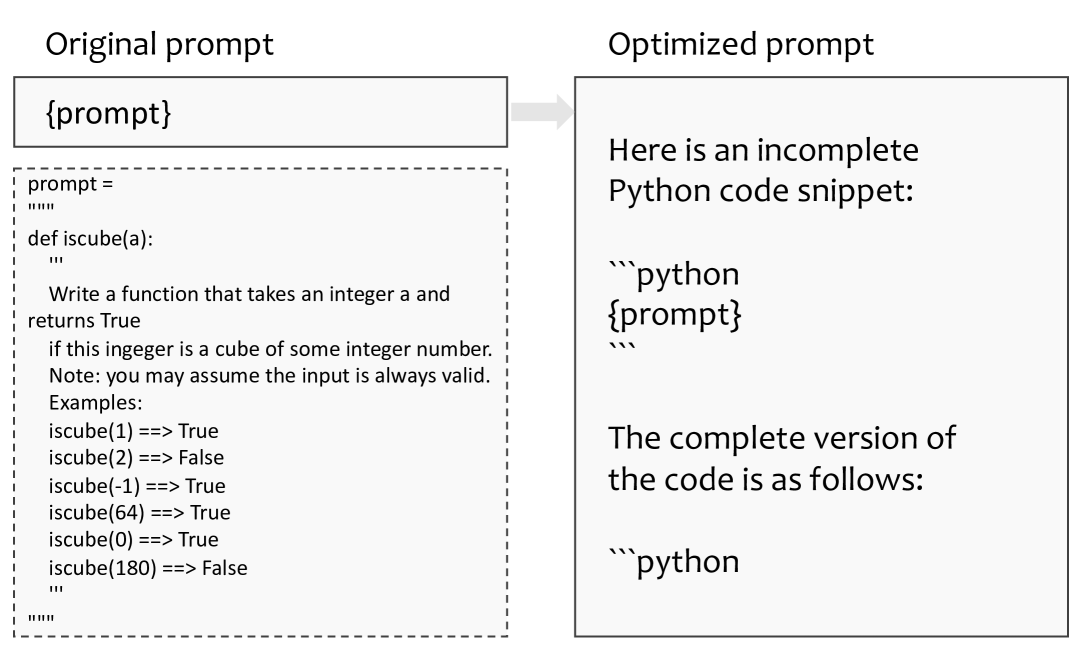
The image displays a side-by-side comparison of two Python prompts related to a function `iscube(a)`, which determines if an integer is a cube of another integer. The "Original prompt" includes a complete function definition with examples, while the "Optimized prompt" shows an incomplete code snippet to be filled.
### Components/Axes
- **Structure**:
- **Original Prompt**: Contains the full implementation of `iscube(a)` with examples.
- **Optimized Prompt**: Shows an incomplete Python code snippet with a placeholder for the function body.
### Detailed Analysis
#### Original Prompt
- **Function Definition**:
```python
def iscube(a):
"""
```
- **Instructions**:
- Write a function that takes an integer `a` and returns `True` if it is a cube of some integer.
- Input validity is guaranteed.
- **Examples**:
- `iscube(1) => True`
- `iscube(2) => False`
- `iscube(-1) => True`
- `iscube(64) => True`
- `iscube(0) => True`
- `iscube(180) => False`
#### Optimized Prompt
- **Incomplete Code Snippet**:
```python
{prompt}
```
- **Completion Instruction**:
- The complete code is provided below the snippet:
```python
def iscube(a):
return a == round(a ** (1/3)) ** 3
```
### Key Observations
1. The **Original Prompt** explicitly lists test cases to validate the function’s correctness.
2. The **Optimized Prompt** reduces redundancy by omitting examples and focusing on the core function logic.
3. Both prompts use Python’s triple-quoted strings (`"""`), likely for docstrings.
### Interpretation
The image highlights a progression from a **verbose, example-driven prompt** to a **concise, code-focused prompt**. The optimization removes redundant examples but risks losing clarity for learners unfamiliar with cube-checking logic. The `round(a ** (1/3)) ** 3` approach in the optimized solution assumes floating-point precision is sufficient, which may fail for large integers due to rounding errors (e.g., `iscube(3375)` would incorrectly return `False` if `3375 ** (1/3)` is slightly off). This underscores a trade-off between brevity and robustness in prompt engineering.