## Neural Network Architecture Diagram: Recurrent Model with Attention Mechanisms
### Overview
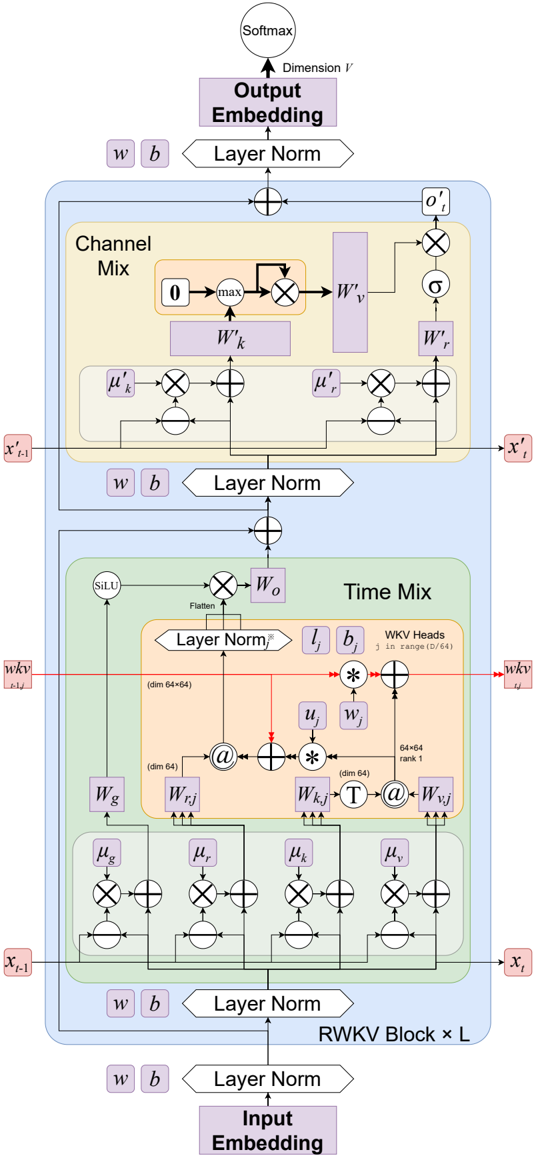
The diagram illustrates a complex neural network architecture combining recurrent processing, attention mechanisms, and channel/time mixing operations. It features multiple layers with explicit weight matrices, normalization operations, and data flow paths. The architecture includes both spatial (channel) and temporal (time) processing components.
### Components/Axes
**Key Labels and Operations:**
1. **Input/Output Embedding**:
- Input: `x_{t-1}` (previous time step)
- Output: `o'_t` (current time step output)
- Operations: `Layer Norm` (purple blocks)
2. **Channel Mix Block**:
- Operations: `max`, `W_k`, `W_v`, `W_r`
- Parameters: `μ_k`, `μ_r` (mean values)
- Flow: Input → `max` → `W_k` → `W_v` → `W_r` → Output
3. **Time Mix Block**:
- Attention Mechanism: `Softmax` (top), `Attention` (middle)
- Operations: `Flatten`, `W_g`, `W_kj`, `W_rj`
- Parameters: `l_j`, `b_j` (attention head dimensions)
- Recurrent Connections: `wkv` (red arrows)
4. **Recurrent Blocks (RWKV)**:
- Structure: `L` repeated blocks (green shaded area)
- Operations: `Layer Norm`, `W_g`, `W_kj`, `W_rj`
- Dimensions: `dim 64-64` (attention head size)
5. **Normalization**:
- `Layer Norm` blocks (purple) at multiple stages
- `SiLU` activation (bottom-left)
**Spatial Grounding**:
- Top section: Output Embedding (purple)
- Middle: Channel Mix (orange) and Time Mix (green)
- Bottom: Recurrent Blocks (green) with `L` repetitions
- Arrows indicate data flow direction (left-to-right, top-to-bottom)
### Detailed Analysis
**Channel Mix Operations**:
- `W_k` (dimension: `d_model × d_head`) processes key vectors
- `W_v` (dimension: `d_head × d_model`) processes value vectors
- `W_r` (dimension: `d_model × d_model`) handles residual connections
**Time Mix Attention**:
- `Softmax` computes attention weights over time steps
- `Attention` block combines query (`W_g`), key (`W_kj`), and value (`W_rj`) vectors
- `Flatten` operation reduces spatial dimensions before temporal processing
**Recurrent Connections**:
- `wkv` (red arrows) enable cross-time dependencies
- `w`, `b` parameters (purple) represent learnable weights/biases
- `μ_g`, `μ_r`, `μ_k` track mean values for normalization
### Key Observations
1. **Dimensional Consistency**:
- All weight matrices maintain compatible dimensions (e.g., `W_k` ∈ ℝ^{d_model×d_head})
- Attention heads operate at `dim 64-64` (query/key/value dimensions)
2. **Normalization Strategy**:
- Layer normalization applied after every major operation
- Mean tracking (`μ_*`) suggests adaptive normalization
3. **Temporal Processing**:
- Recurrent connections (`wkv`) span multiple time steps
- Time Mix block processes sequential data with attention
4. **Architectural Complexity**:
- 3 attention heads (`j=1,2,3`) in Time Mix
- `L` repeated RWKV blocks enable deep temporal modeling
### Interpretation
This architecture combines:
1. **Spatial Processing**: Channel Mix handles feature interactions
2. **Temporal Modeling**: Recurrent connections and attention capture long-range dependencies
3. **Efficient Computation**: Layer normalization and residual connections (via `W_r`) stabilize training
The design suggests optimization for:
- **Sequence-to-Sequence Tasks**: Input `x_{t-1}` → Output `o'_t` pattern
- **High-Dimensional Data**: 64-dimension attention heads handle complex features
- **Long Context**: Multiple recurrent blocks (`L`) and attention mechanisms
Notable design choices:
- Separation of channel/time processing streams
- Explicit mean tracking for adaptive normalization
- Hybrid of feed-forward (Channel Mix) and recurrent (Time Mix) components