## Image Grid: Good vs. Bad Action Examples
### Overview
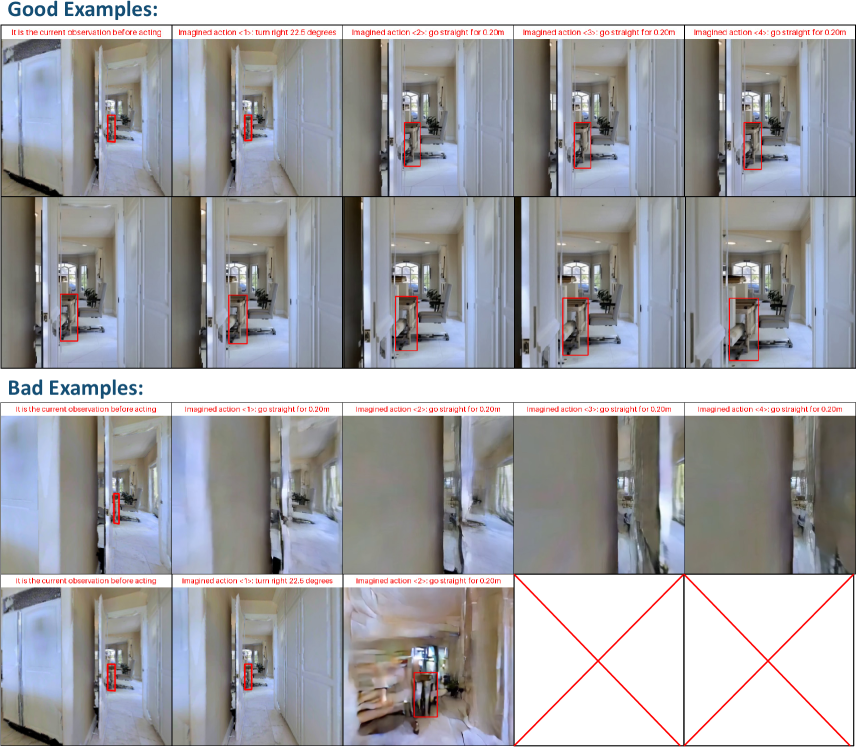
The image presents a grid of visual examples, categorized as "Good Examples" and "Bad Examples," demonstrating the impact of different imagined actions on a simulated environment. Each example consists of a series of images showing the current observation before acting and the subsequent imagined actions. The actions involve turning and moving straight, with the goal of navigating a hallway.
### Components/Axes
* **Title:** "Good Examples:" (top-left)
* **Title:** "Bad Examples:" (mid-left)
* **Image Sets:** Each set consists of a starting image labeled "It is the current observation before acting" followed by images representing imagined actions.
* **Action Labels:** Each imagined action image is labeled with "Imagined action <N>:" followed by a description of the action.
* Actions include: "turn right 22.5 degrees" and "go straight for 0.20m".
* **Bounding Boxes:** Red bounding boxes highlight specific regions of interest within each image.
### Detailed Analysis or ### Content Details
**Good Examples:**
* **Row 1:**
* Image 1: "It is the current observation before acting" - Shows a hallway with a red bounding box around a distant object.
* Image 2: "Imagined action <1>: turn right 22.5 degrees" - Shows the hallway after a slight right turn, with the red bounding box now focused on a different object.
* Image 3: "Imagined action <2>: go straight for 0.20m" - Shows the hallway after moving straight, with the red bounding box around a table and chair.
* Image 4: "Imagined action <3>: go straight for 0.20m" - Shows the hallway after moving straight, with the red bounding box around a table and chair.
* Image 5: "Imagined action <4>: go straight for 0.20m" - Shows the hallway after moving straight, with the red bounding box around a table and chair.
* **Row 2:**
* Image 1: "It is the current observation before acting" - Shows a hallway with a red bounding box around a table and chair.
* Image 2: "Imagined action <1>: go straight for 0.20m" - Shows the hallway after moving straight, with the red bounding box around a table and chair.
* Image 3: "Imagined action <2>: go straight for 0.20m" - Shows the hallway after moving straight, with the red bounding box around a table and chair.
* Image 4: "Imagined action <3>: go straight for 0.20m" - Shows the hallway after moving straight, with the red bounding box around a table and chair.
* Image 5: "Imagined action <4>: go straight for 0.20m" - Shows the hallway after moving straight, with the red bounding box around a table and chair.
**Bad Examples:**
* **Row 1:**
* Image 1: "It is the current observation before acting" - Shows a hallway with a red bounding box around a distant object.
* Image 2: "Imagined action <1>: go straight for 0.20m" - Shows a distorted hallway after moving straight, with the red bounding box around a distant object.
* Image 3: "Imagined action <2>: go straight for 0.20m" - Shows a distorted hallway after moving straight, with the red bounding box around a distant object.
* Image 4: "Imagined action <3>: go straight for 0.20m" - Shows a distorted hallway after moving straight, with the red bounding box around a distant object.
* Image 5: "Imagined action <4>: go straight for 0.20m" - Shows a distorted hallway after moving straight, with the red bounding box around a distant object.
* **Row 2:**
* Image 1: "It is the current observation before acting" - Shows a hallway with a red bounding box around a distant object.
* Image 2: "Imagined action <1>: turn right 22.5 degrees" - Shows a distorted hallway after a slight right turn, with the red bounding box now focused on a different object.
* Image 3: "Imagined action <2>: go straight for 0.20m" - Shows a distorted hallway after moving straight, with the red bounding box around a distant object.
* **Row 3:**
* Images 1-3: Blank images with red diagonal lines forming an "X" shape.
### Key Observations
* The "Good Examples" show a clear progression of actions and a relatively stable environment.
* The "Bad Examples" exhibit distortions and inconsistencies in the imagined actions, suggesting errors in the simulation or prediction.
* The red bounding boxes highlight the focus of the agent's attention in each image.
* The last row of "Bad Examples" is completely blank with red "X" marks, indicating a failure case.
### Interpretation
The image illustrates the difference between successful and unsuccessful imagined actions in a simulated environment. The "Good Examples" demonstrate a coherent and predictable outcome of the actions, while the "Bad Examples" highlight scenarios where the simulation fails to accurately predict the consequences of the actions. This comparison is crucial for training and evaluating AI agents that rely on imagined actions for decision-making. The distortions in the "Bad Examples" suggest potential issues with the agent's perception, planning, or the simulation environment itself. The blank images with red "X" marks indicate a complete failure of the simulation or prediction process.