## Bar Chart: Distribution of Overlap Ratios
### Overview
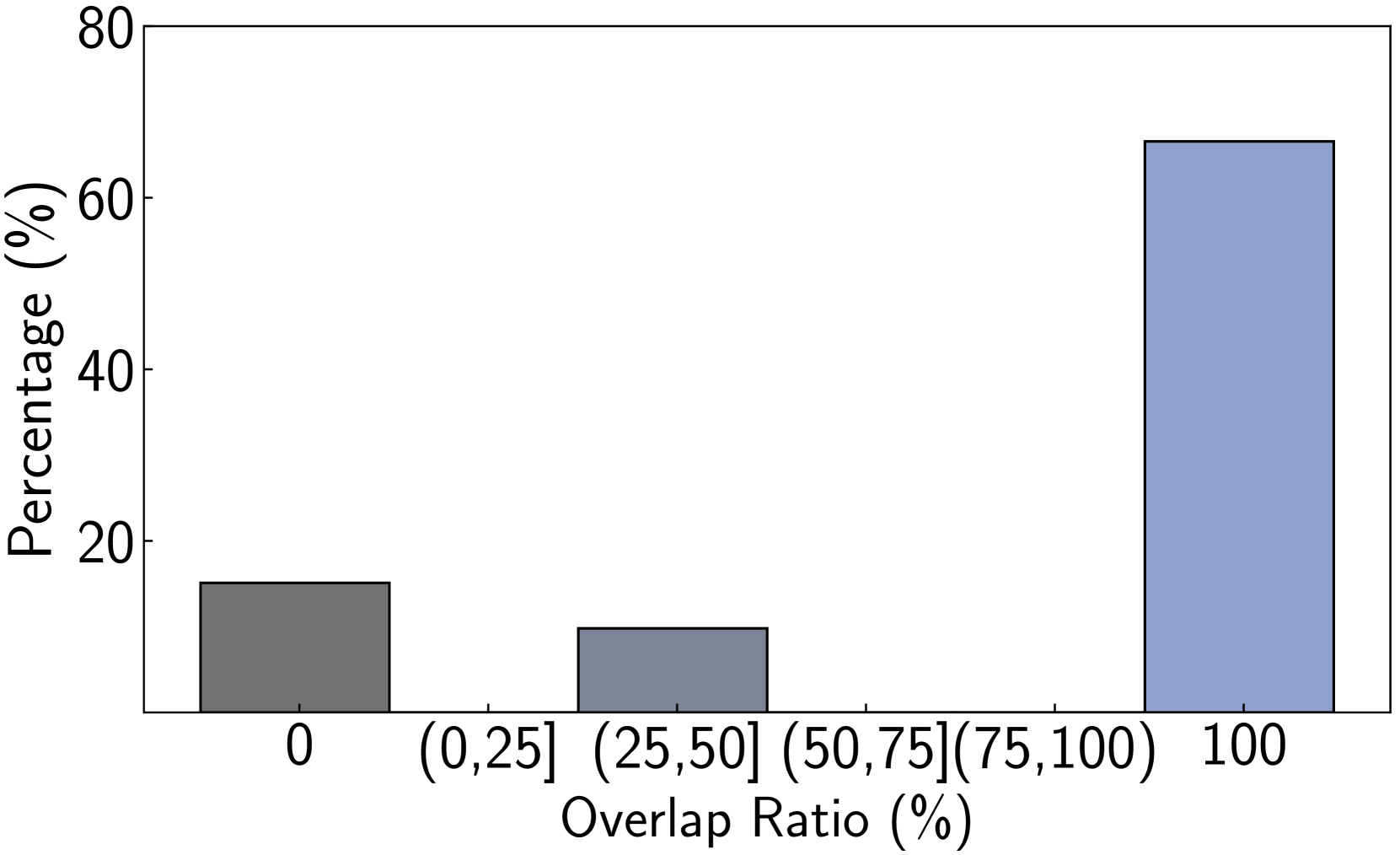
The image displays a vertical bar chart illustrating the percentage distribution of different overlap ratio categories. The chart shows a highly skewed distribution, with the vast majority of cases falling into the 100% overlap category.
### Components/Axes
* **Chart Type:** Vertical Bar Chart.
* **X-Axis (Horizontal):**
* **Label:** "Overlap Ratio (%)"
* **Categories (from left to right):** `0`, `(0,25]`, `(25,50]`, `(50,75]`, `(75,100)`, `100`.
* **Note:** The categories `(0,25]`, `(25,50]`, `(50,75]`, and `(75,100)` represent intervals. The notation `(a,b]` typically means the interval is greater than `a` and less than or equal to `b`.
* **Y-Axis (Vertical):**
* **Label:** "Percentage (%)"
* **Scale:** Linear scale from 0 to 80, with major tick marks at 0, 20, 40, 60, and 80.
* **Legend:** No explicit legend is present. The bars are differentiated by color and their corresponding x-axis category label.
### Detailed Analysis
The chart contains three visible bars, each corresponding to a specific overlap ratio category. The remaining categories have no visible bar, indicating a value of 0%.
1. **Category `0` (Leftmost bar):**
* **Color:** Dark gray.
* **Position:** Centered above the "0" label on the x-axis.
* **Value:** The bar's height is approximately **15%** (visually estimated between the 0 and 20% y-axis ticks, closer to 20).
2. **Category `(25,50]` (Middle bar):**
* **Color:** Medium gray (lighter than the first bar).
* **Position:** Centered above the "(25,50]" label on the x-axis.
* **Value:** The bar's height is approximately **10%** (visually estimated, shorter than the first bar).
3. **Category `100` (Rightmost bar):**
* **Color:** Light blue.
* **Position:** Centered above the "100" label on the x-axis.
* **Value:** The bar's height is approximately **67%** (visually estimated, extending significantly above the 60% y-axis tick but below the 80% tick).
4. **Categories with 0% Value:**
* `(0,25]`
* `(50,75]`
* `(75,100)`
* These categories have no visible bar, indicating their percentage is **0%** or negligibly small.
### Key Observations
* **Dominant Category:** The `100`% overlap ratio category is overwhelmingly dominant, representing approximately two-thirds of the total distribution.
* **Bimodal Distribution:** The data shows a bimodal pattern with peaks at the extremes: a major peak at 100% and a minor peak at 0%.
* **Absence of Partial Overlap:** There is a notable absence of data in the partial overlap intervals `(0,25]`, `(50,75]`, and `(75,100)`. The only non-zero partial overlap is in the `(25,50]` range, which is itself a small fraction.
* **Color Coding:** The bars use a grayscale-to-blue color progression, with the most significant bar (100%) highlighted in a distinct light blue color.
### Interpretation
This chart likely represents the results of a matching or comparison process where two entities (e.g., image segments, data records, object detections) are evaluated for their spatial or conceptual overlap. The data suggests an "all-or-nothing" outcome is most common.
* **High Precision/Consensus:** The large 100% bar indicates that in the majority of cases, the compared entities are in perfect agreement or alignment. This could signify high precision in a detection algorithm, perfect matches in a database, or complete consensus between annotators.
* **Complete Disagreement:** The smaller 0% bar represents cases with no overlap at all, indicating complete disagreement or mismatch.
* **Rare Ambiguity:** The very low percentage in the `(25,50]` range and the absence of data in other partial ranges suggest that ambiguous or partially overlapping cases are rare in this dataset or process. The system or phenomenon being measured tends to resolve clearly into either full match or no match, with only a small fraction falling into a middle ground.
* **Potential Implication:** If this chart evaluates an algorithm's performance, it shows the algorithm is highly confident and accurate in most cases (100% overlap) but fails completely in a smaller subset (0% overlap), with very few uncertain or partially correct outputs. The distribution is not Gaussian or uniform; it is heavily polarized.