## Diagram: Neural Network Architecture (RWKV)
### Overview
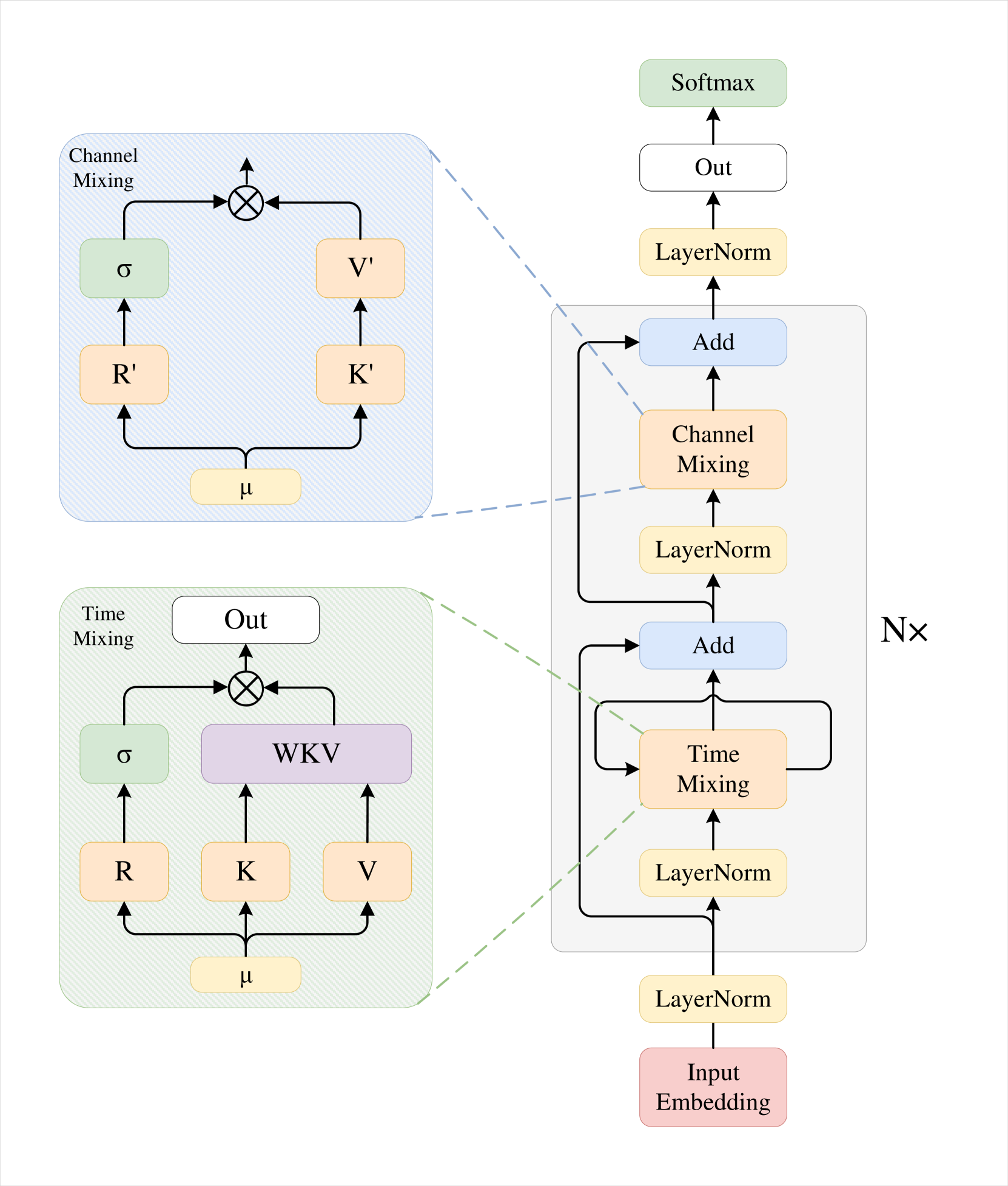
This image illustrates the architecture of a deep learning model, specifically the RWKV (Receptance Weighted Key Value) architecture. The diagram is divided into two primary sections: a main vertical processing stack on the right, and two detailed "expansion" diagrams on the left that explain the internal logic of the "Time Mixing" and "Channel Mixing" blocks. The architecture is designed to process sequential data, utilizing residual connections and layer normalization.
### Components/Axes
**Main Vertical Stack (Right Side):**
* **Input Embedding** (Red block, bottom)
* **LayerNorm** (Yellow block)
* **Time Mixing** (Orange block)
* **Add** (Blue block)
* **LayerNorm** (Yellow block)
* **Channel Mixing** (Orange block)
* **Add** (Blue block)
* **LayerNorm** (Yellow block)
* **Out** (White block)
* **Softmax** (Green block, top)
* **Nx**: A label on the far right indicating that the section enclosed in the gray box (containing Time Mixing, Add, LayerNorm, Channel Mixing, Add) is repeated $N$ times.
**Expansion Diagrams (Left Side):**
* **Channel Mixing (Top-Left, Blue-tinted background):**
* Input: $\mu$ (mu)
* Nodes: $R'$, $K'$, $\sigma$ (sigmoid), $V'$, $\otimes$ (multiplication)
* **Time Mixing (Bottom-Left, Green-tinted background):**
* Input: $\mu$ (mu)
* Nodes: $R$, $K$, $V$, $\sigma$ (sigmoid), $WKV$ (purple block), $\otimes$ (multiplication), Out
### Detailed Analysis
#### 1. Main Vertical Stack (Right)
The data flow moves from bottom to top:
1. **Input Embedding** (Red) feeds into a **LayerNorm** (Yellow).
2. The output of the first LayerNorm enters the **Time Mixing** block (Orange).
3. A residual connection (a line bypassing the Time Mixing block) connects the input of the Time Mixing block to the **Add** (Blue) node above it.
4. The output of the Add node enters a **LayerNorm** (Yellow).
5. This feeds into the **Channel Mixing** block (Orange).
6. A residual connection bypasses the Channel Mixing block to the **Add** (Blue) node above it.
7. The output of the second Add node enters a final **LayerNorm** (Yellow).
8. This leads to the **Out** (White) block, which terminates at the **Softmax** (Green) layer.
#### 2. Expansion: Channel Mixing (Top-Left)
This diagram details the internal operations of the Channel Mixing block:
* The input $\mu$ splits into two paths: $R'$ and $K'$.
* $R'$ flows into $\sigma$ (sigmoid).
* $K'$ flows into $V'$.
* The outputs of $\sigma$ and $V'$ meet at a multiplication node ($\otimes$) to produce the output.
#### 3. Expansion: Time Mixing (Bottom-Left)
This diagram details the internal operations of the Time Mixing block:
* The input $\mu$ splits into three paths: $R$, $K$, and $V$.
* $R$ flows into $\sigma$ (sigmoid).
* $K$ and $V$ flow into the $WKV$ block (Purple).
* The outputs of $\sigma$ and $WKV$ meet at a multiplication node ($\otimes$) to produce the "Out" block.
### Key Observations
* **Residual Connections:** The diagram explicitly shows skip connections (the lines looping around the Time Mixing and Channel Mixing blocks to the "Add" nodes), which are critical for training deep networks by mitigating vanishing gradients.
* **Repetition ($N\times$):** The gray box enclosing the Time Mixing and Channel Mixing blocks indicates that this specific sequence of operations is stacked $N$ times, defining the depth of the model.
* **Color Coding:**
* **Yellow:** Layer Normalization.
* **Orange:** Mixing blocks (Time/Channel).
* **Blue:** Addition/Residual merge points.
* **Green:** Activation/Output layers (Softmax, Time Mixing background).
* **Red:** Input Embedding.
* **Purple:** The specific $WKV$ mechanism.
### Interpretation
This diagram represents the RWKV architecture, a model that attempts to bridge the gap between Transformers and Recurrent Neural Networks (RNNs).
* **Parallelism vs. Recurrence:** By separating "Time Mixing" and "Channel Mixing," the model can be trained in parallel (like a Transformer) but can be formulated as an RNN during inference.
* **The WKV Mechanism:** The "WKV" block is the defining feature of this architecture. It replaces the standard self-attention mechanism found in Transformers. While standard attention requires $O(N^2)$ memory and compute, the $WKV$ mechanism allows for linear scaling, making it highly efficient for long-sequence processing.
* **Flow Logic:** The architecture processes input embeddings through alternating temporal and channel-wise transformations. The use of $\sigma$ (sigmoid) as a gating mechanism (seen in both expansions) suggests that the model learns to "gate" or filter information, determining how much of the current input or historical state should be passed forward.