## Diagram: Transformer Neural Network Architecture
### Overview
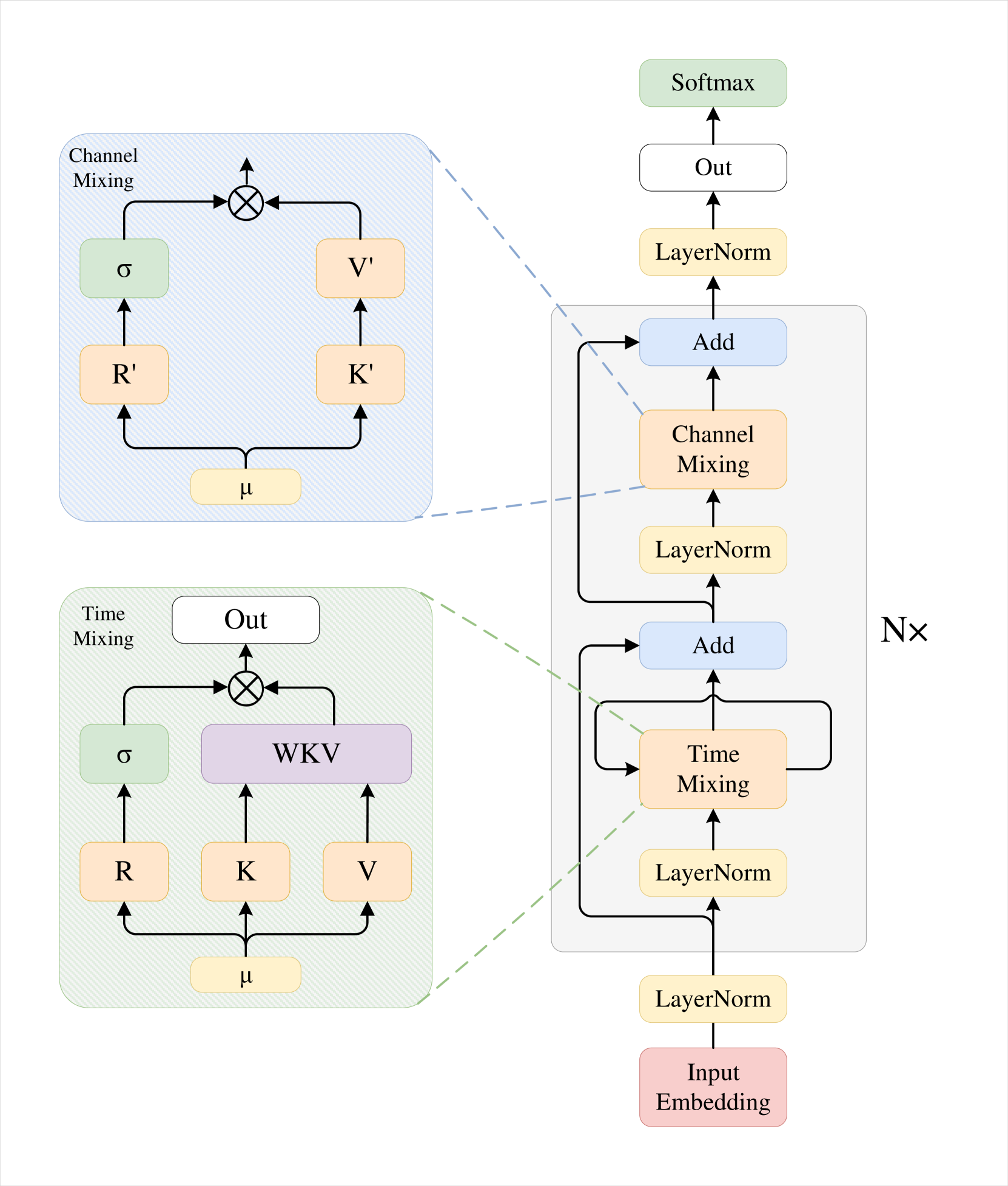
The diagram illustrates a multi-layer Transformer architecture with two primary processing pathways: **Channel Mixing** and **Time Mixing**. The model processes input embeddings through stacked layers (N×), incorporating residual connections, layer normalization, and attention mechanisms.
### Components/Axes
1. **Input Embedding**: Starting point for the data flow.
2. **LayerNorm**: Layer normalization applied after each mixing block.
3. **Add**: Residual connections (skip connections) for gradient stability.
4. **Channel Mixing Block**:
- **R'**, **K'**, **V'**: Modified attention components (likely for channel-wise operations).
- **σ (sigma)**: Non-linear activation function.
- **μ (mu)**: Mean or bias term.
5. **Time Mixing Block**:
- **R**, **K**, **V**: Attention components for temporal operations.
- **WKV**: Weighted key-value mechanism (possibly a variant of attention).
6. **Softmax**: Final output normalization for classification.
7. **Out**: Final output layer.
### Detailed Analysis
- **Channel Mixing**:
- Inputs **R'** and **K'** are combined via cross-attention (⊗ symbol), modulated by **σ**.
- **V'** is derived from the interaction, with **μ** added as a bias.
- **Time Mixing**:
- **R**, **K**, **V** are processed through **WKV**, with **σ** applied to the output.
- Residual connections (Add) merge outputs from both mixing blocks.
- **Stacked Layers (N×)**:
- Each layer repeats the **Channel Mixing** → **Time Mixing** → **Add** → **LayerNorm** sequence.
- Final output is passed through **Softmax** for probabilistic classification.
### Key Observations
- **Residual Connections**: Enable deep network training by mitigating vanishing gradients.
- **Layer Normalization**: Stabilizes training by normalizing activations.
- **Dual Mixing Pathways**: Suggests a hybrid approach combining spatial (channel) and temporal (time) attention.
- **WKV Block**: Likely a specialized attention mechanism for temporal dependencies.
### Interpretation
This architecture combines **channel-wise** and **temporal** attention mechanisms, typical of modern Transformers (e.g., Vision Transformers or Time Series Transformers). The **Channel Mixing** block processes spatial features, while **Time Mixing** handles sequential dependencies. Residual connections and layer normalization ensure efficient training. The **WKV** block may optimize memory usage compared to standard attention. The final **Softmax** layer indicates a classification task, though the exact application (e.g., NLP, computer vision) depends on the input embedding type.
**Note**: No numerical data or uncertainty ranges are present in the diagram. The structure emphasizes modular design and multi-path processing for complex data.