## Diagram: Collaborative LLM-Human System Architecture
### Overview
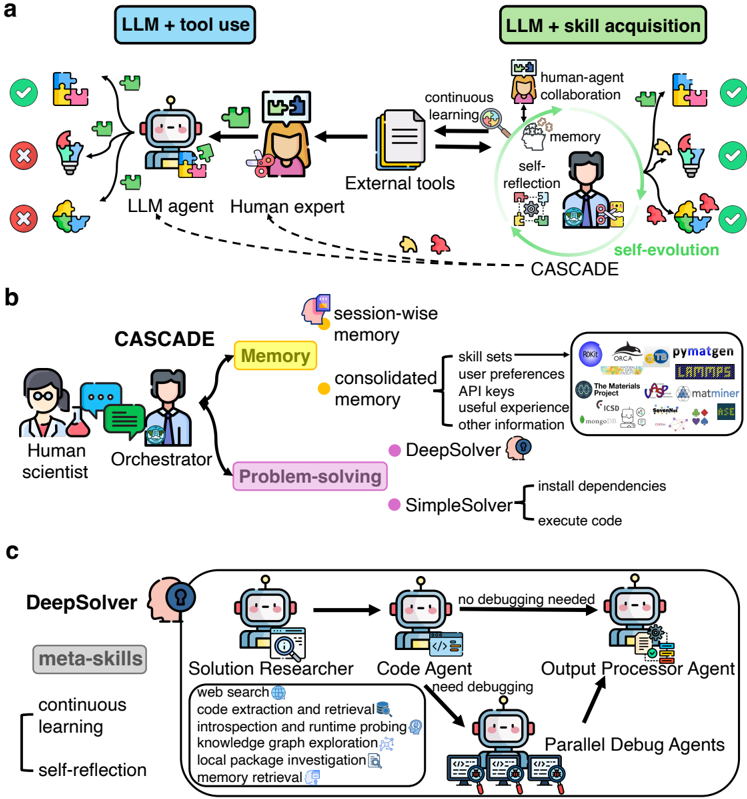
The diagram illustrates a multi-stage collaborative system integrating Large Language Models (LLMs) with human expertise and external tools. It is divided into three sections:
1. **LLM + Tool Use** (a): Focuses on initial problem-solving with human oversight.
2. **CASCADE** (b): A memory-driven framework for skill acquisition and problem-solving.
3. **DeepSolver** (c): A specialized system for code-related tasks with meta-skills.
### Components/Axes
#### Section a: LLM + Tool Use
- **Key Elements**:
- **LLM Agent**: Depicted as a robot with puzzle pieces, connected to a human expert via dashed lines.
- **Human Expert**: Illustrated as a figure interacting with the LLM agent.
- **External Tools**: Represented by icons (e.g., lightbulb, magnifying glass).
- **Flow**:
- Arrows indicate interactions between LLM agent, human expert, and external tools.
- Checkmarks (✓) and crosses (✗) denote successful/failed outcomes.
- **Labels**:
- "LLM + tool use" (top-left), "LLM + skill acquisition" (top-right).
- "External tools," "continuous learning," "memory," "self-reflection," "self-evolution."
#### Section b: CASCADE
- **Key Elements**:
- **Human Scientist**: Collaborates with an **Orchestrator** (another human figure).
- **Memory**: Central node with subcategories:
- Session-wise memory
- Consolidated memory
- Skill sets, API keys, user preferences, useful experience, other information.
- **Problem-Solving**:
- **DeepSolver**: Uses deep learning and self-reflection.
- **SimpleSolver**: Executes code directly.
- **Legend**:
- Yellow (memory), blue (tools), pink (problem-solving), purple (DeepSolver), green (SimpleSolver).
#### Section c: DeepSolver
- **Key Elements**:
- **Meta-Skills**: Continuous learning, self-reflection.
- **Agents**:
- **Solution Researcher**: Performs web search, code extraction, runtime probing.
- **Code Agent**: Handles code execution.
- **Output Processor Agent**: Processes results.
- **Parallel Debug Agents**: Debug code without human intervention.
- **Flow**:
- Arrows show progression from problem-solving to debugging.
- **Legend**:
- Robot icons with labels (e.g., "no debugging needed").
### Detailed Analysis
#### Section a: LLM + Tool Use
- **Flow**:
- LLM agent and human expert collaborate using external tools.
- Successful outcomes (✓) are linked to effective tool use and human oversight.
- Failed outcomes (✗) occur when tools or LLM capabilities are insufficient.
#### Section b: CASCADE
- **Memory Hierarchy**:
- Session-wise memory is transient, while consolidated memory retains long-term data.
- Skill sets and API keys are stored in memory for reuse.
- **Problem-Solving**:
- DeepSolver uses self-reflection and deep learning for complex tasks.
- SimpleSolver executes code directly for simpler tasks.
#### Section c: DeepSolver
- **Meta-Skills**:
- Continuous learning enables adaptation to new tasks.
- Self-reflection improves debugging efficiency.
- **Agent Roles**:
- Solution Researcher gathers data and identifies issues.
- Parallel Debug Agents automate debugging, reducing human intervention.
### Key Observations
1. **Human-LLM Collaboration**: Human experts guide LLM agents, ensuring alignment with real-world needs.
2. **Memory as a Bridge**: Consolidated memory enables skill reuse across sessions.
3. **Automation in Debugging**: Parallel Debug Agents minimize manual debugging, improving efficiency.
4. **Modular Design**: Each section (a, b, c) represents a specialized subsystem with distinct workflows.
### Interpretation
The diagram emphasizes a **symbiotic relationship** between LLMs and humans, where memory and meta-skills enhance problem-solving.
- **CASCADE** (b) acts as a bridge between raw data (session-wise memory) and actionable solutions (DeepSolver/SimpleSolver).
- **DeepSolver** (c) specializes in code tasks, leveraging automation to reduce human workload.
- **Checkmarks/Crosses** (a) highlight the importance of human oversight in tool use.
**Notable Trends**:
- Memory consolidation (b) is critical for long-term skill retention.
- Parallel debugging (c) suggests a shift toward autonomous systems in technical workflows.
**Anomalies**:
- No explicit data points or numerical values are provided, limiting quantitative analysis.
- The absence of failure cases in sections b and c implies an idealized workflow.
**Conclusion**:
This architecture demonstrates how LLMs can evolve from tool users to autonomous problem-solvers through human collaboration, memory integration, and meta-skill development.