## Diagram: Tensor Network Equivalence
### Overview
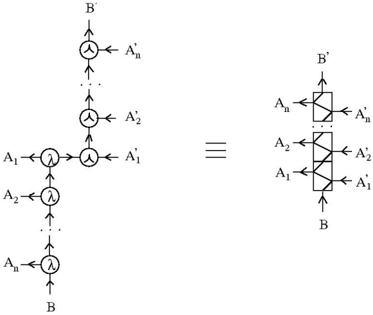
The image presents a diagram illustrating the equivalence between two tensor network representations. On the left, a network of tensors connected in a chain-like structure is shown. On the right, a more compact representation of the same network is depicted. The diagram uses symbols to represent tensors and lines to represent tensor contractions.
### Components/Axes
**Left Diagram:**
* **Tensors:** Represented by circles containing the symbol "λ".
* **Input Tensors:** Labeled as A1, A2, ... , An, and B, each with an arrow pointing towards the tensor network.
* **Output Tensors:** Labeled as A'1, A'2, ... , A'n, and B', each with an arrow pointing away from the tensor network.
* **Ellipsis:** Represented by dotted lines, indicating that the pattern continues.
**Right Diagram:**
* **Box:** A rectangular box represents the entire tensor network.
* **Input Tensors:** Labeled as A1, A2, ... , An, and B, each with an arrow pointing towards the box.
* **Output Tensors:** Labeled as A'1, A'2, ... , A'n, and B', each with an arrow pointing away from the box.
* **Ellipsis:** Represented by dotted lines within the box, indicating that the pattern continues.
* **Internal Lines:** Zig-zag lines within the box connect the input and output tensors.
**Equivalence Symbol:**
* The symbol "≡" is placed between the two diagrams, indicating that they are equivalent representations.
### Detailed Analysis
**Left Diagram:**
* The tensor network consists of 'n' tensors connected in a chain.
* Each tensor has one input tensor (A1, A2, ..., An) and one output tensor (A'1, A'2, ..., A'n).
* The input tensor B is connected to the first tensor in the chain.
* The output tensor B' is connected to the last tensor in the chain.
**Right Diagram:**
* The box represents the entire tensor network as a single unit.
* The input and output tensors are connected to the box.
* The zig-zag lines within the box represent the tensor contractions that occur within the network.
### Key Observations
* The diagram illustrates that a complex tensor network can be represented by a simpler, more compact diagram.
* The equivalence symbol indicates that the two representations are mathematically equivalent.
* The ellipsis indicates that the pattern can be extended to any number of tensors.
### Interpretation
The diagram demonstrates the concept of tensor network equivalence, which is a fundamental concept in tensor network theory. It shows that a complex tensor network can be represented by a simpler, more compact diagram without losing any information. This is useful for simplifying calculations and visualizing complex tensor networks. The diagram highlights the relationship between the individual tensors in the network and the overall network structure. The use of ellipsis indicates that the concept can be generalized to tensor networks of arbitrary size.