## Bar Charts: GPT-3 vs. Human Performance on Rule-Based Problems
### Overview
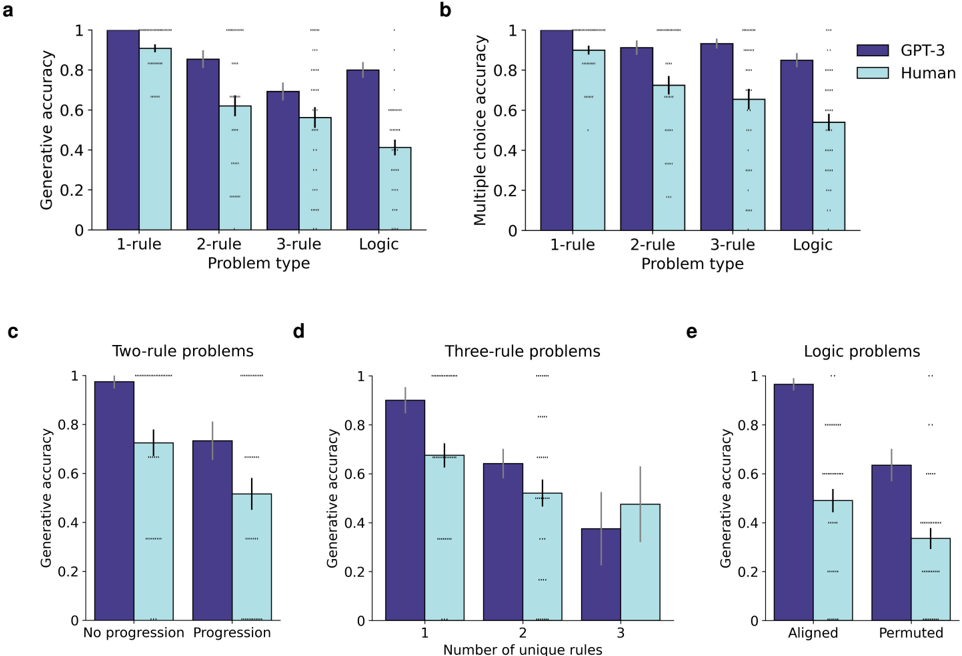
The image presents a series of bar charts comparing the performance of GPT-3 and humans on various rule-based problems. The charts are organized into five subplots (a-e), each focusing on a different problem type or characteristic. The performance is measured in terms of generative accuracy or multiple-choice accuracy.
### Components/Axes
* **Y-axis (all subplots):**
* Label: "Generative accuracy" (subplots a, c, d, e) or "Multiple choice accuracy" (subplot b)
* Scale: 0 to 1, with increments of 0.2.
* **X-axis:**
* **Subplot a:** "Problem type" with categories: "1-rule", "2-rule", "3-rule", "Logic"
* **Subplot b:** "Problem type" with categories: "1-rule", "2-rule", "3-rule", "Logic"
* **Subplot c:** "Two-rule problems" with categories: "No progression", "Progression"
* **Subplot d:** "Three-rule problems" with categories: "1", "2", "3" (Number of unique rules)
* **Subplot e:** "Logic problems" with categories: "Aligned", "Permuted"
* **Legend (top-right of subplot b):**
* Dark Blue: "GPT-3"
* Light Blue: "Human"
* **Error Bars:** Each bar has an associated error bar, indicating the variability in the data.
### Detailed Analysis
**Subplot a: Generative Accuracy vs. Problem Type**
* **GPT-3 (Dark Blue):**
* 1-rule: Accuracy ~0.99
* 2-rule: Accuracy ~0.85
* 3-rule: Accuracy ~0.70
* Logic: Accuracy ~0.80
* **Human (Light Blue):**
* 1-rule: Accuracy ~0.90
* 2-rule: Accuracy ~0.62
* 3-rule: Accuracy ~0.55
* Logic: Accuracy ~0.42
**Subplot b: Multiple Choice Accuracy vs. Problem Type**
* **GPT-3 (Dark Blue):**
* 1-rule: Accuracy ~0.99
* 2-rule: Accuracy ~0.92
* 3-rule: Accuracy ~0.92
* Logic: Accuracy ~0.80
* **Human (Light Blue):**
* 1-rule: Accuracy ~0.90
* 2-rule: Accuracy ~0.75
* 3-rule: Accuracy ~0.70
* Logic: Accuracy ~0.55
**Subplot c: Generative Accuracy for Two-Rule Problems**
* **GPT-3 (Dark Blue):**
* No progression: Accuracy ~0.99
* Progression: Accuracy ~0.73
* **Human (Light Blue):**
* No progression: Accuracy ~0.72
* Progression: Accuracy ~0.52
**Subplot d: Generative Accuracy for Three-Rule Problems**
* **GPT-3 (Dark Blue):**
* 1 unique rule: Accuracy ~0.90
* 2 unique rules: Accuracy ~0.65
* 3 unique rules: Accuracy ~0.38
* **Human (Light Blue):**
* 1 unique rule: Accuracy ~0.68
* 2 unique rules: Accuracy ~0.50
* 3 unique rules: Accuracy ~0.48
**Subplot e: Generative Accuracy for Logic Problems**
* **GPT-3 (Dark Blue):**
* Aligned: Accuracy ~0.98
* Permuted: Accuracy ~0.65
* **Human (Light Blue):**
* Aligned: Accuracy ~0.50
* Permuted: Accuracy ~0.33
### Key Observations
* **GPT-3 generally outperforms humans** across most problem types and conditions, especially in multiple-choice accuracy (subplot b).
* **Performance varies with problem complexity.** Both GPT-3 and human accuracy tend to decrease as the number of rules increases (subplots a and d).
* **Progression impacts two-rule problem accuracy.** GPT-3 and human accuracy are lower for problems with progression (subplot c).
* **Alignment affects logic problem accuracy.** Both GPT-3 and human accuracy are higher for aligned logic problems compared to permuted ones (subplot e).
* **Error bars** suggest variability in the data, but the general trends are consistent.
### Interpretation
The data suggests that GPT-3 is more adept at solving rule-based problems than humans, particularly in multiple-choice scenarios. However, the performance of both GPT-3 and humans is influenced by the complexity of the problem, with accuracy decreasing as the number of rules increases. The alignment and progression of rules also play a significant role in problem difficulty.
GPT-3's superior performance could be attributed to its ability to process and retain large amounts of information, allowing it to identify and apply rules more effectively. However, the error bars indicate that there is still variability in GPT-3's performance, suggesting that it is not infallible.
The observed trends highlight the importance of problem structure and complexity in determining the difficulty of rule-based tasks. These findings have implications for the design of AI systems and the development of educational materials.