## Bar Chart: Model Performance Metrics (ECE and AUROC)
### Overview
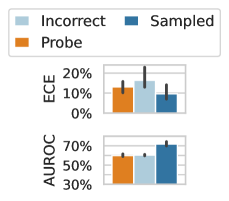
The image displays a comparative bar chart with two vertically stacked subplots, evaluating three different methods ("Incorrect", "Sampled", "Probe") across two performance metrics: Expected Calibration Error (ECE) and Area Under the ROC Curve (AUROC). The chart includes a legend and error bars on each bar, indicating variability or uncertainty in the measurements.
### Components/Axes
* **Legend:** Positioned at the top center of the image. It contains three entries:
* A light blue square labeled "Incorrect".
* A dark blue square labeled "Sampled".
* An orange square labeled "Probe".
* **Subplot 1 (Top):**
* **Y-Axis Label:** "ECE" (Expected Calibration Error).
* **Y-Axis Scale:** Percentage, ranging from 0% to 20%, with tick marks at 0%, 10%, and 20%.
* **Bars:** Three bars corresponding to the legend categories.
* **Subplot 2 (Bottom):**
* **Y-Axis Label:** "AUROC" (Area Under the Receiver Operating Characteristic Curve).
* **Y-Axis Scale:** Percentage, ranging from 30% to 70%, with tick marks at 30%, 50%, and 70%.
* **Bars:** Three bars corresponding to the legend categories.
* **X-Axis:** No explicit categorical labels are present on the x-axis. The bars are grouped by the three methods defined in the legend.
### Detailed Analysis
**ECE Subplot (Top):**
* **Trend Verification:** The "Incorrect" (light blue) bar is the tallest, indicating the highest ECE. The "Probe" (orange) and "Sampled" (dark blue) bars are shorter and of similar height.
* **Data Points (Approximate):**
* **Incorrect (Light Blue):** ~15% ECE. Error bar extends from approximately 12% to 18%.
* **Probe (Orange):** ~10% ECE. Error bar extends from approximately 8% to 12%.
* **Sampled (Dark Blue):** ~10% ECE. Error bar extends from approximately 7% to 13%.
**AUROC Subplot (Bottom):**
* **Trend Verification:** The "Sampled" (dark blue) bar is the tallest, indicating the highest AUROC. The "Incorrect" (light blue) and "Probe" (orange) bars are shorter and of similar height.
* **Data Points (Approximate):**
* **Incorrect (Light Blue):** ~50% AUROC. Error bar extends from approximately 48% to 52%.
* **Probe (Orange):** ~50% AUROC. Error bar extends from approximately 45% to 55%.
* **Sampled (Dark Blue):** ~65% AUROC. Error bar extends from approximately 60% to 70%.
### Key Observations
1. **Inverse Relationship:** There is an inverse relationship between the performance of the "Incorrect" method and the "Sampled" method across the two metrics. "Incorrect" has the worst (highest) ECE but ties for the lowest AUROC. "Sampled" has a low ECE (tied with "Probe") and the best (highest) AUROC.
2. **"Probe" Method Consistency:** The "Probe" method shows consistent, moderate performance. It matches the "Sampled" method on the calibration metric (ECE) but performs similarly to the "Incorrect" method on the discrimination metric (AUROC).
3. **Variability:** The error bars suggest the most uncertainty (widest range) is associated with the "Probe" method's AUROC measurement and the "Sampled" method's ECE measurement. The "Incorrect" method's AUROC appears to have the least variability.
### Interpretation
This chart likely compares different strategies for handling or sampling data in a machine learning context, possibly related to model calibration or uncertainty estimation.
* **What the data suggests:** The "Sampled" method appears to be the most effective overall, achieving strong discrimination (high AUROC) while maintaining good calibration (low ECE). The "Incorrect" method, which may represent a baseline or a flawed approach, is poorly calibrated (high ECE) and has poor discriminative ability. The "Probe" method offers a middle ground; it is well-calibrated but does not improve discrimination over the flawed baseline.
* **How elements relate:** The two subplots together provide a more complete picture of model performance than either metric alone. A model can be well-calibrated (low ECE) but have poor discriminative power (low AUROC), or vice-versa. The ideal model minimizes ECE while maximizing AUROC, a position occupied here by the "Sampled" method.
* **Notable anomalies:** The near-identical ECE for "Probe" and "Sampled" is notable, suggesting these two methods are equally effective at reducing calibration error compared to the "Incorrect" baseline. The significant jump in AUROC for "Sampled" is the most striking result, indicating it provides a substantial benefit in classification performance.