## Reward Clipping and Delta Mechanisms
### Overview
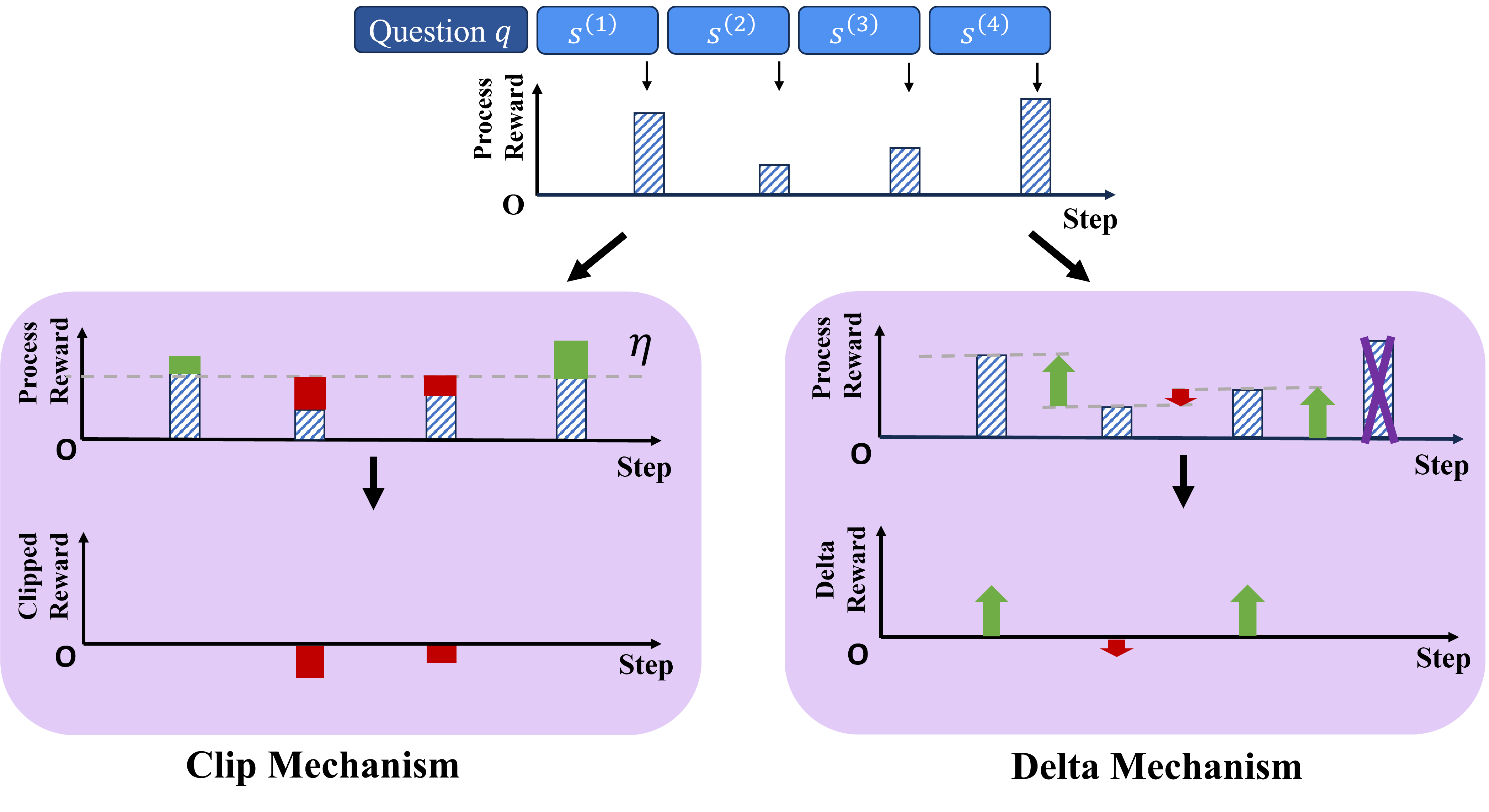
The image illustrates two different mechanisms for adjusting rewards in a process: a "Clip Mechanism" and a "Delta Mechanism." Each mechanism is depicted through a series of plots showing the original process reward, an intermediate stage, and the final adjusted reward. The image starts with a general reward distribution across steps and then shows how each mechanism modifies these rewards.
### Components/Axes
**Top Chart:**
* **Title:** Question q
* **X-axis:** Step
* **Y-axis:** Process Reward
* **Data Series:** Four states labeled s^(1), s^(2), s^(3), and s^(4) represented by blue striped bars.
**Clip Mechanism (Left Side):**
* **Top Chart:**
* **Y-axis:** Process Reward
* **X-axis:** Step
* **Horizontal Dashed Line:** Represents a clipping threshold, labeled as η.
* **Data Series:** Blue striped bars, with portions above the threshold colored green and portions below colored red.
* **Bottom Chart:**
* **Y-axis:** Clipped Reward
* **X-axis:** Step
* **Data Series:** Red bars representing the clipped rewards.
**Delta Mechanism (Right Side):**
* **Top Chart:**
* **Y-axis:** Process Reward
* **X-axis:** Step
* **Horizontal Dashed Line:** Represents a threshold.
* **Data Series:** Blue striped bars, with green upward arrows indicating positive delta adjustments and a red downward arrow indicating a negative delta adjustment. A bar with a purple "X" through it indicates a removal or significant reduction.
* **Bottom Chart:**
* **Y-axis:** Delta Reward
* **X-axis:** Step
* **Data Series:** Green upward arrows and a red downward arrow representing the delta rewards.
### Detailed Analysis
**Top Chart (Question q):**
* The initial reward distribution across the four steps shows varying levels of reward.
* s^(1): Reward value is approximately 0.7.
* s^(2): Reward value is approximately 0.2.
* s^(3): Reward value is approximately 0.4.
* s^(4): Reward value is approximately 0.8.
**Clip Mechanism:**
* **Top Chart:** The clipping threshold η is approximately at a reward level of 0.6.
* The first bar is colored green above the threshold and blue striped below.
* The second and fourth bars are colored red below the threshold and blue striped below.
* The third bar is colored green above the threshold and blue striped below.
* **Bottom Chart:** The clipped reward shows only negative rewards (red bars).
* The first bar has a reward value of approximately -0.6.
* The second bar has a reward value of approximately -0.2.
**Delta Mechanism:**
* **Top Chart:**
* The first step has a green upward arrow, indicating a positive delta.
* The second step has a red downward arrow, indicating a negative delta.
* The fourth step's bar is crossed out with a purple "X", indicating removal.
* **Bottom Chart:** The delta reward shows both positive and negative rewards.
* The first step has a green upward arrow, indicating a positive delta.
* The second step has a red downward arrow, indicating a negative delta.
* The third step has a green upward arrow, indicating a positive delta.
### Key Observations
* The Clip Mechanism truncates rewards based on a threshold, resulting in only negative rewards in the example shown.
* The Delta Mechanism adjusts rewards by adding or subtracting values, and can also remove rewards entirely.
* The initial reward distribution (Question q) serves as the basis for both mechanisms.
### Interpretation
The image illustrates two distinct approaches to reward shaping. The Clip Mechanism appears to penalize rewards exceeding a certain threshold, effectively discouraging actions that lead to those rewards. The Delta Mechanism, on the other hand, provides more granular control by allowing for both positive and negative adjustments to the rewards, potentially encouraging or discouraging specific actions. The removal of a reward in the Delta Mechanism suggests a more drastic intervention, possibly to prevent undesirable outcomes. The choice between these mechanisms depends on the specific goals of the reward shaping process.