## Attestation Diagram: Enclave Verification Process
### Overview
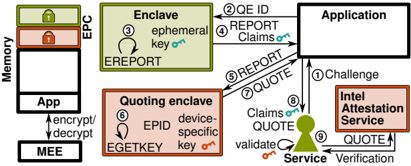
The image is a diagram illustrating the process of attestation for an enclave, involving components like memory, EPC, enclave, quoting enclave, application, Intel Attestation Service, and a generic service. The diagram outlines the flow of information and cryptographic operations between these components to verify the integrity and authenticity of the enclave.
### Components/Axes
* **Memory:** Represents the system memory, containing the application and the MEE (likely Management Engine Environment).
* **App:** Application running in memory.
* **MEE:** Management Engine Environment.
* **EPC:** Enclave Page Cache, a protected memory region. It has two lock icons, one green on top and one red below.
* **Enclave:** A secure region within memory.
* Label: "Enclave"
* Text: "ephemeral key" with a key icon.
* Process: EREPORT
* **Quoting Enclave:** A specialized enclave responsible for generating quotes.
* Label: "Quoting enclave"
* Text: "EPID device-specific key" with a key icon.
* Process: EGETKEY
* **Application:** The application that needs to verify the enclave.
* Label: "Application"
* **Intel Attestation Service:** A service provided by Intel for attestation.
* Label: "Intel Attestation Service"
* **Service:** A generic service that validates the quote.
* Label: "Service"
* Text: "validate" and "Verification"
### Detailed Analysis or Content Details
The diagram depicts a series of steps, numbered 1 through 9, illustrating the attestation process:
1. **Challenge:** The Application sends a challenge to the Service.
2. **QE ID:** The Enclave sends the QE ID to the Application.
3. **EREPORT:** The Enclave generates a report (EREPORT) using an ephemeral key.
4. **REPORT Claims:** The Enclave sends a REPORT containing claims to the Application.
5. **REPORT QUOTE:** The Application sends a REPORT and requests a QUOTE from the Quoting Enclave.
6. **EGETKEY:** The Quoting Enclave uses EGETKEY to generate a device-specific key and EPID.
7. **QUOTE:** The Quoting Enclave sends a QUOTE to the Application.
8. **Claims QUOTE:** The Application sends Claims and the QUOTE to the Service.
9. **QUOTE:** The Service sends the QUOTE to the Intel Attestation Service for verification. The Intel Attestation Service sends the QUOTE back to the Service.
Additional details:
* The Enclave is colored light green.
* The Quoting Enclave and Intel Attestation Service are colored light red.
* The Service is represented by a green keyhole icon.
* The Application is a white rectangle.
* The Memory block is white with a black outline.
* The EPC has a green lock on top and a red lock below.
* Arrows indicate the direction of data flow.
* The application encrypts/decrypts data to/from the MEE.
### Key Observations
* The diagram highlights the interaction between different components to establish trust in the Enclave.
* The use of cryptographic keys and reports is central to the attestation process.
* The Intel Attestation Service plays a crucial role in verifying the QUOTE.
* The process involves multiple steps to ensure the integrity and authenticity of the Enclave.
### Interpretation
The diagram illustrates a typical remote attestation process for enclaves. The application, seeking to trust the enclave, initiates a challenge. The enclave, through a series of cryptographic operations and interactions with the quoting enclave and the Intel Attestation Service, provides evidence of its integrity and authenticity. The service validates this evidence, allowing the application to establish trust in the enclave. The use of ephemeral keys and device-specific keys adds layers of security to the process. The diagram demonstrates the complexity involved in establishing trust in secure enclaves, highlighting the importance of secure key management and robust attestation mechanisms.