\n
## Diagram: Fake Media (FM) Generation and Detection
### Overview
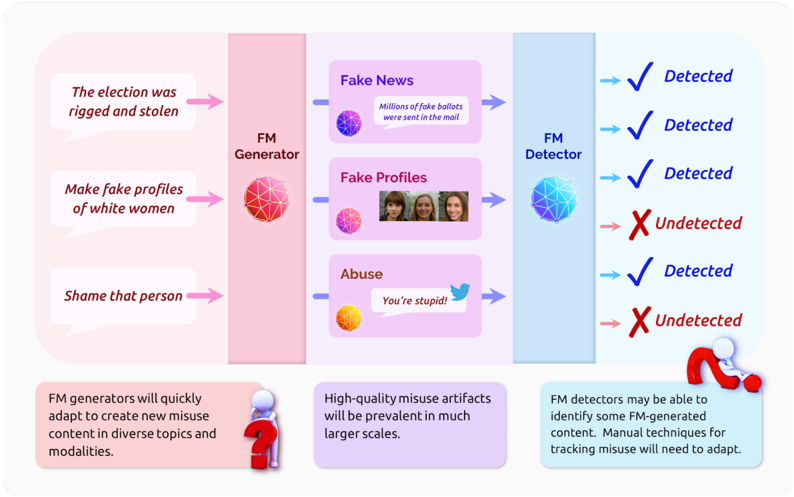
This diagram illustrates the process of Fake Media (FM) generation, the types of content created, and the effectiveness of FM detection. It depicts a flow from initial prompts to generated content, then to detection results, highlighting both successful and unsuccessful detection attempts. The diagram is divided into three main sections: FM Generator, FM Detector, and a footer with concluding statements.
### Components/Axes
The diagram consists of the following components:
* **FM Generator (Pink Section):** This section shows the input prompts and the resulting generated content.
* **FM Detector (Blue Section):** This section displays the detection results (Detected/Undetected) for each type of generated content.
* **Arrows:** Pink arrows indicate the flow of prompts to the generator. Blue arrows indicate the flow of generated content to the detector.
* **Footer (Bottom Section):** Contains three statements regarding the future of FM generation and detection.
* **Input Prompts:** "The election was rigged and stolen", "Make fake profiles of white women", "Shame that person".
* **Generated Content:** "Fake News" (with the example "Millions of fake ballots were sent in the mail"), "Fake Profiles" (showing three female faces), "Abuse" (with the text "You're stupid!").
* **Detection Results:** "Detected" (indicated by a green checkmark) and "Undetected" (indicated by a red X).
### Detailed Analysis or Content Details
The diagram shows a flow of information from prompts to generated content and then to detection.
1. **Prompt 1: "The election was rigged and stolen"**
* Generates "Fake News" with the example: "Millions of fake ballots were sent in the mail."
* Detected by the FM Detector.
2. **Prompt 2: "Make fake profiles of white women"**
* Generates "Fake Profiles" displaying three images of women.
* Detected by the FM Detector.
3. **Prompt 3: "Shame that person"**
* Generates "Abuse" with the text: "You're stupid!".
* Detected by the FM Detector.
4. **Undetected Case:** One instance of generated content (likely related to "Fake Profiles" or "Abuse") is marked as "Undetected".
5. **Footer Statements:**
* "FM generators will quickly adapt to create new misuse content in diverse topics and modalities."
* "High-quality misuse artifacts will be prevalent in much larger scales."
* "FM detectors may be able to identify some FM-generated content. Manual techniques for tracking misuse will need to adapt."
### Key Observations
* The FM Generator appears capable of creating diverse types of misinformation.
* The FM Detector successfully detects most of the generated content, but there are instances where it fails.
* The footer statements suggest that FM generation is evolving rapidly and that detection methods need to keep pace.
* The diagram highlights the potential for FM to be used for malicious purposes, such as spreading false information, creating fake identities, and engaging in abuse.
### Interpretation
The diagram illustrates a concerning trend: the increasing sophistication and accessibility of fake media generation. While current detection methods can identify some FM-generated content, the diagram acknowledges that generators are rapidly adapting, and detection is not foolproof. The footer statements emphasize the need for ongoing research and development in both FM generation and detection, as well as the importance of manual techniques for tracking misuse. The diagram suggests a potential arms race between FM generators and detectors, with the generators constantly evolving to evade detection. The specific examples used (election rigging, fake profiles, abuse) highlight the potential for FM to be used to manipulate public opinion, damage reputations, and cause emotional harm. The diagram serves as a warning about the dangers of FM and the need for proactive measures to mitigate its risks. The diagram does not provide quantitative data, but rather a qualitative overview of the FM landscape. It is a conceptual illustration rather than a data-driven analysis.