## ROC Curve: Receiver Operating Characteristic (ROC) Curves
### Overview
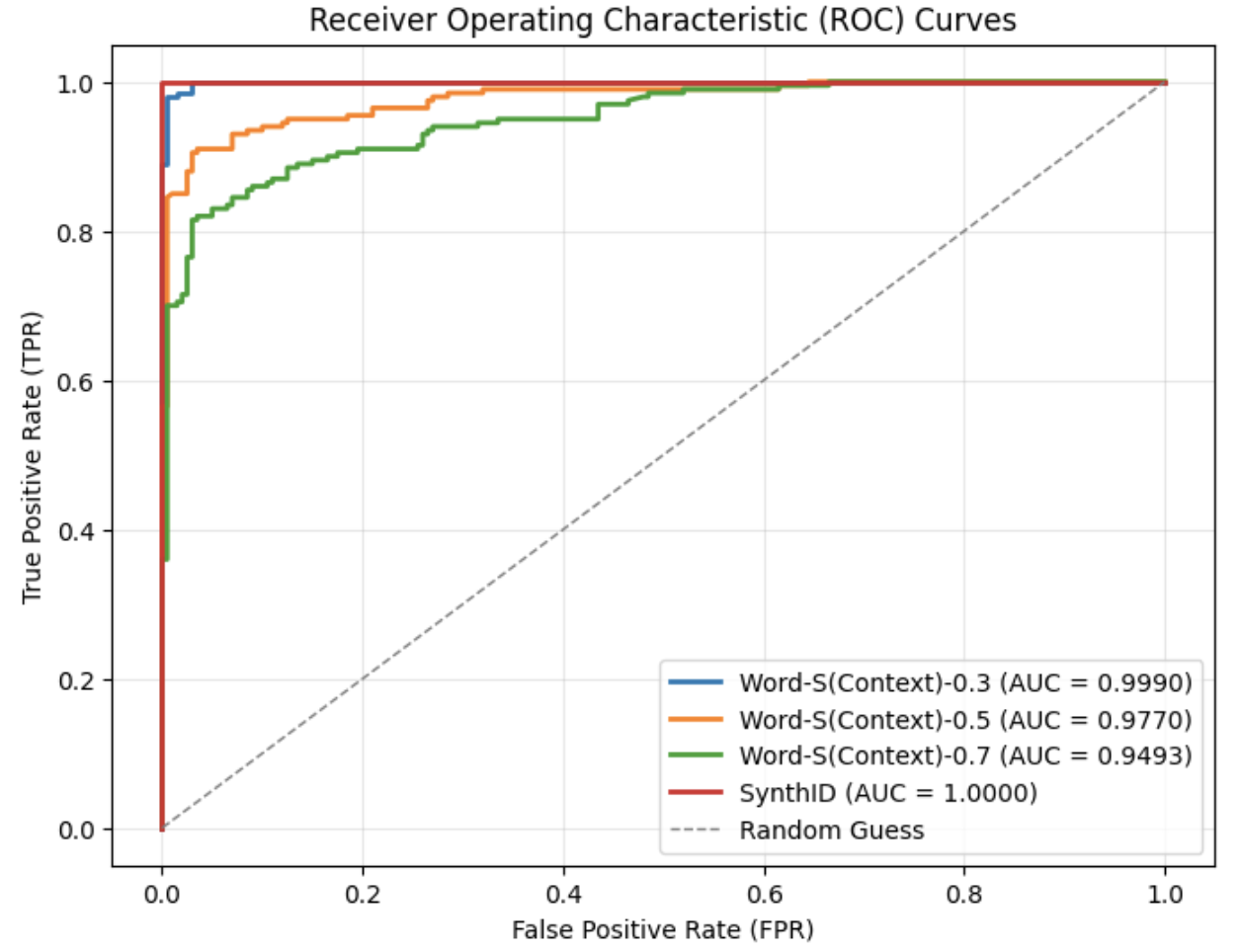
The image displays a Receiver Operating Characteristic (ROC) curve comparing the performance of multiple classification models. The chart plots **True Positive Rate (TPR)** against **False Positive Rate (FPR)** for four distinct methods, with a diagonal dashed line representing random guessing. All models outperform random guessing, with varying degrees of effectiveness.
---
### Components/Axes
- **X-axis**: False Positive Rate (FPR) ranging from 0.0 to 1.0 in increments of 0.2.
- **Y-axis**: True Positive Rate (TPR) ranging from 0.0 to 1.0 in increments of 0.2.
- **Legend**: Located at the bottom-right corner, with four entries:
- **Blue line**: Word-S(Context)-0.3 (AUC = 0.9990)
- **Orange line**: Word-S(Context)-0.5 (AUC = 0.9770)
- **Green line**: Word-S(Context)-0.7 (AUC = 0.9493)
- **Red line**: SynthID (AUC = 1.0000)
- **Dashed gray line**: Random Guess (AUC = 0.5000, implied)
- **Axis markers**: Gridlines at 0.0, 0.2, 0.4, 0.6, 0.8, and 1.0 for both axes.
---
### Detailed Analysis
1. **SynthID (Red line)**:
- Starts at (FPR=0.0, TPR=1.0) and remains perfectly flat at TPR=1.0 across all FPR values.
- AUC = 1.0000, indicating perfect classification performance.
2. **Word-S(Context)-0.3 (Blue line)**:
- Begins at (FPR=0.0, TPR≈0.95) and rises sharply to TPR=1.0 by FPR=0.1.
- Maintains near-perfect TPR (0.98–1.0) for FPR < 0.2.
- AUC = 0.9990, slightly lower than SynthID but still highly effective.
3. **Word-S(Context)-0.5 (Orange line)**:
- Starts at (FPR=0.0, TPR≈0.85) and rises to TPR=1.0 by FPR=0.2.
- Maintains TPR > 0.9 for FPR < 0.4.
- AUC = 0.9770, showing diminishing performance compared to lower-context Word-S.
4. **Word-S(Context)-0.7 (Green line)**:
- Starts at (FPR=0.0, TPR≈0.75) and reaches TPR=1.0 by FPR=0.3.
- TPR drops below 0.9 for FPR > 0.4.
- AUC = 0.9493, the lowest among the Word-S variants.
5. **Random Guess (Dashed gray line)**:
- Diagonal line from (0.0, 0.0) to (1.0, 1.0), representing a baseline AUC of 0.5000.
---
### Key Observations
- **SynthID dominates**: Its perfect AUC and flat TPR=1.0 line indicate it never misclassifies positive samples, regardless of FPR.
- **Context sensitivity**: Word-S performance degrades as context value increases (0.3 > 0.5 > 0.7), suggesting lower-context models are more robust.
- **FPR-TPR tradeoff**: All models show increasing TPR with FPR, but SynthID maintains the steepest initial ascent, minimizing false positives.
- **Random Guess benchmark**: All lines lie above the diagonal, confirming all models outperform random chance.
---
### Interpretation
The data demonstrates that **SynthID** is the optimal model for this classification task, achieving perfect separation between classes. The Word-S models exhibit context-dependent performance, with lower-context configurations (e.g., 0.3) being more effective. The steep initial rise of the Word-S lines suggests strong early discrimination, but their performance plateaus at higher FPRs. The Random Guess line underscores the importance of AUC as a metric—all models achieve AUC > 0.9, indicating high reliability. Notably, SynthID’s AUC=1.0 implies no overlap between positive and negative class distributions, a rare and ideal scenario in classification tasks.