## Code Snippet: Rust Function for Creating a Sequence
### Overview
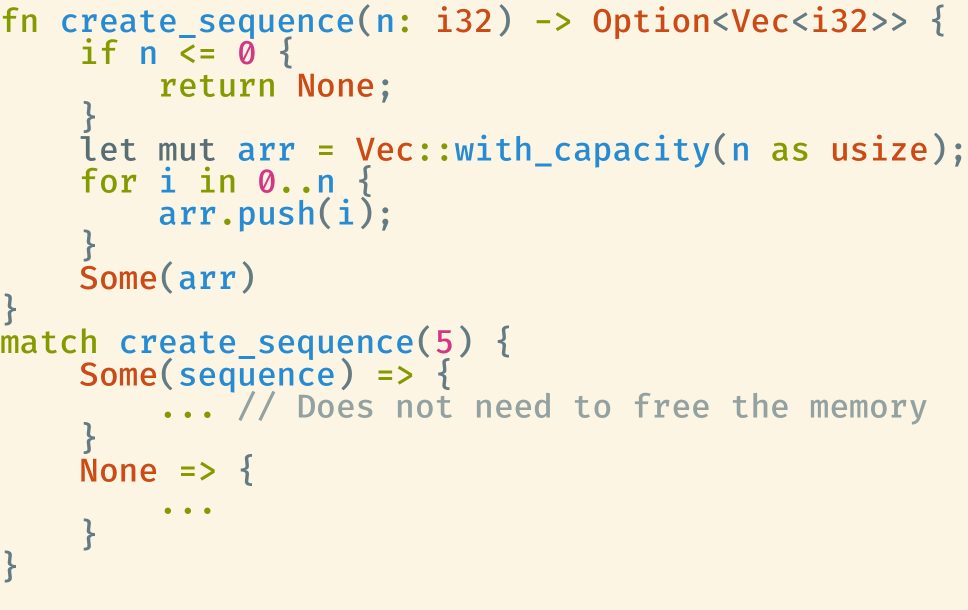
The image contains a Rust code snippet defining a function `create_sequence` that generates a vector of integers. It also includes a `match` statement that calls this function and handles the possible return values (`Some` or `None`).
### Components/Axes
* **Function Definition:** `fn create_sequence(n: i32) -> Option<Vec<i32>>`
* Input: `n` of type `i32` (32-bit integer).
* Output: `Option<Vec<i32>>` which can be either `Some(Vec<i32>)` or `None`.
* **Conditional Statement:** `if n <= 0 { return None; }`
* **Vector Initialization:** `let mut arr = Vec::with_capacity(n as usize);`
* **Loop:** `for i in 0..n { arr.push(i); }`
* **Return Statement (Success):** `Some(arr)`
* **Match Statement:** `match create_sequence(5) { ... }`
* Case 1: `Some(sequence) => { ... // Does not need to free the memory }`
* Case 2: `None => { ... }`
### Detailed Analysis or ### Content Details
The `create_sequence` function takes an integer `n` as input. If `n` is less than or equal to 0, the function returns `None`. Otherwise, it creates a vector `arr` with a pre-allocated capacity of `n`. The function then iterates from `i = 0` to `n-1`, pushing each value of `i` into the vector `arr`. Finally, the function returns `Some(arr)`.
The `match` statement calls `create_sequence(5)`. If the function returns `Some(sequence)`, the code block associated with `Some(sequence)` is executed. The comment "// Does not need to free the memory" suggests that the memory allocated for the vector does not need to be manually deallocated. If the function returns `None`, the code block associated with `None` is executed.
### Key Observations
* The function uses `Option` to handle the case where the input `n` is invalid (<= 0).
* The vector is initialized with a specific capacity to potentially improve performance.
* The `match` statement demonstrates how to handle the `Option` return type.
* The comment indicates a memory management consideration.
### Interpretation
The code snippet demonstrates a common pattern in Rust: using `Option` to handle potential errors or invalid inputs. The `create_sequence` function provides a safe way to generate a vector of integers, and the `match` statement provides a clear way to handle both success and failure cases. The comment about memory management suggests that Rust's ownership and borrowing system automatically handles memory deallocation in this case, relieving the programmer from manual memory management.