\n
## Code Snippet: Rust Function Definition
### Overview
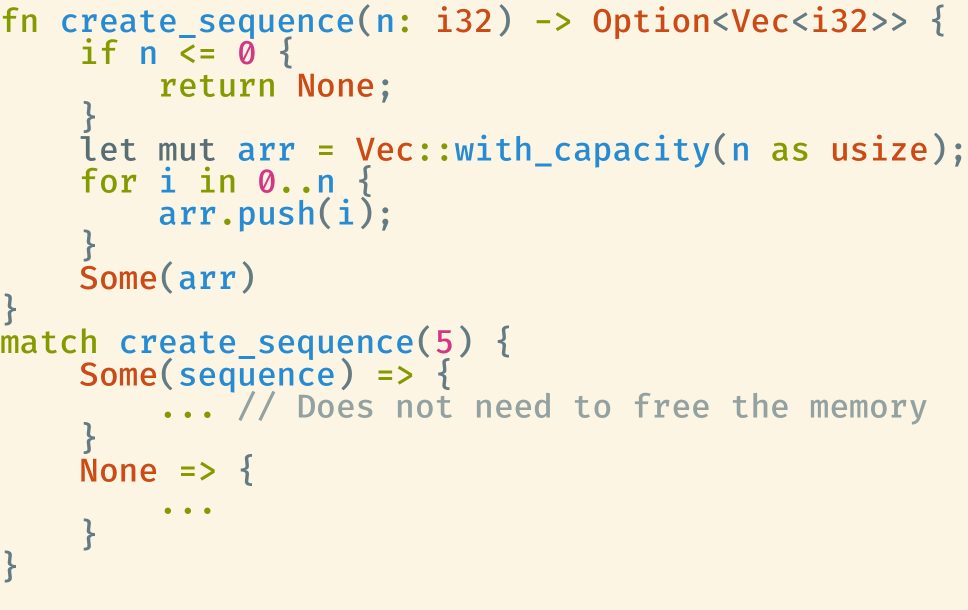
The image presents a Rust code snippet defining a function `create_sequence` and demonstrating its usage with a `match` statement. The code aims to create a vector of i32 integers from 0 up to (and including) a given input `n`. It handles the case where `n` is zero or negative by returning `None`.
### Components/Axes
There are no axes or traditional chart components. The image consists entirely of code. The key elements are:
* **Function Definition:** `fn create_sequence(n: i32) -> Option<Vec<i32>> { ... }`
* **Conditional Statement:** `if n <= 0 { return None; }`
* **Vector Initialization:** `let mut arr = Vec::with_capacity(n as usize);`
* **Loop:** `for i in 0..n { arr.push(i); }`
* **Return Statement:** `Some(arr)`
* **Match Statement:** `match create_sequence(5) { ... }`
* **Match Cases:** `Some(sequence) => { ... }` and `None => { ... }`
* **Comments:** `// Does not need to free the memory`
### Detailed Analysis or Content Details
The code defines a function `create_sequence` that takes an integer `n` as input and returns an `Option<Vec<i32>>`.
1. **Function Signature:**
* `fn create_sequence(n: i32) -> Option<Vec<i32>>`
* The function is named `create_sequence`.
* It accepts a single argument `n` of type `i32` (32-bit signed integer).
* It returns an `Option<Vec<i32>>`. `Option` is an enum that can be either `Some(value)` or `None`. `Vec<i32>` represents a dynamically sized vector of `i32` integers.
2. **Conditional Logic:**
* `if n <= 0 { return None; }`
* If `n` is less than or equal to 0, the function immediately returns `None`, indicating that no sequence can be created.
3. **Vector Creation and Population:**
* `let mut arr = Vec::with_capacity(n as usize);`
* A mutable vector named `arr` is created using `Vec::with_capacity(n as usize)`. `with_capacity` pre-allocates memory for `n` elements, improving performance. The `n` is cast to `usize` which is an unsigned integer type used for indexing.
* `for i in 0..n { arr.push(i); }`
* A `for` loop iterates from `i = 0` up to (but not including) `n`.
* Inside the loop, `arr.push(i)` adds the current value of `i` to the end of the vector `arr`.
4. **Return Value:**
* `Some(arr)`
* If `n` is greater than 0, the function returns `Some(arr)`, wrapping the created vector `arr` inside the `Some` variant of the `Option` enum.
5. **Match Statement Usage:**
* `match create_sequence(5) { ... }`
* The `match` statement calls `create_sequence` with the argument `5`.
* The `match` statement then handles the possible return values of `create_sequence(5)`.
6. **Match Cases:**
* `Some(sequence) => { ... }`
* If `create_sequence(5)` returns `Some(sequence)`, this case is executed. The vector is bound to the variable `sequence`. The code within this block is represented by `...`.
* `None => { ... }`
* If `create_sequence(5)` returns `None`, this case is executed. The code within this block is represented by `...`.
7. **Comment:**
* `// Does not need to free the memory`
* This comment indicates that Rust's ownership and borrowing system automatically manages memory, so explicit memory deallocation is not required.
### Key Observations
* The code demonstrates a common pattern in Rust: using `Option` to handle cases where a function might not be able to produce a valid result.
* The use of `Vec::with_capacity` is a performance optimization.
* The `match` statement provides a concise way to handle different possible return values.
* The comment highlights Rust's memory safety features.
### Interpretation
The code snippet illustrates a safe and efficient way to create a sequence of integers in Rust. The use of `Option` and `Vec::with_capacity` demonstrates Rust's focus on error handling and performance. The `match` statement provides a clear and structured way to handle the different possible outcomes of the function call. The comment about memory management underscores Rust's automatic memory management system, which eliminates the need for manual memory allocation and deallocation, reducing the risk of memory leaks and other memory-related errors. The code is well-structured and easy to understand, showcasing the readability of the Rust language.