\n
## Code Snippet: Rust Function for Sequence Generation
### Overview
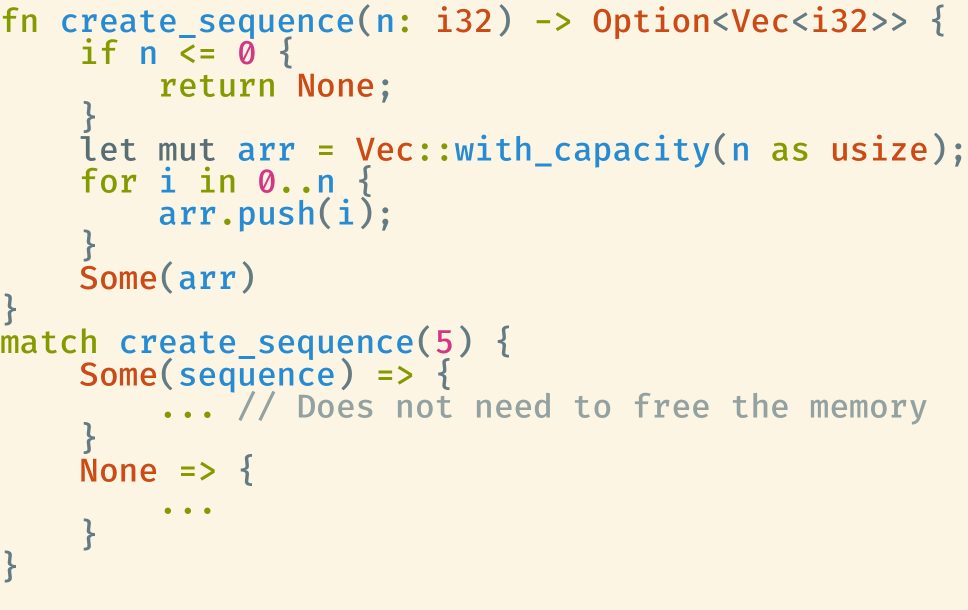
The image displays a code snippet written in the Rust programming language. It defines a function `create_sequence` that generates a vector of integers from 0 to n-1, wrapped in an `Option` type for safe error handling. The snippet also includes an example of how to call this function and handle its result using a `match` expression. The code is presented with syntax highlighting on a light beige background.
### Components/Axes
* **Language:** Rust
* **Primary Function:** `create_sequence(n: i32) -> Option<Vec<i32>>`
* **Key Syntax Elements:**
* Function definition (`fn`)
* Conditional check (`if n <= 0`)
* Vector initialization (`Vec::with_capacity`)
* Loop (`for i in 0..n`)
* Option enum (`Some`, `None`)
* Pattern matching (`match`)
* **Syntax Highlighting Colors (Approximate):**
* Keywords (`fn`, `let`, `mut`, `for`, `in`, `match`, `return`): Blue
* Types (`i32`, `Option`, `Vec`, `usize`): Teal/Green
* Function/Method names (`create_sequence`, `with_capacity`, `push`): Dark Blue/Black
* Variables (`n`, `arr`, `i`, `sequence`): Black
* Literals (`0`, `5`): Purple
* Operators (`->`, `<=`, `..`): Black
* Braces/Punctuation (`{`, `}`, `(`, `)`, `;`): Black
* Comment (`// Does not need to free the memory`): Gray
### Detailed Analysis / Content Details
**Transcription of Code:**
```rust
fn create_sequence(n: i32) -> Option<Vec<i32>> {
if n <= 0 {
return None;
}
let mut arr = Vec::with_capacity(n as usize);
for i in 0..n {
arr.push(i);
}
Some(arr)
}
match create_sequence(5) {
Some(sequence) => {
... // Does not need to free the memory
}
None => {
...
}
}
```
**Code Logic Flow:**
1. **Function Definition (`create_sequence`):**
* **Input:** Takes a single parameter `n` of type `i32` (32-bit signed integer).
* **Return Type:** `Option<Vec<i32>>`. This means it will return either `Some(vector)` containing a list of integers on success, or `None` on failure.
* **Guard Clause:** Checks if `n <= 0`. If true, it immediately returns `None`.
* **Vector Creation:** If `n > 0`, it creates a mutable vector `arr` with an initial capacity equal to `n` (cast to `usize` for memory sizing).
* **Population Loop:** Iterates from `i = 0` up to (but not including) `n`, pushing each value of `i` into the vector `arr`.
* **Successful Return:** Wraps the populated vector `arr` in `Some()` and returns it.
2. **Example Usage (`match` block):**
* Calls `create_sequence` with the argument `5`.
* Uses a `match` expression to handle the two possible outcomes of the `Option`:
* `Some(sequence)`: The success case. The generated vector is bound to the variable `sequence`. The comment `// Does not need to free the memory` indicates that Rust's ownership system will automatically deallocate the vector when it goes out of scope.
* `None`: The failure case (if `n` had been <= 0). The code block is represented by `...`, indicating omitted logic.
### Key Observations
* **Error Handling Pattern:** The function uses Rust's `Option` type for explicit, safe error handling instead of panicking or returning null pointers.
* **Memory Efficiency:** The vector is initialized with `Vec::with_capacity(n as usize)`, which pre-allocates memory to avoid reallocations during the loop, making the function efficient.
* **Ownership & Safety:** The comment in the `Some` branch highlights a core Rust principle: memory is managed automatically via ownership, eliminating the need for manual `free` or `delete` calls and preventing memory leaks.
* **Syntax Highlighting:** The color scheme is consistent with common IDE themes (e.g., similar to "Solarized Light" or "GitHub Light"), aiding readability by distinguishing language constructs.
### Interpretation
This code snippet is a pedagogical example demonstrating several fundamental Rust concepts:
1. **Type Safety & Expressiveness:** The function signature `-> Option<Vec<i32>>` clearly communicates both the potential failure mode (`None`) and the success data type (`Vec<i32>`), making the API's contract explicit at compile time.
2. **Idiomatic Control Flow:** It showcases the common Rust pattern of using a guard clause (`if n <= 0 { return None; }`) for early exit, followed by the main logic.
3. **Resource Management:** The example implicitly teaches Rust's ownership model. The vector `arr` is owned by the function and moved into the `Some` variant upon return. The caller (`match` block) then owns the `sequence`, and the compiler ensures it is dropped (and its memory freed) automatically when `sequence` goes out of scope. This is the meaning behind the comment.
4. **Practical Utility:** While simple, the function is a useful utility for generating a sequence of numbers, a common task in programming. The use of `0..n` creates a half-open range, which is a Rust convention.
The snippet effectively serves as a mini-tutorial on writing safe, efficient, and idiomatic Rust code for sequence generation and result handling.