## Diagram: Tree Transformations
### Overview
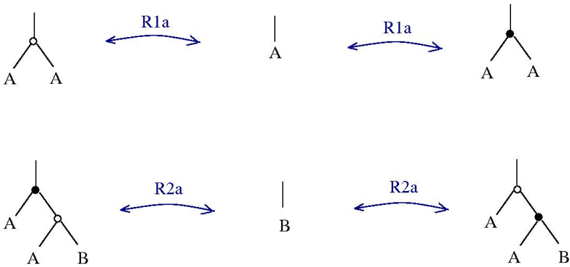
The image depicts two tree transformation rules, R1a and R2a. Each rule shows a transformation between a tree structure and a single node. The nodes in the trees are labeled with 'A' or 'B', and the nodes themselves are either filled (black) or unfilled (white).
### Components/Axes
* **Nodes:** Represented as circles, either filled (black) or unfilled (white).
* **Edges:** Represented as lines connecting the nodes, forming a tree structure.
* **Labels:** 'A' and 'B' are used to label the leaf nodes of the trees.
* **Transformation Rules:** R1a and R2a, indicated by blue double-headed arrows.
### Detailed Analysis
**Row 1: Transformation Rule R1a**
* **Left:** A tree with a root node (unfilled) and two child nodes labeled 'A' and 'A'.
* **Transformation:** The rule R1a transforms this tree into a single node labeled 'A'.
* **Right:** A tree with a root node (filled) and two child nodes labeled 'A' and 'A'.
* The transformation is reversible, as indicated by the double-headed arrow.
**Row 2: Transformation Rule R2a**
* **Left:** A tree with a root node (filled), a left child node labeled 'A', and a right child node which is a subtree. This subtree has a root node (unfilled) and a child node labeled 'A' and 'B'.
* **Transformation:** The rule R2a transforms this tree into a single node labeled 'B'.
* **Right:** A tree with a root node (unfilled), a left child node labeled 'A', and a right child node which is a subtree. This subtree has a root node (filled) and a child node labeled 'A' and 'B'.
* The transformation is reversible, as indicated by the double-headed arrow.
### Key Observations
* The rules R1a and R2a define transformations between tree structures and single nodes.
* The filled/unfilled state of the nodes seems to be significant, as it changes during the transformation.
* The labels 'A' and 'B' appear to be related to the structure of the tree.
### Interpretation
The diagram illustrates a set of tree transformation rules. These rules likely form part of a larger system for manipulating or simplifying tree structures. The filled/unfilled state of the nodes could represent different types or properties of the nodes, and the labels 'A' and 'B' could represent different categories or values associated with the nodes. The transformations could be used to reduce complex trees to simpler representations, or to perform other operations on the trees. The specific meaning of the nodes, edges, and labels would depend on the context in which these rules are used.