## Diagram: Causal Model of Score and Test Outcomes
### Overview
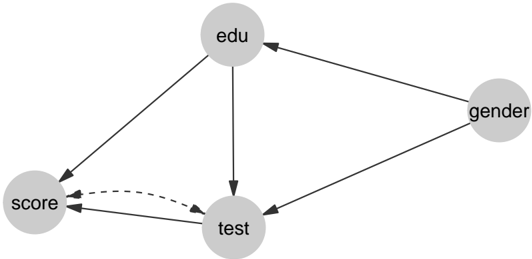
This image displays a directed graph, commonly known as a causal diagram or a Directed Acyclic Graph (DAG), illustrating hypothesized relationships between four variables: 'gender', 'edu' (education), 'test', and 'score'. The diagram uses nodes to represent variables and directed arrows to indicate the flow of influence or causality. Both solid and dashed arrows are present, suggesting different types of relationships.
### Components/Axes
The diagram consists of four circular nodes, each labeled with a variable name in black text on a light gray background. These nodes are connected by directed arrows, which are black lines with arrowheads indicating the direction of influence.
**Nodes and their approximate positions:**
* **edu**: Located at the top-center of the diagram.
* **gender**: Located at the right-center of the diagram, slightly below and to the right of 'edu'.
* **score**: Located at the bottom-left of the diagram.
* **test**: Located at the bottom-center of the diagram, to the right of 'score' and directly below 'edu'.
**Edges (Arrows) and their relationships:**
There are six directed edges in total, five solid and one dashed.
1. **gender → edu**: A solid arrow originating from 'gender' (right-center) and pointing upwards and left to 'edu' (top-center).
2. **gender → test**: A solid arrow originating from 'gender' (right-center) and pointing downwards and left to 'test' (bottom-center).
3. **edu → score**: A solid arrow originating from 'edu' (top-center) and pointing downwards and left to 'score' (bottom-left).
4. **edu → test**: A solid arrow originating from 'edu' (top-center) and pointing directly downwards to 'test' (bottom-center).
5. **test → score**: A solid arrow originating from 'test' (bottom-center) and pointing horizontally left to 'score' (bottom-left).
6. **score ⇢ test**: A dashed arrow originating from 'score' (bottom-left) and curving upwards and right to 'test' (bottom-center). This is a directed dashed arrow.
### Detailed Analysis
The diagram illustrates a network of dependencies among the four variables.
* **'gender'** acts as an exogenous variable, having no incoming arrows. It directly influences 'edu' and 'test'.
* The solid arrow from 'gender' to 'edu' suggests that 'gender' has a direct effect on 'edu'.
* The solid arrow from 'gender' to 'test' suggests that 'gender' also has a direct effect on 'test'.
* **'edu'** is influenced by 'gender' and, in turn, influences 'score' and 'test'.
* The solid arrow from 'edu' to 'score' indicates a direct effect of 'edu' on 'score'.
* The solid arrow from 'edu' to 'test' indicates a direct effect of 'edu' on 'test'.
* **'test'** is influenced by 'gender' and 'edu'. It also directly influences 'score' via a solid arrow and is potentially influenced by 'score' via a dashed arrow.
* The solid arrow from 'test' to 'score' indicates a direct effect of 'test' on 'score'.
* The dashed arrow from 'score' to 'test' suggests a directed relationship from 'score' to 'test', but the dashed line typically implies a different nature of relationship compared to solid lines (e.g., a hypothesized link, an unmeasured confounder, or a non-causal association being modeled, or a feedback loop that is not strictly causal in the same way as solid arrows).
* **'score'** is influenced by 'edu' and 'test'. It also has a dashed directed influence on 'test'.
* 'score' is the ultimate outcome of several pathways:
* gender → edu → score
* gender → test → score
* gender → edu → test → score
### Key Observations
* 'gender' is positioned as a root cause, influencing other variables but not being influenced by any.
* 'edu' and 'test' appear to be intermediate variables, mediating the effect of 'gender' on 'score', and also having direct effects on 'score'.
* 'score' is a dependent variable, influenced by 'edu' and 'test'.
* The presence of both solid and dashed arrows is a critical distinction. Solid arrows typically denote direct causal effects.
* The dashed arrow from 'score' to 'test' is unique and suggests a specific type of relationship that warrants further consideration beyond simple direct causality. It creates a potential feedback loop or a non-causal association between 'score' and 'test'.
### Interpretation
This diagram represents a hypothesized causal model.
The solid arrows indicate direct causal relationships. For example, 'gender' is hypothesized to directly influence 'education level' ('edu') and 'test performance' ('test'). Similarly, 'education level' is hypothesized to directly affect both 'test performance' and 'score'. 'Test performance' is also hypothesized to directly affect 'score'.
The dashed arrow from 'score' to 'test' is particularly significant. In causal diagrams, dashed arrows can represent several things:
1. **Unmeasured Confounding**: It could indicate an unmeasured common cause affecting both 'score' and 'test', leading to an observed correlation that is not a direct causal effect in the same way as the solid arrows.
2. **Hypothesized or Weaker Link**: It might represent a hypothesized relationship that is less certain than the solid arrows, or a relationship that is not strictly causal but rather an association or a feedback mechanism.
3. **Feedback Loop**: Given the solid arrow from 'test' to 'score' and the dashed arrow from 'score' to 'test', this could represent a feedback loop where 'test performance' influences 'score', and 'score' in turn influences 'test performance' (perhaps through motivation, learning from results, or other mechanisms). The dashed nature might imply this feedback is less direct, or of a different nature (e.g., not a direct causal effect in the same time frame or mechanism as the solid arrows).
Overall, the model suggests that 'gender' influences 'score' both directly through 'test' and indirectly through 'edu' which then influences 'test' and 'score'. 'Edu' also has a direct path to 'score'. The relationship between 'test' and 'score' is complex, with 'test' influencing 'score' directly, and 'score' potentially influencing 'test' via a distinct, possibly non-causal or feedback, mechanism. This diagram is a tool for understanding and potentially testing these hypothesized relationships in a system where 'score' is the primary outcome of interest.