## Diagram: Daoist Concept of "Dao" (道)
### Overview
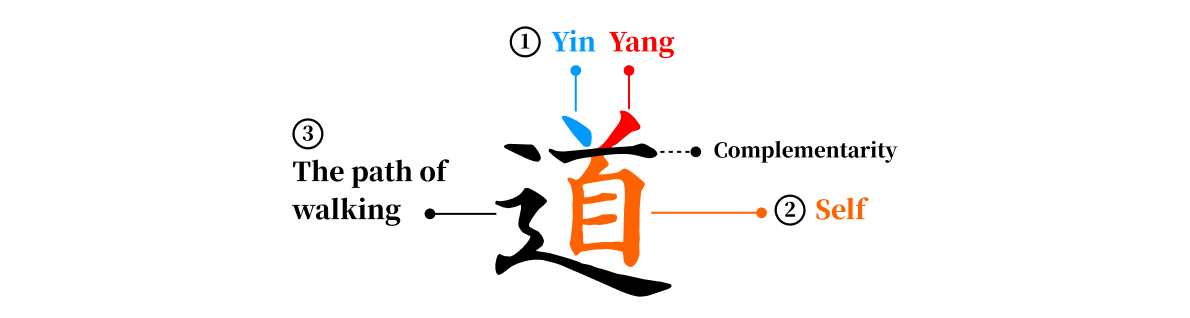
The image depicts a stylized Chinese character "道" (Dao), representing the Daoist concept of "the Way." The character is annotated with three labeled components (①, ②, ③) and a dotted line indicating "Complementarity." Colors (blue, red, orange, black) differentiate elements, with textual labels in English and Chinese.
### Components/Axes
1. **Character Structure**:
- The character "道" is composed of three distinct segments:
- **① Yin Yang**: A blue and red yin-yang symbol at the top, split vertically.
- **② Self**: An orange vertical stroke on the right side.
- **③ The path of walking**: A black horizontal stroke at the bottom.
- A dotted line labeled "Complementarity" connects the blue and red yin-yang segments.
2. **Annotations**:
- **① Yin Yang**: Blue (yin) and red (yang) halves, labeled in English and Chinese (阴阳).
- **② Self**: Orange stroke labeled "Self" (自我 in Chinese).
- **③ The path of walking**: Black stroke labeled "The path of walking" (走路之道 in Chinese).
3. **Spatial Grounding**:
- **① Yin Yang**: Top-center of the character.
- **② Self**: Right-middle of the character.
- **③ The path of walking**: Bottom-left of the character.
- **Complementarity**: Dotted line spans the top horizontal axis of the character.
### Detailed Analysis
- **Color Coding**:
- Blue (yin) and red (yang) represent dualistic opposites.
- Orange (self) and black (path) symbolize individual agency and action.
- **Textual Labels**:
- All annotations are in English, with direct Chinese translations provided.
- No numerical data or scales are present.
### Key Observations
1. The yin-yang symbol (①) is split vertically, emphasizing balance between opposing forces.
2. The "Self" (②) is positioned as a vertical counterpoint to the horizontal "path of walking" (③), suggesting integration of inner and outer journeys.
3. "Complementarity" (dotted line) implies dynamic interaction between yin and yang, not static opposition.
### Interpretation
This diagram illustrates the Daoist principle that the Dao (道) arises from the interplay of complementary forces (yin-yang), individual self-cultivation (self), and embodied action (path of walking). The vertical-horizontal alignment of components reflects the Daoist emphasis on harmony between heaven (yin) and earth (yang), while the character’s structure itself embodies the idea that the Dao is both a metaphysical principle and a practical guide for living. The absence of numerical data reinforces its philosophical rather than empirical nature.