## Image Analysis: Scene Classification with Object Relationships
### Overview
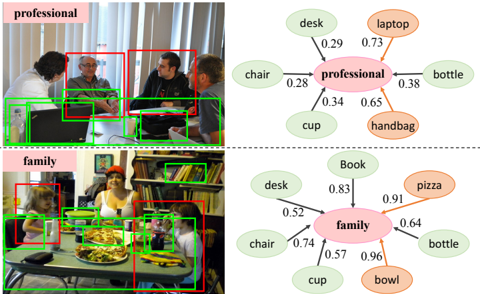
The image presents a comparative analysis of two scenes, labeled "professional" and "family," each accompanied by a photograph and a corresponding object relationship diagram. The photographs depict typical scenarios associated with each label, while the diagrams illustrate the relationships between the scene label and various objects, quantified by numerical weights.
### Components/Axes
**Photographs:**
* **Top-Left:** A photograph labeled "professional" shows a group of people in what appears to be an office or meeting setting. Bounding boxes are drawn around detected objects or people. Red boxes appear to highlight people's faces and torsos, while green boxes highlight objects like laptops, cups, and desks.
* **Bottom-Left:** A photograph labeled "family" shows a family gathered around a table with food. Similar bounding boxes are used, with red boxes around people and green boxes around objects like cups, bowls, and books.
**Object Relationship Diagrams:**
* **Top-Right:** A diagram associated with the "professional" scene. The central node is labeled "professional" (pink). Connected to this node are other nodes representing objects: "desk," "chair," "bottle," "cup," "laptop," and "handbag" (green, except for "laptop" and "handbag" which are orange). Each connection is labeled with a numerical weight.
* **Bottom-Right:** A diagram associated with the "family" scene. The central node is labeled "family" (pink). Connected to this node are other nodes representing objects: "desk," "chair," "bottle," "cup," "Book," and "bowl," "pizza" (green, except for "pizza" and "bowl" which are orange). Each connection is labeled with a numerical weight.
### Detailed Analysis
**"Professional" Scene:**
* **Photograph:** The scene shows four individuals. One woman is on the left, and three men are on the right. A laptop is visible on the table.
* **Diagram:**
* professional -> desk: 0.29
* professional -> chair: 0.28
* professional -> bottle: 0.38
* professional -> cup: 0.34
* professional -> laptop: 0.73
* professional -> handbag: 0.65
**"Family" Scene:**
* **Photograph:** The scene shows a family of three (two adults and one child) seated at a table with food. Bookshelves are visible in the background.
* **Diagram:**
* family -> desk: 0.52
* family -> chair: 0.74
* family -> bottle: 0.64
* family -> cup: 0.57
* family -> Book: 0.83
* family -> pizza: 0.91
* family -> bowl: 0.96
### Key Observations
* The diagrams quantify the association between the scene label and the presence of specific objects.
* Objects like "laptop" and "handbag" have higher weights in the "professional" scene, while "pizza" and "bowl" have higher weights in the "family" scene.
* The bounding boxes in the photographs highlight the objects that are considered relevant to each scene.
* The color of the object nodes in the diagrams (green vs. orange) might indicate different categories or levels of association.
### Interpretation
The image demonstrates a system for classifying scenes based on the objects present within them. The numerical weights in the diagrams represent the strength of the relationship between the scene label and the objects. This suggests a machine learning approach where the presence and frequency of certain objects contribute to the classification of a scene as "professional" or "family." The higher weights for "laptop" and "handbag" in the "professional" scene, and "pizza" and "bowl" in the "family" scene, align with common associations. The bounding boxes in the photographs visually confirm the presence of these key objects. The system appears to be using object detection and relationship analysis to understand and categorize visual scenes.