## Diagram: Contextual Object Associations
### Overview
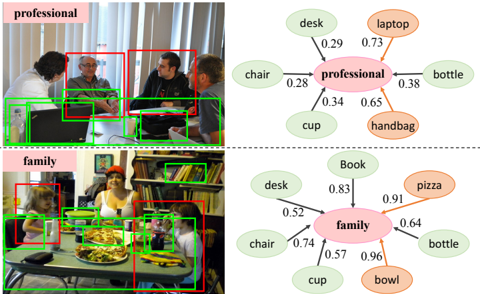
The image presents two contextual scenarios ("professional" and "family") with corresponding object association diagrams. Each scenario includes a photograph and a probabilistic network diagram showing relationships between contextual labels and objects. The diagrams use color-coded nodes (green for objects, orange for contextual labels) with edge weights indicating association strength.
### Components/Axes
**Left Section (Professional):**
- **Photograph:** Four individuals in a meeting environment with labeled bounding boxes (green for objects, red for people)
- **Diagram:**
- Central node: "professional" (pink)
- Connected nodes: desk (0.28), laptop (0.73), chair (0.34), cup (0.34), bottle (0.38), handbag (0.65)
- Legend: Green nodes = objects, Orange nodes = contextual labels
**Right Section (Family):**
- **Photograph:** Family meal with labeled bounding boxes (green for objects, red for people)
- **Diagram:**
- Central node: "family" (pink)
- Connected nodes: desk (0.52), book (0.83), chair (0.74), pizza (0.91), bottle (0.64), cup (0.57), bowl (0.96)
- Legend: Same color coding as professional section
### Detailed Analysis
**Professional Context:**
- Strongest associations: laptop (0.73), handbag (0.65)
- Weakest associations: desk (0.28), cup (0.34)
- Spatial grounding: Laptop and handbag nodes positioned prominently near the "professional" center
**Family Context:**
- Strongest associations: bowl (0.96), pizza (0.91)
- Weakest associations: desk (0.52), cup (0.57)
- Spatial grounding: Food-related items (pizza, bowl) clustered near the "family" center
### Key Observations
1. **Contextual Prioritization:**
- Professional context emphasizes work tools (laptop, handbag) over furniture (desk, chair)
- Family context prioritizes food items (pizza, bowl) over household objects (book, desk)
2. **Probability Distribution:**
- Family context shows higher average association strength (0.78) vs professional (0.52)
- Food-related items dominate family associations (pizza 0.91, bowl 0.96)
3. **Object Overlap:**
- Common objects: bottle (0.38 professional vs 0.64 family), chair (0.34 professional vs 0.74 family)
- Unique items: handbag (professional only), book (family only)
### Interpretation
The diagrams reveal how contextual framing influences object perception:
- **Professional Context:** Suggests work environments prioritize mobility (handbag) and digital tools (laptop) over static furniture. The lower probabilities indicate more nuanced object relationships in professional settings.
- **Family Context:** Demonstrates strong associations with consumables (pizza, bowl) and reading materials (book), reflecting domestic priorities. The higher probabilities suggest more definitive object categorization in family contexts.
- **Anomalies:** The presence of a book in family context (0.83) vs absence in professional context raises questions about work-life balance representation. The desk's lower probability in professional context (0.28) contradicts typical office environments, possibly indicating mobile work scenarios.
The color-coded legend (green for objects, orange for contexts) effectively distinguishes node types while maintaining visual clarity across both scenarios.