## Line Chart: MER Average vs N
### Overview
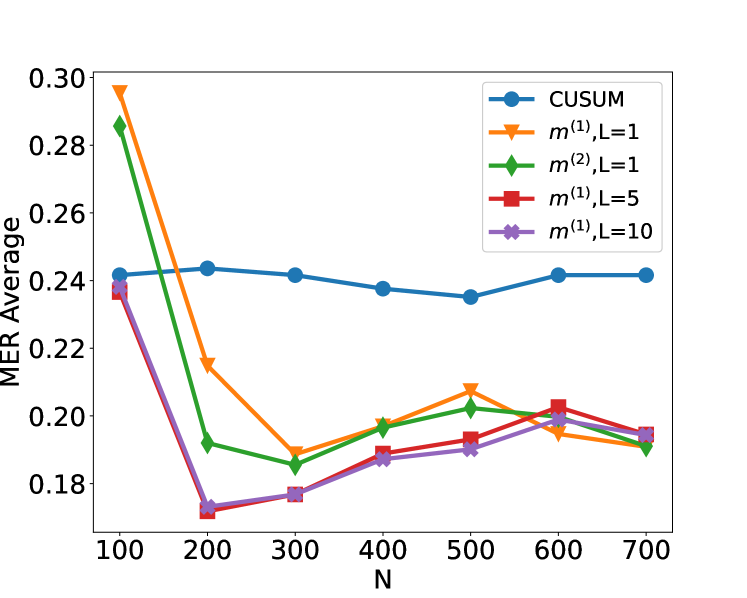
The image is a line chart comparing the MER (Minimum Error Rate) Average for different algorithms (CUSUM, m^(1), m^(2)) with varying parameters (L=1, L=5, L=10) against the variable N. The chart displays how the MER Average changes as N increases from 100 to 700.
### Components/Axes
* **X-axis:** N, ranging from 100 to 700 in increments of 100.
* **Y-axis:** MER Average, ranging from 0.18 to 0.30 in increments of 0.02.
* **Legend (Top-Right):**
* Blue line with circle markers: CUSUM
* Orange line with triangle markers: m^(1), L=1
* Green line with diamond markers: m^(2), L=1
* Red line with square markers: m^(1), L=5
* Purple line with pentagon markers: m^(1), L=10
### Detailed Analysis
* **CUSUM (Blue):** The MER Average starts at approximately 0.24 at N=100, remains relatively stable between 0.24 and 0.235 from N=200 to N=500, then increases slightly to approximately 0.24 at N=600 and remains at 0.24 at N=700.
* N=100: 0.24
* N=200: 0.243
* N=300: 0.242
* N=400: 0.241
* N=500: 0.236
* N=600: 0.242
* N=700: 0.242
* **m^(1), L=1 (Orange):** The MER Average starts at approximately 0.29 at N=100, decreases sharply to approximately 0.215 at N=200, then decreases further to approximately 0.19 at N=300. It then increases to approximately 0.198 at N=400, then increases further to approximately 0.208 at N=500, then decreases to approximately 0.20 at N=600, and finally decreases to approximately 0.195 at N=700.
* N=100: 0.29
* N=200: 0.215
* N=300: 0.19
* N=400: 0.198
* N=500: 0.208
* N=600: 0.20
* N=700: 0.195
* **m^(2), L=1 (Green):** The MER Average starts at approximately 0.285 at N=100, decreases sharply to approximately 0.19 at N=200, then decreases slightly to approximately 0.185 at N=300. It then increases to approximately 0.198 at N=400, then increases slightly to approximately 0.198 at N=500, then increases slightly to approximately 0.20 at N=600, and finally decreases to approximately 0.19 at N=700.
* N=100: 0.285
* N=200: 0.19
* N=300: 0.185
* N=400: 0.198
* N=500: 0.198
* N=600: 0.20
* N=700: 0.19
* **m^(1), L=5 (Red):** The MER Average starts at approximately 0.235 at N=100, decreases sharply to approximately 0.17 at N=200, then increases slightly to approximately 0.177 at N=300. It then increases to approximately 0.188 at N=400, then increases slightly to approximately 0.19 at N=500, then increases to approximately 0.202 at N=600, and finally decreases to approximately 0.195 at N=700.
* N=100: 0.235
* N=200: 0.17
* N=300: 0.177
* N=400: 0.188
* N=500: 0.19
* N=600: 0.202
* N=700: 0.195
* **m^(1), L=10 (Purple):** The MER Average starts at approximately 0.238 at N=100, decreases sharply to approximately 0.172 at N=200, then increases slightly to approximately 0.177 at N=300. It then increases to approximately 0.188 at N=400, then increases slightly to approximately 0.19 at N=500, then increases to approximately 0.20 at N=600, and finally decreases to approximately 0.192 at N=700.
* N=100: 0.238
* N=200: 0.172
* N=300: 0.177
* N=400: 0.188
* N=500: 0.19
* N=600: 0.20
* N=700: 0.192
### Key Observations
* The CUSUM algorithm (blue line) has a relatively stable MER Average across the range of N values, with a slight increase at N=600.
* The m^(1), L=1 (orange line) and m^(2), L=1 (green line) algorithms show a sharp decrease in MER Average from N=100 to N=200, followed by a gradual increase and then a slight decrease.
* The m^(1), L=5 (red line) and m^(1), L=10 (purple line) algorithms show a sharp decrease in MER Average from N=100 to N=200, followed by a gradual increase and then a slight decrease.
* For N values greater than 200, the m^(1), L=5 and m^(1), L=10 algorithms have the lowest MER Average.
### Interpretation
The chart suggests that the CUSUM algorithm is more stable across different values of N, while the other algorithms (m^(1), m^(2)) are more sensitive to changes in N, particularly at lower values. The algorithms m^(1), L=5 and m^(1), L=10 appear to perform better (lower MER Average) for N values greater than 200. The initial sharp decrease in MER Average for m^(1) and m^(2) algorithms indicates that increasing N from 100 to 200 significantly improves their performance. The subsequent gradual increase and slight decrease suggest that there is an optimal range of N values for these algorithms.