## 3D Diagram: Intersecting Cylinders
### Overview
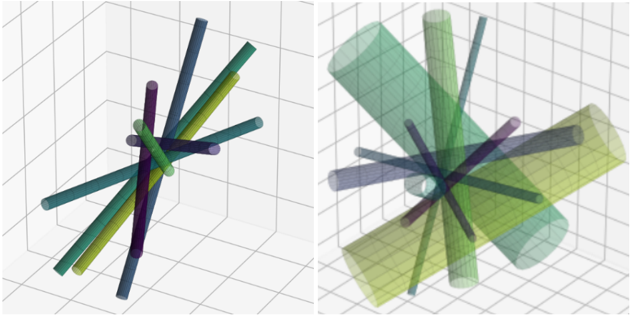
The image presents two 3D diagrams side-by-side, each depicting a set of intersecting cylinders within a 3D coordinate system. The left diagram shows the cylinders as solid objects, while the right diagram displays them with a translucent, wireframe-like rendering, revealing their internal structure and intersections more clearly. The cylinders are colored in shades of green, blue, yellow, and purple.
### Components/Axes
* **Coordinate System:** Both diagrams are rendered within a 3D coordinate system, indicated by grid lines along the x, y, and z axes. The origin appears to be located at the bottom-left corner of each diagram.
* **Cylinders:** The primary components are several cylinders of varying lengths and orientations. They intersect near the center of the coordinate system.
* **Colors:** The cylinders are colored in four distinct hues:
* Green
* Blue
* Yellow
* Purple
### Detailed Analysis
**Left Diagram:**
* The cylinders are rendered as solid objects, making it difficult to discern their exact intersection points.
* The green cylinder appears to be oriented diagonally, extending from the bottom-left towards the top-right of the coordinate system.
* The blue cylinder is also diagonal, but oriented differently from the green one.
* The yellow cylinder is shorter and appears to be oriented more vertically.
* The purple cylinder is the shortest and is oriented diagonally.
**Right Diagram:**
* The translucent rendering allows for a clearer view of the cylinders' intersections.
* The green and yellow cylinders are rendered as translucent tubes.
* The blue and purple cylinders are rendered as solid objects.
* The grid lines of the coordinate system are visible through the translucent cylinders.
### Key Observations
* The cylinders intersect near the center of the coordinate system in both diagrams.
* The right diagram provides a better understanding of the spatial relationships between the cylinders due to its translucent rendering.
* The cylinders are oriented in various directions, creating a complex network of intersections.
### Interpretation
The diagrams illustrate the concept of intersecting geometric shapes in 3D space. The use of different rendering styles (solid vs. translucent) highlights the importance of visualization techniques in understanding complex spatial relationships. The arrangement of the cylinders suggests a potential model for representing complex structures or networks, where the cylinders could represent different components or pathways. The translucent rendering in the right diagram is particularly useful for visualizing the internal structure and intersection points, which would be obscured in a solid rendering.