## Network Diagram: Dense Interconnected Graph
### Overview
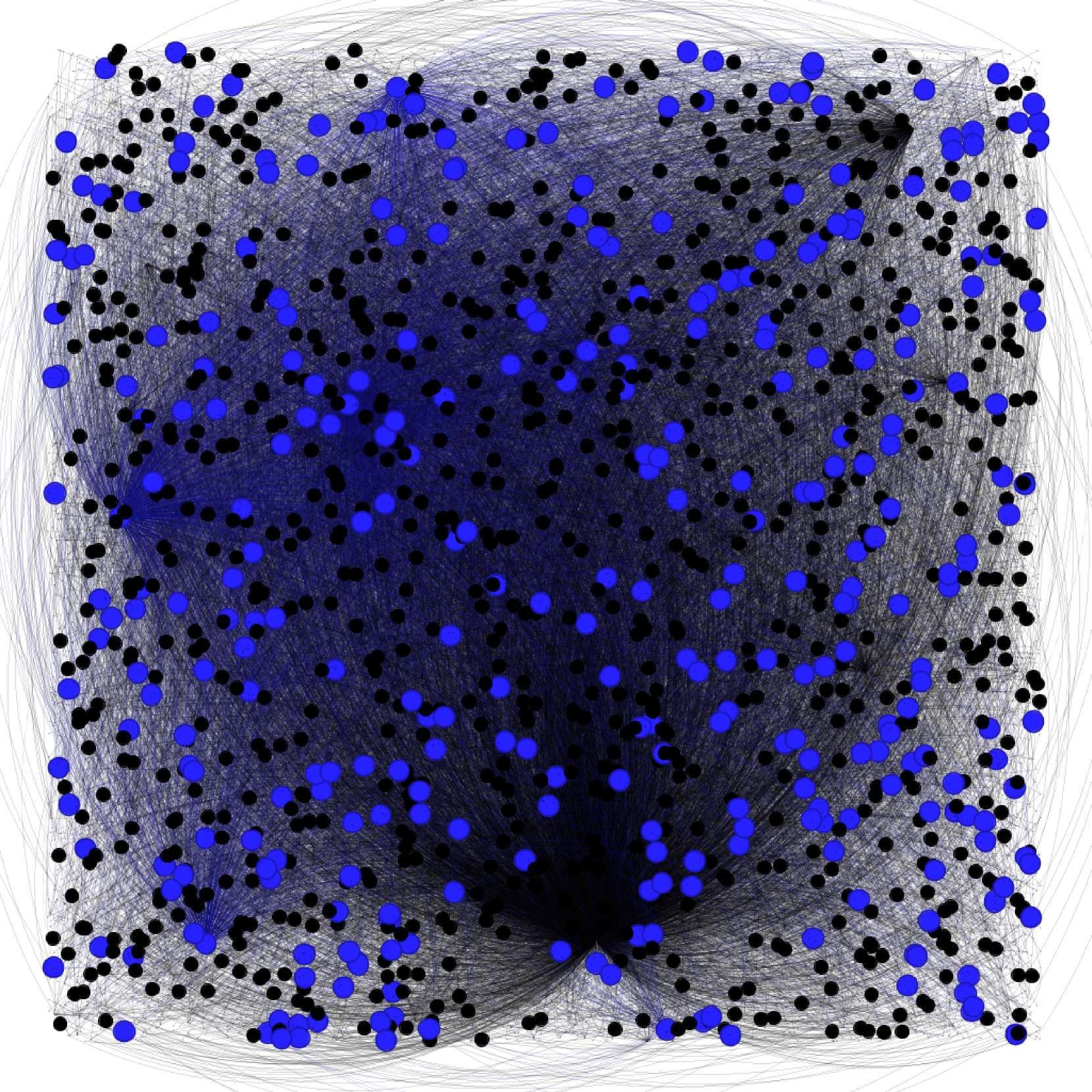
The image displays a complex, dense network graph (also known as a node-link diagram) on a white background. It consists of hundreds of circular nodes connected by a web of thin, semi-transparent gray lines (edges). There are two distinct node types differentiated by color: blue and black. The graph exhibits a high degree of connectivity, with many nodes serving as hubs for numerous connections. There is no accompanying text, title, legend, or axis labels within the image frame.
### Components/Axes
* **Nodes:** Circular markers representing entities in the network.
* **Blue Nodes:** Approximately 150-200 bright blue circles, distributed throughout the graph but appearing slightly more concentrated in the central and upper-left regions.
* **Black Nodes:** Approximately 300-400 black circles, more numerous than the blue nodes and spread across the entire visualization.
* **Edges:** Thin, gray, semi-transparent lines connecting nodes. The density of edges is extremely high, creating a dark, almost solid mass in the center of the graph where connections overlap heavily. The edges appear to have no directionality (undirected graph).
* **Layout:** The graph uses a force-directed layout algorithm, where connected nodes are pulled together and unconnected nodes are pushed apart. This results in a roughly circular or organic cluster with a very dense core and a slightly less dense periphery. No spatial axes (X/Y coordinates with meaning) are present.
### Detailed Analysis
* **Node Distribution:** Both blue and black nodes are interspersed throughout the network. There is no clear spatial segregation where one color is confined to a specific region. However, the highest density of *both* node types and their connecting edges is in the central area of the image.
* **Connectivity Pattern:** The network is highly interconnected. Many nodes, particularly in the central mass, appear to be connected to dozens of other nodes, forming dense local clusters. The edges create a complex, hairball-like structure, making it impossible to trace individual connections without interactive tools.
* **Visual Density:** The center of the graph is so densely packed with overlapping edges that it appears as a dark blue-black mass. The density decreases towards the edges of the image, where individual nodes and their connecting lines become more distinguishable.
### Key Observations
1. **High Clustering Coefficient:** The visual density suggests a network with a high clustering coefficient, meaning nodes tend to form tightly knit groups.
2. **Hub Nodes:** Several nodes (both blue and black) appear to be major hubs, with a visibly higher number of edges radiating from them compared to others. These are often located in the central dense region.
3. **Lack of Clear Community Structure:** At this scale and without algorithmic analysis, no distinct, separate communities or modules are visually apparent. The network appears as one large, integrated component.
4. **Two-Category System:** The use of only two node colors (blue and black) implies a fundamental binary classification of the entities within the network (e.g., active/inactive, type A/type B, infected/healthy).
### Interpretation
This visualization represents a complex system characterized by dense, non-random interconnections. The absence of labels or a legend means the specific domain (e.g., social network, biological pathway, citation network, neural connections) cannot be determined from the image alone.
**What the data suggests:**
* **Robustness and Vulnerability:** Such a densely connected network is likely robust to random failures (removing random nodes may not disconnect the graph) but potentially vulnerable to targeted attacks on the high-degree hub nodes.
* **Efficient Information/Resource Flow:** The short path lengths implied by the dense core suggest that information, signals, or resources could propagate very quickly through this system.
* **Binary Attribute Interaction:** The mixing of blue and black nodes throughout the structure indicates that the binary attribute they represent is not a primary driver of the network's overall topology. Connections form readily between nodes of the same color and different colors.
**Notable Anomalies:**
The primary "anomaly" is the extreme density itself. In many real-world networks, some degree of sparsity is common. This graph's density might indicate a specific type of system (like a fully connected layer in a neural network, a very small-world social group, or a synthetic dataset designed to show high connectivity) or a visualization choice where a very large number of edges are drawn with low opacity, creating an aggregated dark mass.
**Peircean Investigation:**
* **Icon:** The image is an icon of a network—a direct visual representation of nodes and links.
* **Index:** The dense clustering and hub formation are indices of underlying forces (like preferential attachment or community structure) that shaped the network's growth.
* **Symbol:** The blue/black color scheme is a symbolic, arbitrary convention to denote a categorical difference between nodes. Without a key, the symbol's meaning is lost, highlighting the critical importance of metadata in technical visualizations.
**Conclusion:** The image effectively conveys the *structural property* of being a dense, interconnected, small-world network with a binary node classification. However, it fails as a standalone technical document due to the complete absence of explanatory text, labels, or a legend, which are essential for interpreting the *meaning* of the nodes, edges, and their categories. To make this diagram informative, it requires a title, a legend explaining the blue/black node distinction, and ideally, annotations for key hub nodes or clusters.