\n
## Diagram: Federated Learning Process
### Overview
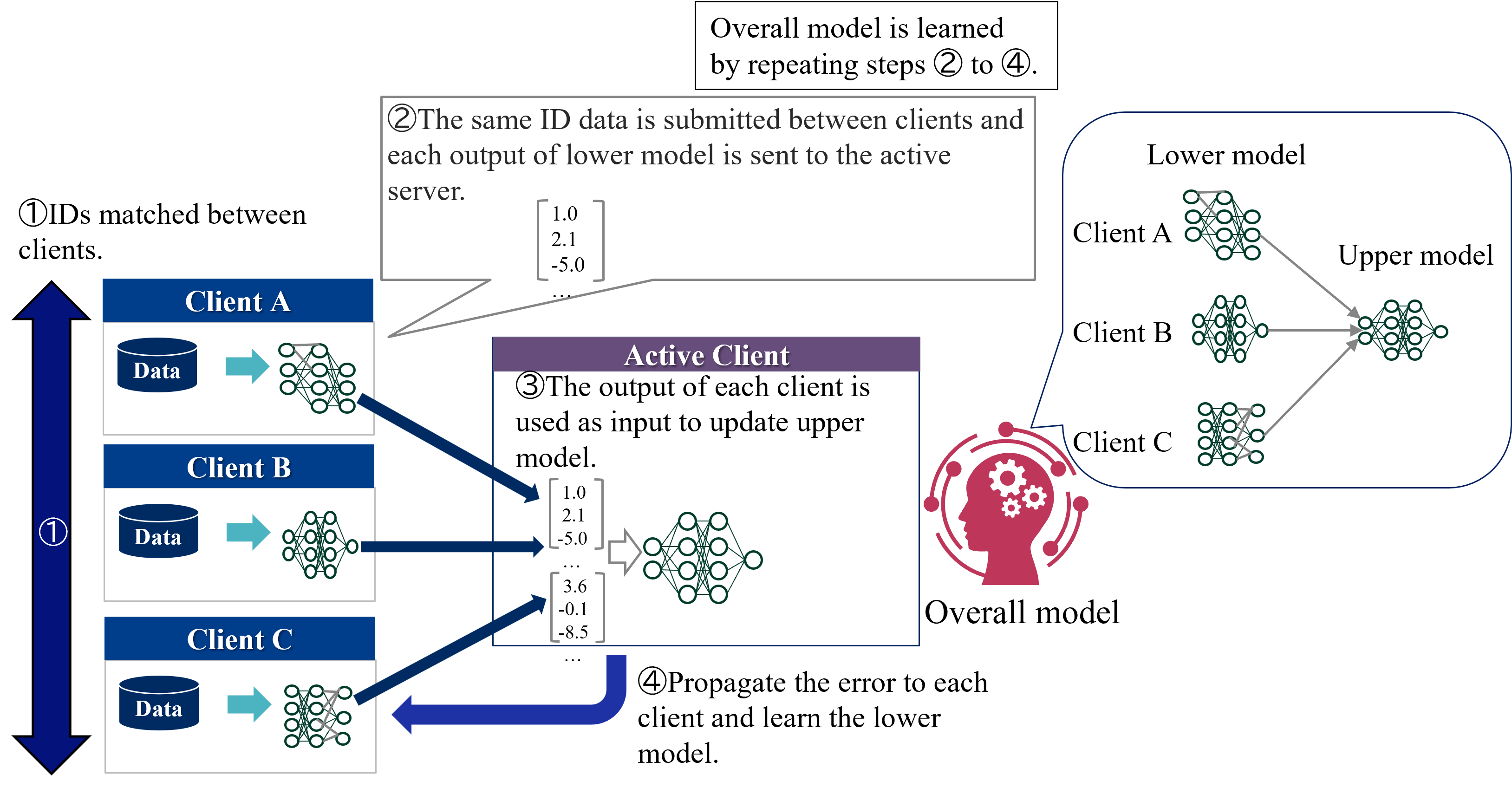
This diagram illustrates a federated learning process involving multiple clients (A, B, and C) and a central server. The process involves iterative steps of data submission, model updating, and error propagation to learn an overall model without directly sharing the raw data. The diagram depicts the flow of information and model updates between clients and the server.
### Components/Axes
The diagram consists of the following key components:
* **Clients (A, B, C):** Represent individual devices or entities holding local data. Each client has a "Data" input and a local model represented by interconnected nodes.
* **Active Client:** A designated client responsible for receiving and processing model updates.
* **Server:** A central entity coordinating the learning process.
* **Lower Model:** A client-specific model.
* **Upper Model:** A global model aggregated from client models.
* **Overall Model:** The final learned model.
* **Arrows:** Indicate the flow of data and model updates.
* **Numbered Steps (①, ②, ③, ④):** Describe the sequence of operations in the federated learning process.
### Detailed Analysis or Content Details
The diagram outlines a four-step process:
**① IDs matched between clients.**
This step is represented by bidirectional purple arrows connecting Clients A, B, and C. It indicates that the clients are synchronized based on their IDs.
**② The same ID data is submitted between clients and each output of lower model is sent to the active server.**
This step shows data flowing from Clients A, B, and C to the "Active Client". The Active Client displays a data block labeled "Data" and a local model. The output of the lower model is represented by a bracketed list of numerical values:
* 1.0
* 2.1
* -5.0
* ... (indicating more values are present but not shown)
**③ The output of each client is used as input to update upper model.**
This step shows the output from the Active Client being used to update the "Upper Model". The Upper Model is connected to Clients A, B, and C. The Active Client displays a data block labeled "Data" and a local model. The output of the lower model is represented by a bracketed list of numerical values:
* 1.0
* 2.1
* -5.0
* 3.6
* -0.1
* -8.5
* ... (indicating more values are present but not shown)
**④ Propagate the error to each client and learn the lower model.**
This step shows the error being propagated back to each client (A, B, and C) to update their respective "Lower Models". A gear icon is placed between the "Overall Model" and the clients, suggesting a mechanism for error propagation and model learning.
The right side of the diagram shows the relationship between the "Lower Model" and the "Upper Model" for each client (A, B, and C). The "Lower Model" is represented by interconnected nodes, and the "Upper Model" is a larger network of interconnected nodes that aggregates the information from the lower models.
### Key Observations
* The process is iterative, as indicated by the statement "Overall model is learned by repeating steps ② to ④."
* The diagram emphasizes the decentralized nature of federated learning, where clients contribute to the learning process without sharing their raw data.
* The numerical values provided in steps ② and ③ suggest that the models are producing numerical outputs, potentially representing predictions or feature representations.
* The gear icon in step ④ suggests a gradient descent or similar optimization algorithm is used to update the lower models.
### Interpretation
The diagram illustrates the core principles of federated learning. The process aims to build a robust "Overall Model" by leveraging data from multiple clients while preserving data privacy. The iterative steps of data submission, model updating, and error propagation allow the model to learn from distributed data sources without requiring centralized data storage. The use of "Lower Models" and "Upper Models" suggests a hierarchical approach to model aggregation, where client-specific models are combined to form a global model. The numerical values in steps ② and ③ likely represent the outputs of the models, which are used to calculate the error and update the models in subsequent iterations. The diagram highlights the importance of synchronization between clients (step ①) to ensure that the learning process is consistent and effective. The overall process is designed to improve model performance while addressing privacy concerns associated with traditional centralized machine learning approaches.