TECHNICAL ASSET FINGERPRINT
5025d42c895f36ecdc14c082
Click to view fullscreen
Press ESC or click to close
FOUND IN PAPERS
EXPERT: gemini-2.5-flash-lite-free VERSION 1
RUNTIME: google-free/gemini-2.5-flash-lite
INTEL_VERIFIED
## Diagram: Food Delivery Process in an Agora Sub-network
### Overview
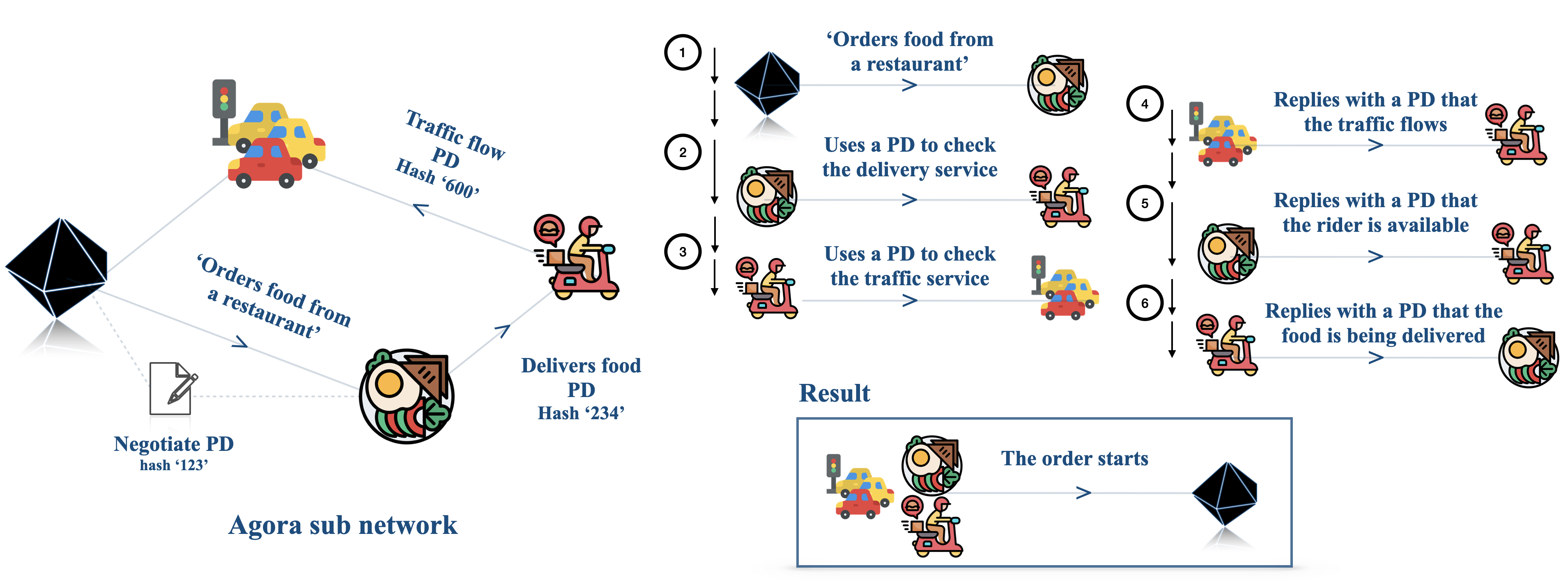
This diagram illustrates a simplified workflow for a food delivery process within an "Agora sub network." It depicts the interactions between a central entity (represented by a black octahedron, likely the Agora network or a smart contract), a customer ordering food, a restaurant, a delivery rider, and external services like traffic and delivery status checks. The diagram is divided into two main sections: the initial ordering and negotiation phase on the left, and a step-by-step process flow on the right, culminating in a "Result" section.
### Components/Axes
The diagram does not feature traditional axes or legends. Instead, it uses icons and text labels to represent entities and actions.
**Key Components and Icons:**
* **Black Octahedron:** Represents the central network or a smart contract. It is shown at the start of the process and at the end of the "Result" section.
* **Document with Pencil Icon:** Represents negotiation or agreement, labeled "Negotiate PD hash '123'".
* **Plate with Food Icon:** Represents food being prepared or ready for delivery.
* **Scooter Rider Icon:** Represents the delivery rider.
* **Cars and Traffic Light Icon:** Represents traffic conditions or a traffic service.
* **Numbered Circles (1-6):** Indicate sequential steps in the process flow.
* **Text Labels:** Describe actions, services, and data hashes.
**Textual Labels and Their Meanings:**
* **Left Section (Agora Sub network):**
* "Orders food from a restaurant": An action initiated from the central entity.
* "Negotiate PD hash '123'": Represents a negotiation phase with a specific hash value.
* "Delivers food PD Hash '234'": Represents the delivery of food with a specific hash value.
* "Traffic flow PD Hash '600'": Represents traffic flow information with a specific hash value.
* **Right Section (Process Flow):**
* **Step 1:** "Orders food from a restaurant"
* **Step 2:** "Uses a PD to check the delivery service"
* **Step 3:** "Uses a PD to check the traffic service"
* **Step 4:** "Replies with a PD that the traffic flows"
* **Step 5:** "Replies with a PD that the rider is available"
* **Step 6:** "Replies with a PD that the food is being delivered"
* **Result Section:**
* "The order starts"
* An arrow leading from the "Result" section to the black octahedron.
### Detailed Analysis or Content Details
The diagram outlines a process flow with distinct stages:
**Left Side (Initial Interaction):**
1. The process begins with the **black octahedron** (Agora sub network).
2. An action "Orders food from a restaurant" is initiated, leading to a **plate with food icon**.
3. A separate path shows "Negotiate PD hash '123'" originating from the **black octahedron** and leading to a **document with pencil icon**.
4. Another path shows "Delivers food PD Hash '234'" originating from the **plate with food icon** and leading to the **scooter rider icon**.
5. A path labeled "Traffic flow PD Hash '600'" originates from the **cars and traffic light icon** and leads to the **scooter rider icon**.
**Right Side (Step-by-Step Process):**
This section details the interaction with external services and the rider.
1. **Step 1:** The **black octahedron** initiates "Orders food from a restaurant." This is followed by an arrow to the **plate with food icon**.
2. **Step 2:** The **plate with food icon** (representing the order or restaurant) uses a "PD" (likely a data packet or proof of delivery) to check the delivery service. This is represented by an arrow to the **scooter rider icon**.
3. **Step 3:** The **scooter rider icon** uses a "PD" to check the traffic service. This is represented by an arrow to the **cars and traffic light icon**.
4. **Step 4:** The **cars and traffic light icon** (representing the traffic service) replies with a "PD that the traffic flows." This is represented by an arrow to the **scooter rider icon**.
5. **Step 5:** The **scooter rider icon** (now potentially representing the delivery service) replies with a "PD that the rider is available." This is represented by an arrow to the **plate with food icon**.
6. **Step 6:** The **plate with food icon** (representing the restaurant or order status) replies with a "PD that the food is being delivered." This is represented by an arrow to the **scooter rider icon**.
**Result Section:**
* "The order starts" is indicated by an arrow from the **plate with food icon** to the **black octahedron**. This suggests the completion of the initial setup and the commencement of the actual delivery process, with the network confirming the start.
### Key Observations
* **Decentralized Nature:** The use of "PD" (likely Proof of Delivery or similar data structure) and hashes suggests a decentralized or blockchain-based system.
* **Service Integration:** The diagram highlights the integration of multiple services: restaurant ordering, delivery service, and traffic information.
* **Information Flow:** The arrows clearly indicate the direction of information and action flow between different entities and services.
* **Hash Values:** Specific hash values ('123', '234', '600') are associated with different stages or data points, implying data integrity and traceability.
* **Iterative Checking:** The process involves the rider checking traffic and availability, and services responding with relevant data.
### Interpretation
This diagram illustrates a streamlined food delivery process within a hypothetical "Agora sub network." The black octahedron likely represents a smart contract or a decentralized application orchestrating the entire workflow.
The process begins with an order being placed, followed by negotiation and the preparation of food. The core of the diagram on the right details how the delivery rider interacts with external services. The rider uses "PDs" (which could be verifiable credentials or data proofs) to query the delivery service for availability and the traffic service for real-time conditions. The responses from these services, also in the form of "PDs," enable the rider to proceed. The final step shows the confirmation that the food is being delivered, leading back to the central network, signifying the start of the actual delivery phase.
The "Result" section, "The order starts," implies that after all checks and confirmations, the network acknowledges the commencement of the delivery. The inclusion of hash values suggests that each significant piece of information or transaction is cryptographically secured and verifiable, which is a hallmark of blockchain or distributed ledger technologies. This system aims to ensure transparency, efficiency, and reliability in the food delivery ecosystem by leveraging verifiable data and automated checks. The diagram effectively visualizes a smart contract-driven or decentralized autonomous organization (DAO)-managed delivery service.
DECODING INTELLIGENCE...