## Lattice Partition Diagrams
### Overview
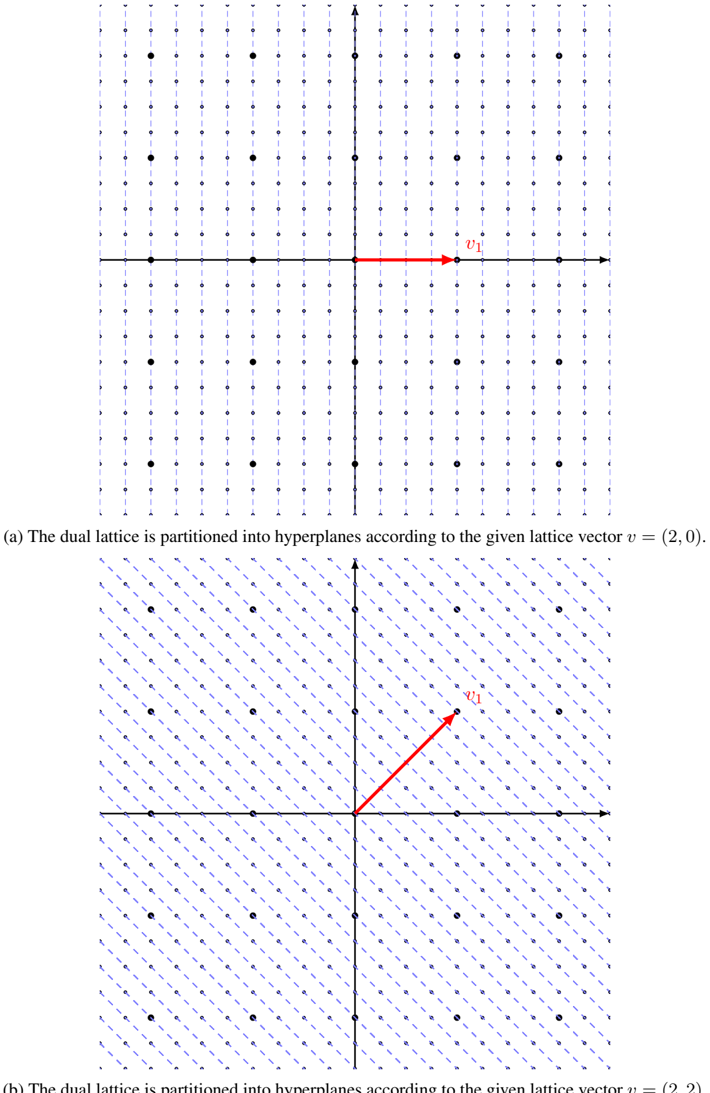
The image presents two diagrams illustrating the partitioning of a dual lattice into hyperplanes based on given lattice vectors. The top diagram (a) shows partitioning with the vector v = (2,0), while the bottom diagram (b) shows partitioning with the vector v = (2,2). Both diagrams feature a grid of points, axes, and a vector labeled v1.
### Components/Axes
Both diagrams share the following components:
* **Axes:** A horizontal x-axis and a vertical y-axis intersect at the origin (0,0). Both axes are marked with arrowheads indicating positive direction.
* **Lattice Points:** A grid of small, evenly spaced points represents the dual lattice.
* **Hyperplanes:** Dashed lines represent the hyperplanes partitioning the lattice.
* **Vector v1:** A red arrow originating from the origin represents the lattice vector.
* **Labels:** The vector is labeled "v1" in red.
* **Captions:**
* (a) The dual lattice is partitioned into hyperplanes according to the given lattice vector v = (2,0).
* (b) The dual lattice is partitioned into hyperplanes according to the given lattice vector v = (2,2).
### Detailed Analysis
**Diagram (a): Partitioning with v = (2,0)**
* **Hyperplanes:** The dashed lines are vertical and parallel to the y-axis. They are spaced such that every other column of lattice points lies on a hyperplane.
* **Vector v1:** The red vector points directly along the positive x-axis, extending approximately two units.
* **Lattice Points:** The points are arranged in a square grid. Some points are highlighted in black, while the rest are smaller and lighter. The highlighted points appear to be located on the hyperplanes.
**Diagram (b): Partitioning with v = (2,2)**
* **Hyperplanes:** The dashed lines are diagonal, running from the bottom-left to the top-right. They are spaced such that the lattice points are partitioned into parallel lines.
* **Vector v1:** The red vector points diagonally upwards and to the right, forming a 45-degree angle with the x-axis. It extends approximately two units in both the x and y directions.
* **Lattice Points:** The points are arranged in a square grid. Some points are highlighted in black, while the rest are smaller and lighter. The highlighted points appear to be located on the hyperplanes.
### Key Observations
* The orientation of the hyperplanes is directly influenced by the components of the lattice vector *v*.
* In diagram (a), with *v* = (2,0), the hyperplanes are vertical, indicating that the partitioning is only dependent on the x-coordinate.
* In diagram (b), with *v* = (2,2), the hyperplanes are diagonal, indicating that the partitioning is dependent on both the x and y coordinates equally.
* The highlighted points likely represent the lattice points that satisfy the equation defining the hyperplanes.
### Interpretation
The diagrams visually demonstrate how different lattice vectors can partition a dual lattice into hyperplanes. The choice of the lattice vector *v* dictates the orientation and spacing of these hyperplanes. This partitioning is a fundamental concept in lattice theory and has applications in various fields, including cryptography, coding theory, and signal processing. The highlighted points on the hyperplanes likely represent solutions to a linear equation related to the lattice vector. The diagrams illustrate the geometric interpretation of these algebraic concepts.