\n
## Diagram: Dual Lattice Partitioning
### Overview
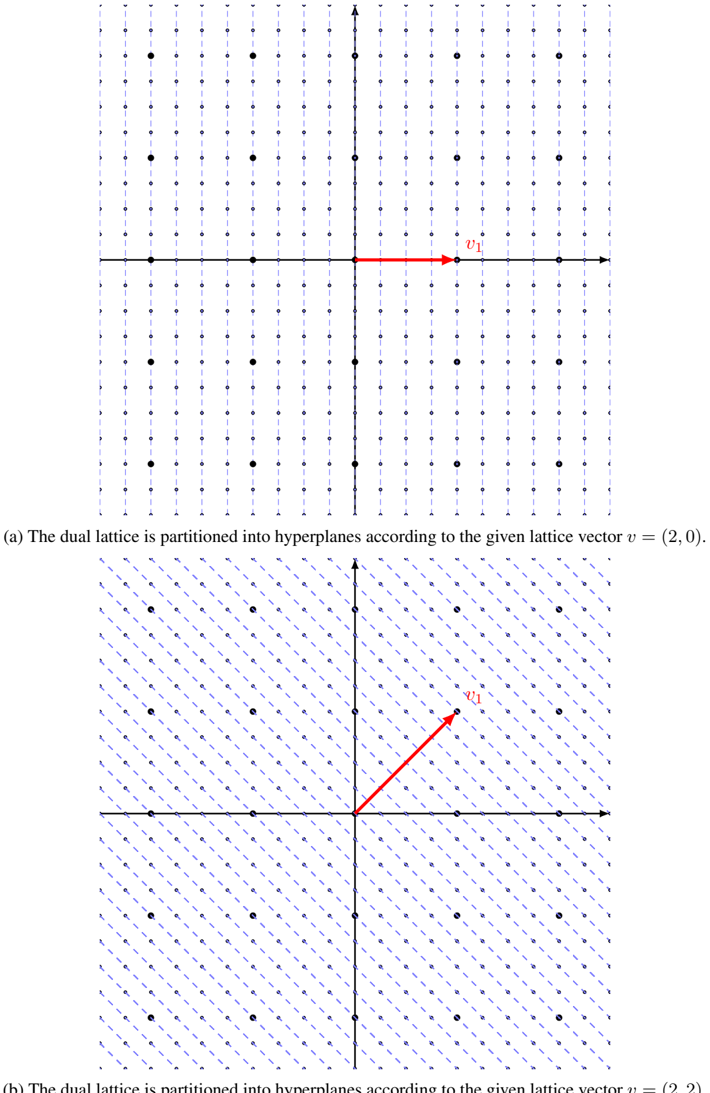
The image presents two diagrams illustrating the partitioning of a dual lattice into hyperplanes based on given lattice vectors. Both diagrams depict a 2D coordinate system with a grid of points representing the dual lattice. Each diagram shows the lattice partitioned by lines corresponding to a specific lattice vector.
### Components/Axes
Both diagrams share the following components:
* **Coordinate System:** A standard Cartesian coordinate system with a vertical y-axis and a horizontal x-axis. The axes intersect at the origin (0,0).
* **Dual Lattice:** A grid of small black dots representing the points of the dual lattice.
* **Hyperplane Partitioning Lines:** Lines that divide the lattice into regions. These lines are determined by the given lattice vectors.
* **Lattice Vector:** A red arrow indicating the lattice vector used for partitioning.
* **Captions:** Text descriptions below each diagram explaining the partitioning process.
Diagram (a) has the caption: "(a) The dual lattice is partitioned into hyperplanes according to the given lattice vector v = (2, 0)."
Diagram (b) has the caption: "(b) The dual lattice is partitioned into hyperplanes according to the given lattice vector v = (2, 2)."
### Detailed Analysis or Content Details
**Diagram (a):**
* **Lattice Vector:** The lattice vector *v* is represented by a red arrow pointing horizontally to the right, originating near the center of the diagram. The vector is defined as (2, 0).
* **Hyperplane Partitioning:** The dual lattice is partitioned into vertical hyperplanes. These hyperplanes are spaced 2 units apart along the x-axis. The lines are parallel to the y-axis.
* **Grid Spacing:** The grid appears to be spaced at intervals of 1 unit along both the x and y axes.
**Diagram (b):**
* **Lattice Vector:** The lattice vector *v* is represented by a red arrow pointing diagonally upwards and to the right, originating near the center of the diagram. The vector is defined as (2, 2).
* **Hyperplane Partitioning:** The dual lattice is partitioned into hyperplanes defined by the lines x = y + c, where c is a constant. The lines are at 45-degree angles to the x and y axes.
* **Grid Spacing:** The grid appears to be spaced at intervals of 1 unit along both the x and y axes.
### Key Observations
* The lattice vector directly determines the orientation and spacing of the hyperplanes.
* In diagram (a), the lattice vector (2, 0) results in vertical hyperplanes, indicating that the partitioning is based solely on the x-coordinate.
* In diagram (b), the lattice vector (2, 2) results in diagonal hyperplanes, indicating that the partitioning is based on a combination of the x and y coordinates.
* The diagrams visually demonstrate how different lattice vectors lead to different partitioning schemes of the dual lattice.
### Interpretation
These diagrams illustrate a fundamental concept in lattice theory and related fields like crystallography and Fourier analysis. The partitioning of the dual lattice represents the set of all possible reciprocal vectors. The lattice vector *v* defines the basis for the partitioning, and the hyperplanes represent the boundaries between different regions in the dual space.
The choice of lattice vector significantly impacts the structure of the partitioning. A vector along a single axis (as in diagram (a)) leads to a simple, axis-aligned partitioning, while a vector with components in multiple directions (as in diagram (b)) results in a more complex, angled partitioning.
These concepts are crucial for understanding the behavior of waves and signals in periodic structures, as well as for analyzing the symmetry properties of crystals and other materials. The diagrams provide a visual representation of how the underlying mathematical structure of lattices manifests in physical phenomena. The diagrams do not contain numerical data beyond the vector definitions (2,0) and (2,2). They are conceptual illustrations.