## Diagram: Dual Lattice Partitioning into Hyperplanes
### Overview
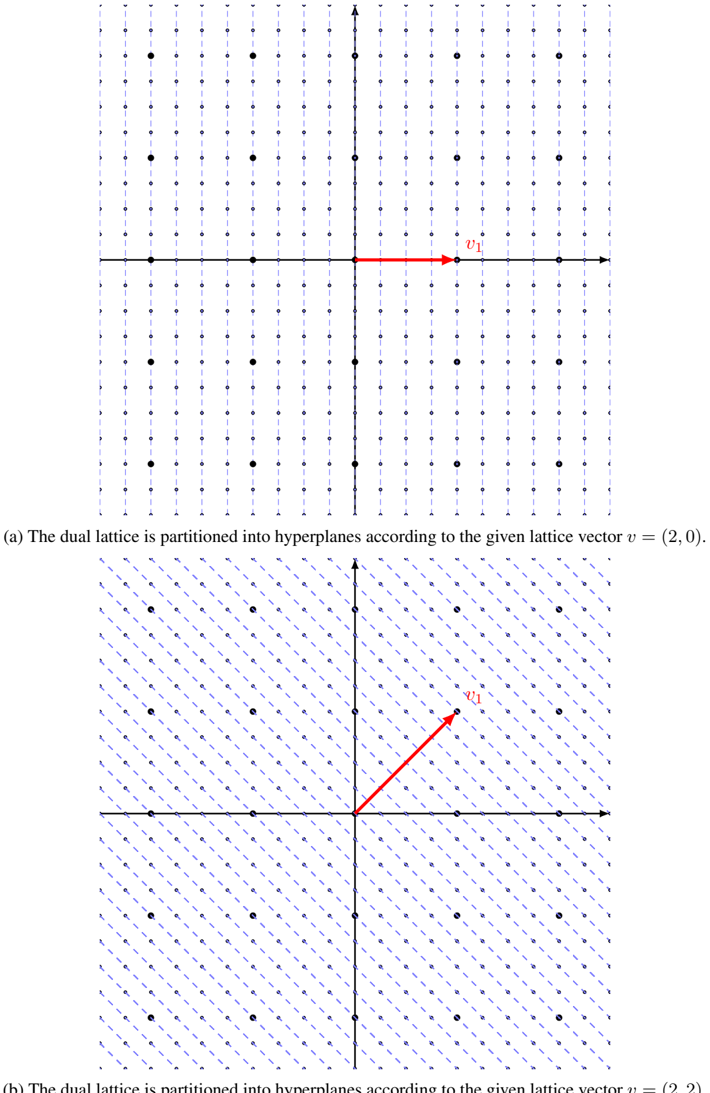
The image contains two diagrams (a) and (b) illustrating the partitioning of a dual lattice into hyperplanes based on distinct lattice vectors. Each diagram uses a grid of black dots to represent lattice points, with hyperplanes depicted as dashed lines and a red arrow labeled **v₁** indicating the lattice vector direction.
---
### Components/Axes
- **Axes**: Standard Cartesian coordinate system (x-axis horizontal, y-axis vertical).
- **Lattice Points**: Black dots arranged in a grid pattern, representing discrete lattice points.
- **Hyperplanes**:
- Diagram (a): Vertical dashed lines spaced every 2 units along the x-axis.
- Diagram (b): Diagonal dashed lines with slope -1 (perpendicular to the lattice vector direction).
- **Lattice Vector (v)**:
- Diagram (a): **v = (2, 0)** (horizontal vector).
- Diagram (b): **v = (2, 2)** (diagonal vector).
- **Vector v₁**: Red arrow originating from the origin, aligned with the lattice vector direction in each diagram.
---
### Detailed Analysis
#### Diagram (a): v = (2, 0)
- **Hyperplane Orientation**: Vertical lines (parallel to the y-axis).
- **Spacing**: Hyperplanes are spaced at intervals of 2 units along the x-axis.
- **Vector v₁**: Points directly along the positive x-axis, matching the hyperplane orientation.
- **Lattice Interaction**: Partitions the lattice into vertical columns, grouping points with the same x-coordinate modulo 2.
#### Diagram (b): v = (2, 2)
- **Hyperplane Orientation**: Diagonal lines with slope -1 (perpendicular to the vector **v = (2, 2)**).
- **Spacing**: Hyperplanes are spaced such that the distance between adjacent lines corresponds to the magnitude of **v**.
- **Vector v₁**: Points diagonally upward to the right, aligning with the direction of **v = (2, 2)**.
- **Lattice Interaction**: Partitions the lattice into regions separated by diagonal hyperplanes, grouping points based on their projection onto the vector **v**.
---
### Key Observations
1. **Hyperplane Orientation**: The orientation of hyperplanes is determined by the lattice vector **v**. Vertical hyperplanes for **v = (2, 0)** and diagonal hyperplanes for **v = (2, 2)**.
2. **Vector Alignment**: The red arrow **v₁** in each diagram aligns precisely with the lattice vector **v**, confirming the partitioning direction.
3. **Lattice Symmetry**: The grid structure remains consistent across both diagrams, but the partitioning logic changes with **v**.
---
### Interpretation
The diagrams demonstrate how lattice vectors define hyperplane partitions in a dual lattice:
- **Diagram (a)** shows a simple axis-aligned partitioning, useful for problems requiring orthogonal symmetry.
- **Diagram (b)** illustrates a rotated partitioning, critical for applications like lattice-based cryptography, where non-axis-aligned structures enhance security.
- The red arrow **v₁** serves as a visual anchor, clarifying the relationship between the lattice vector and hyperplane orientation. This partitioning method could be applied to optimize computational problems in high-dimensional spaces or analyze periodic structures in materials science.