## Diagram: Transformation Types and Examples
### Overview
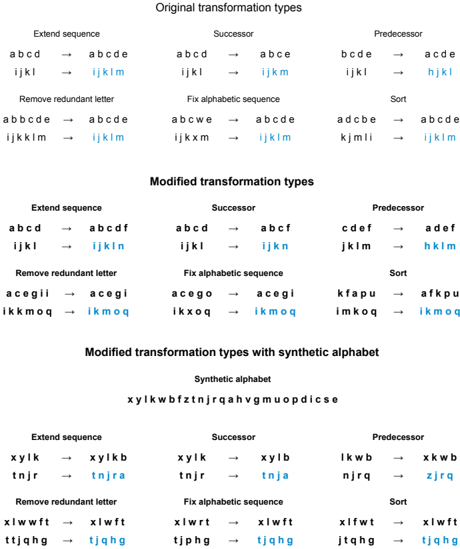
The image is a structured diagram illustrating various string transformation types applied to alphabetic sequences and a synthetic alphabet. It is divided into three main sections: **Original transformation types**, **Modified transformation types**, and **Modified transformation types with synthetic alphabet**. Each section contains subcategories (e.g., Extend sequence, Remove redundant letter) with specific examples of transformations.
---
### Components/Axes
- **Sections**:
1. **Original transformation types**
2. **Modified transformation types**
3. **Modified transformation types with synthetic alphabet**
- **Subcategories** (consistent across sections):
- Extend sequence
- Remove redundant letter
- Fix alphabetic sequence
- Successor
- Predecessor
- Sort
- **Examples**:
- Arrows (`→`) denote transformations.
- Blue highlights emphasize specific letters in transformations.
- Synthetic alphabet uses symbols like `x, y, l, k, t, n, j, r, q, a, h, v, g, m, u, o, p, d, i, c, s, e`.
---
### Detailed Analysis
#### Original Transformation Types
- **Extend sequence**:
- `abcd → abcde` (adds `e`)
- `ijkl → ijklm` (adds `m`)
- **Remove redundant letter**:
- `abbcde → abcde` (removes duplicate `b`)
- `ijkkim → ijkIm` (removes duplicate `k`)
- **Fix alphabetic sequence**:
- `abcwe → abcde` (replaces `w` with `d`)
- `ijkmx → ijkIm` (replaces `x` with `m`)
- **Successor**:
- `abcd → abce` (replaces `d` with `e`)
- `ijkl → ijkM` (replaces `l` with `M`)
- **Predecessor**:
- `bcde → acde` (replaces `b` with `a`)
- `ijkl → hjkl` (replaces `i` with `h`)
- **Sort**:
- `adcbe → abcde` (reorders letters)
- `kimli → ijkIm` (reorders letters)
#### Modified Transformation Types
- **Extend sequence**:
- `abcd → abcdef` (adds `f`)
- `ijkl → ijklmn` (adds `n`)
- **Remove redundant letter**:
- `acegii → acegi` (removes duplicate `i`)
- `ikkmoq → ikmoq` (removes duplicate `k`)
- **Fix alphabetic sequence**:
- `acego → acegi` (replaces `o` with `i`)
- `ikxoq → ikmoq` (replaces `x` with `m`)
- **Successor**:
- `abcd → abcf` (replaces `d` with `f`)
- `ijkl → ijkN` (replaces `l` with `N`)
- **Predecessor**:
- `cdef → adef` (replaces `c` with `a`)
- `jklm → hklm` (replaces `j` with `h`)
- **Sort**:
- `kfapu → afkpu` (reorders letters)
- `imkoq → ikmoq` (reorders letters)
#### Modified Transformation Types with Synthetic Alphabet
- **Extend sequence**:
- `xylk → xylkb` (adds `b`)
- `tnjr → tnjra` (adds `a`)
- **Remove redundant letter**:
- `xlwwft → xlwft` (removes duplicate `w`)
- `ttjqhg → tjqhg` (removes duplicate `t`)
- **Fix alphabetic sequence**:
- `xlwrt → xlwft` (replaces `r` with `f`)
- `tjphg → tjqhg` (replaces `p` with `q`)
- **Successor**:
- `xylk → xylb` (replaces `k` with `b`)
- `tnjr → tnja` (replaces `r` with `a`)
- **Predecessor**:
- `lkwb → xkwb` (replaces `l` with `x`)
- `njrq → zjrq` (replaces `n` with `z`)
- **Sort**:
- `xlfwt → xlwft` (reorders letters)
- `jtqhg → tjqhg` (reorders letters)
---
### Key Observations
1. **Consistency**: Each transformation type (e.g., Extend, Remove) follows a logical pattern across all sections.
2. **Synthetic Alphabet**: The synthetic alphabet (`x, y, l, k, ...`) mirrors the structure of the original alphabet but uses non-standard symbols.
3. **Highlighting**: Blue highlights emphasize specific letters in transformations (e.g., `ijklm` in "Extend sequence").
4. **Directionality**: Successor/Predecessor transformations explicitly modify one letter at a time, while Sort reorders entire sequences.
---
### Interpretation
This diagram demonstrates a systematic approach to string manipulation, likely for computational or linguistic applications. The **Original transformation types** establish foundational operations (e.g., adding/removing letters, fixing order). The **Modified transformation types** introduce variations, such as extending sequences with additional letters or adjusting for synthetic alphabets. The **synthetic alphabet** section tests the adaptability of these transformations to non-standard symbols, suggesting their utility in encoding/decoding or cryptographic systems. The consistent use of arrows and highlights implies a focus on clarity and step-by-step reasoning in transformation logic.