## Transformation Types: Original, Modified, and Synthetic
### Overview
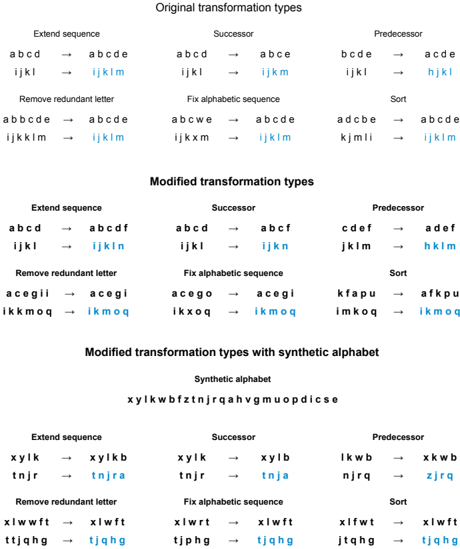
The image presents a comparison of string transformation types, categorized into "Original," "Modified," and "Modified with Synthetic Alphabet." Each category demonstrates four transformation operations: "Extend sequence," "Remove redundant letter," "Fix alphabetic sequence," and "Sort." The transformations are shown with example strings, illustrating the input and output of each operation. The output strings are highlighted in blue.
### Components/Axes
The image is divided into three main sections, each representing a different type of transformation:
1. **Original transformation types:** Located at the top.
2. **Modified transformation types:** Located in the middle.
3. **Modified transformation types with synthetic alphabet:** Located at the bottom.
Each section is further divided into four transformation operations:
* **Extend sequence:** Shows how a string is extended.
* **Remove redundant letter:** Shows how a redundant letter is removed from a string.
* **Fix alphabetic sequence:** Shows how a string's alphabetic sequence is corrected.
* **Sort:** Shows how a string is sorted alphabetically.
Within each operation, there are three columns:
* **Left Column:** Shows the original string before transformation.
* **Middle Column:** Shows the "Successor" transformation.
* **Right Column:** Shows the "Predecessor" transformation.
The "Modified transformation types with synthetic alphabet" section includes a "Synthetic alphabet" which is: `xylkwbfztnjrqahvgmuopdicse`
### Detailed Analysis or ### Content Details
**1. Original transformation types:**
* **Extend sequence:**
* `abcd` -> `abcde` (Successor)
* `ijkl` -> `ijklm` (Successor)
* `bcde` -> `acde` (Predecessor)
* `ijkl` -> `hjkl` (Predecessor)
* **Remove redundant letter:**
* `abbcde` -> `abcde`
* `ijkklm` -> `ijklm`
* **Fix alphabetic sequence:**
* `abcwe` -> `abcde`
* `ijkxm` -> `ijklm`
* **Sort:**
* `adcbe` -> `abcde`
* `kjmli` -> `ijklm`
**2. Modified transformation types:**
* **Extend sequence:**
* `abcd` -> `abcdf` (Successor)
* `ijkl` -> `ijklm` (Successor)
* `cdef` -> `adef` (Predecessor)
* `jklm` -> `hklm` (Predecessor)
* **Remove redundant letter:**
* `acegii` -> `acegi`
* `ikkmoq` -> `ikmoq`
* **Fix alphabetic sequence:**
* `acego` -> `acegi`
* `ikxoq` -> `ikmoq`
* **Sort:**
* `kfapu` -> `afkpu`
* `imkoq` -> `ikmoq`
**3. Modified transformation types with synthetic alphabet:**
* **Synthetic alphabet:** `xylkwbfztnjrqahvgmuopdicse`
* **Extend sequence:**
* `xylk` -> `xylkb` (Successor)
* `tnjr` -> `tnjra` (Successor)
* `lkwb` -> `xkwb` (Predecessor)
* `njrq` -> `zjrq` (Predecessor)
* **Remove redundant letter:**
* `xlwwft` -> `xlwft`
* `ttjqhg` -> `tjqhg`
* **Fix alphabetic sequence:**
* `xlwrt` -> `xlwft`
* `tjphg` -> `tjqhg`
* **Sort:**
* `xlfwt` -> `xlwft`
* `jtqhg` -> `tjqhg`
### Key Observations
* The "Original transformation types" section uses standard alphabetical order.
* The "Modified transformation types" section also uses standard alphabetical order but with different examples.
* The "Modified transformation types with synthetic alphabet" section uses a custom alphabet, which significantly alters the sorting and sequence-related transformations.
* The "Remove redundant letter" transformation simply removes a repeated character.
* The "Fix alphabetic sequence" transformation aims to correct the order of characters within the string based on the alphabet being used.
* The "Sort" transformation arranges the characters in the string according to the defined alphabet.
### Interpretation
The image illustrates different approaches to string transformation, highlighting the impact of using a custom alphabet. The "Original" and "Modified" types demonstrate transformations based on the standard alphabet, while the "Synthetic alphabet" type shows how a different alphabet can drastically change the outcome of these transformations. This comparison is useful for understanding how algorithms can be adapted to work with different character sets or customized ordering rules. The use of "Successor" and "Predecessor" transformations suggests a focus on generating variations of strings, potentially for tasks like data augmentation or code generation.