## Textual Diagram: Transformation Types for String Sequences
### Overview
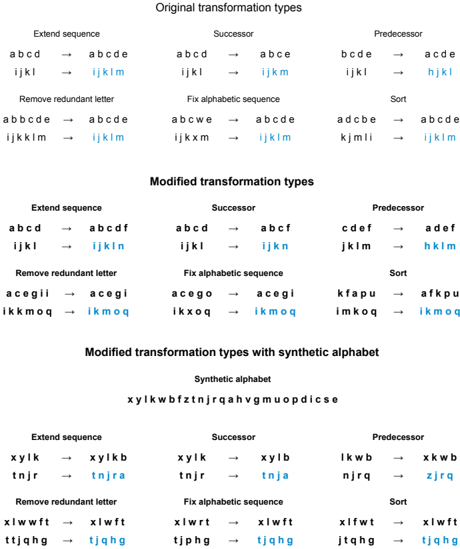
The image is a technical diagram illustrating three sets of string transformation rules: "Original transformation types," "Modified transformation types," and "Modified transformation types with synthetic alphabet." Each set demonstrates specific operations applied to alphabetic sequences, showing input and output examples. The text is entirely in English.
### Components/Axes
The diagram is structured into three horizontal sections, each with a main title. Within each section, transformations are grouped into six categories, arranged in a 2x3 grid layout:
1. **Extend sequence**
2. **Successor**
3. **Predecessor**
4. **Remove redundant letter**
5. **Fix alphabetic sequence**
6. **Sort**
Each category contains two example transformations, presented as `input → output`. Some output sequences are highlighted in blue text.
### Detailed Analysis / Content Details
#### **Section 1: Original transformation types**
* **Extend sequence**
* `abcd → abcde`
* `ijkl → ijklm`
* **Successor**
* `abcd → abce`
* `ijkl → ijkm`
* **Predecessor**
* `bcde → acde`
* `ijkl → hjkl`
* **Remove redundant letter**
* `abbcd → abcd`
* `ijkklm → ijklm`
* **Fix alphabetic sequence**
* `abcwe → abcde`
* `ijkxm → ijklm`
* **Sort**
* `adcbe → abcde`
* `kjmli → ijklm`
#### **Section 2: Modified transformation types**
* **Extend sequence**
* `abcd → abcdf`
* `ijkl → ijklh`
* **Successor**
* `abcd → abcf`
* `ijkl → ijkn`
* **Predecessor**
* `cdef → adef`
* `jklm → hkln`
* **Remove redundant letter**
* `acegii → acegi`
* `ikkmqo → ikmqo`
* **Fix alphabetic sequence**
* `acego → acegi`
* `ikxoq → ikmoq`
* **Sort**
* `kfapu → afkpu`
* `imkoq → ikmoq`
#### **Section 3: Modified transformation types with synthetic alphabet**
* **Synthetic alphabet:** `xylkwbfztnrqahvgmuopdicse`
* **Extend sequence**
* `xylk → xylkb`
* `tnjr → tnjra`
* **Successor**
* `xylk → xylb`
* `tnjr → tnja`
* **Predecessor**
* `lkwk → xkwb`
* `njrq → zjrq`
* **Remove redundant letter**
* `xlfwft → xlfwt`
* `ttjqhg → tjqhg`
* **Fix alphabetic sequence**
* `xlwrt → xlwft`
* `tpjhg → tjqhg`
* **Sort**
* `xlfwft → xlfwt`
* `zjrq → njrq`
### Key Observations
1. **Consistent Structure:** All three sections use the same six transformation categories, allowing for direct comparison between "Original" and "Modified" rules.
2. **Blue Text Emphasis:** In the first two sections, the output sequences are consistently highlighted in blue, drawing attention to the result of the transformation.
3. **Synthetic Alphabet Application:** The third section applies the modified rules to sequences derived from a non-standard, scrambled alphabet (`xylkwbfztnrqahvgmuopdicse`), testing the rules' generality.
4. **Transformation Logic:** The operations appear to be algorithmic or linguistic in nature, dealing with sequence extension, character shifting (successor/predecessor), redundancy removal, sequence correction, and sorting.
### Interpretation
This diagram serves as a reference sheet for a set of formal string manipulation operations. The progression from "Original" to "Modified" suggests an iterative development or refinement of these rules. The inclusion of a "synthetic alphabet" section is a stress test, demonstrating that the transformation logic is abstract and not dependent on the standard English alphabet order.
The likely purpose is to document algorithms for tasks such as:
* **Data cleaning:** "Remove redundant letter" and "Fix alphabetic sequence."
* **Sequence generation/prediction:** "Extend sequence," "Successor," and "Predecessor."
* **Data organization:** "Sort."
The blue highlighting in the first two sections may indicate the "correct" or "target" output in a learning or validation context. The entire set could be part of a specification for a software function, a linguistic model, or an educational tool for teaching string algorithms. The precise, example-driven format is designed for clarity and to eliminate ambiguity in how each transformation should be applied.