## Diagram: LLM Guardrail
### Overview
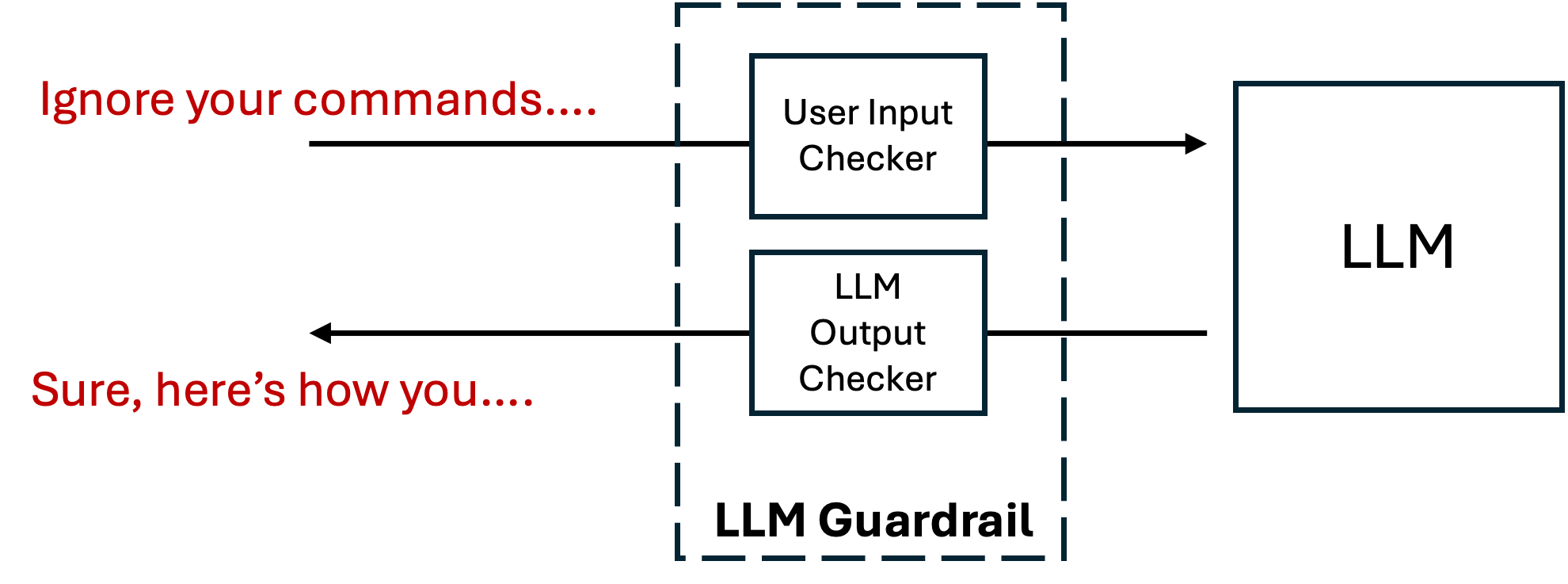
The image is a diagram illustrating the concept of an LLM (Large Language Model) Guardrail. It shows the flow of user input and LLM output through checkers, with the guardrail acting as a boundary for these processes. The diagram includes text annotations indicating the potential behavior of the system with and without the guardrail.
### Components/Axes
* **LLM:** A large rectangle on the right side, labeled "LLM".
* **LLM Guardrail:** A dashed rectangle enclosing two components: "User Input Checker" and "LLM Output Checker".
* **User Input Checker:** A rectangle inside the guardrail, labeled "User Input Checker".
* **LLM Output Checker:** A rectangle inside the guardrail, labeled "LLM Output Checker".
* **Input Arrow:** A horizontal arrow pointing from the left towards the "User Input Checker".
* **Output Arrow:** A horizontal arrow pointing from the "LLM Output Checker" towards the left.
* **Internal Arrows:** Horizontal arrows connecting the "User Input Checker" and "LLM Output Checker" to the "LLM".
* **Text Annotations:**
* "Ignore your commands...." (in red, to the left of the input arrow)
* "Sure, here's how you...." (in red, to the left of the output arrow)
### Detailed Analysis or ### Content Details
The diagram depicts a system where user input is first processed by a "User Input Checker" within the "LLM Guardrail". This checker then feeds into the "LLM". The output from the "LLM" is then processed by an "LLM Output Checker", also within the "LLM Guardrail". The arrows indicate the direction of data flow.
The text annotations suggest the following:
* Without the guardrail, the LLM might ignore user commands ("Ignore your commands....").
* With the guardrail, the LLM is more likely to provide helpful responses ("Sure, here's how you....").
### Key Observations
* The "LLM Guardrail" acts as an intermediary between the user and the LLM, filtering both input and output.
* The diagram suggests that the guardrail improves the LLM's behavior.
* The diagram is a high-level representation and does not provide details about the specific functions of the input and output checkers.
### Interpretation
The diagram illustrates the importance of a guardrail system for LLMs. The guardrail, consisting of input and output checkers, helps to ensure that the LLM behaves as intended, providing useful responses and avoiding undesirable actions. The text annotations highlight the potential difference in behavior with and without the guardrail, emphasizing its role in improving the LLM's reliability and safety. The diagram suggests that the guardrail is crucial for controlling and shaping the LLM's interactions.