## Bar Chart: Accuracy of Voting Methods
### Overview
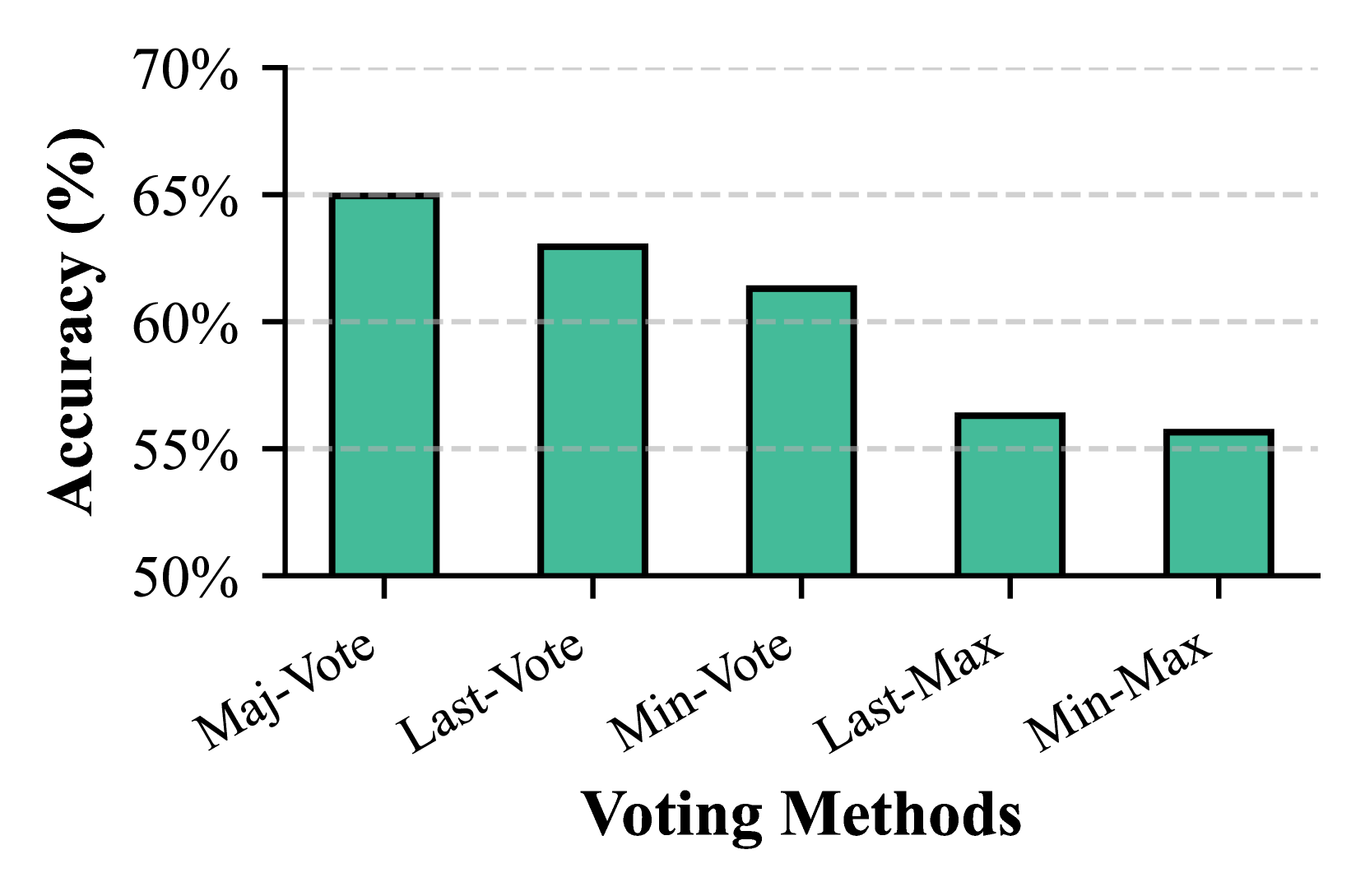
The image is a bar chart comparing the accuracy of five voting methods: **Maj-Vote**, **Last-Vote**, **Min-Vote**, **Last-Max**, and **Min-Max**. The y-axis represents accuracy as a percentage (50% to 70%), and the x-axis lists the voting methods. All bars are teal with black borders, and a legend confirms the color association. Accuracy values are approximate and decrease progressively from left to right.
### Components/Axes
- **X-Axis (Voting Methods)**:
- Labels: "Maj-Vote", "Last-Vote", "Min-Vote", "Last-Max", "Min-Max".
- Positioning: Horizontally spaced, left-aligned.
- **Y-Axis (Accuracy %)**:
- Scale: 50% to 70% in 5% increments.
- Positioning: Left-aligned, vertical.
- **Legend**:
- Color: Teal (labeled as "Accuracy (%)").
- Positioning: Not explicitly visible in the image but implied by bar color.
### Detailed Analysis
- **Maj-Vote**: Tallest bar, reaching ~65% accuracy.
- **Last-Vote**: Second tallest, ~63% accuracy.
- **Min-Vote**: Third, ~61% accuracy.
- **Last-Max**: Fourth, ~56% accuracy.
- **Min-Max**: Shortest bar, ~55% accuracy.
- **Trend**: Accuracy decreases monotonically from left to right (Maj-Vote to Min-Max).
### Key Observations
1. **Maj-Vote** achieves the highest accuracy (~65%), suggesting it is the most reliable method among those tested.
2. **Min-Max** has the lowest accuracy (~55%), indicating potential inefficiencies or biases in this method.
3. The decline in accuracy is consistent across all methods, with no outliers or anomalies.
### Interpretation
The data suggests that **Maj-Vote** (majority voting) is the most accurate method, likely due to its reliance on consensus. In contrast, **Min-Max** (minimum-maximum voting) performs poorly, possibly because it prioritizes extreme values, which may not reflect collective preference. The gradual decline in accuracy from **Maj-Vote** to **Min-Max** implies that methods emphasizing consensus or majority agreement are more effective than those focusing on extremes or minority preferences. This could inform the design of voting systems in contexts requiring high reliability, such as decision-making processes or resource allocation.