\n
## Histogram: Bridge Node Persistence Over Time
### Overview
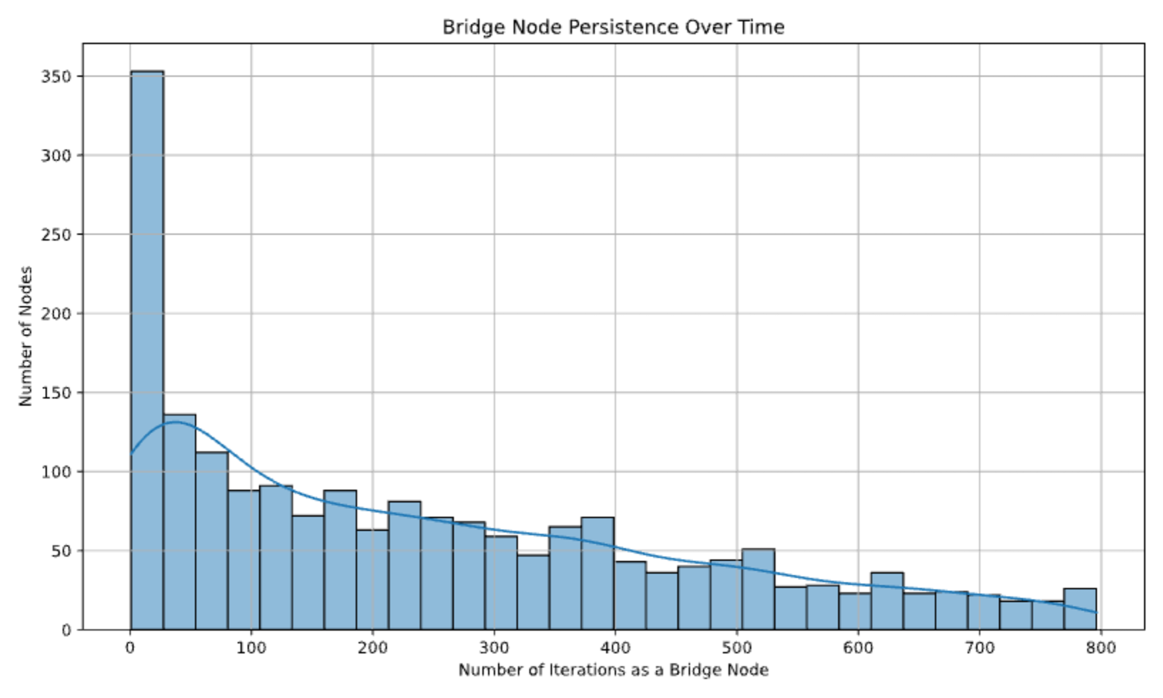
The image presents a histogram visualizing the persistence of bridge nodes over time, specifically the number of iterations a node remains a bridge node. The x-axis represents the number of iterations as a bridge node, and the y-axis represents the number of nodes. A blue line overlays the histogram, likely representing a fitted curve or trendline.
### Components/Axes
* **Title:** "Bridge Node Persistence Over Time" - positioned at the top-center of the image.
* **X-axis Label:** "Number of Iterations as a Bridge Node" - positioned at the bottom-center. The scale ranges from 0 to approximately 800, with tick marks at intervals of 100.
* **Y-axis Label:** "Number of Nodes" - positioned at the left-center. The scale ranges from 0 to 350, with tick marks at intervals of 50.
* **Histogram Bars:** Represent the distribution of nodes based on their persistence as bridge nodes.
* **Trendline:** A smooth blue curve overlaid on the histogram, indicating the general trend of node persistence.
### Detailed Analysis
The histogram shows a decreasing frequency of nodes as the number of iterations as a bridge node increases. The highest frequency is observed between 0 and approximately 50 iterations, with around 330 nodes. The frequency decreases steadily as the number of iterations increases.
Here's a breakdown of approximate values, reading from left to right:
* **0-50 Iterations:** Approximately 330 nodes.
* **50-100 Iterations:** Approximately 170 nodes.
* **100-150 Iterations:** Approximately 120 nodes.
* **150-200 Iterations:** Approximately 90 nodes.
* **200-250 Iterations:** Approximately 70 nodes.
* **250-300 Iterations:** Approximately 60 nodes.
* **300-350 Iterations:** Approximately 50 nodes.
* **350-400 Iterations:** Approximately 40 nodes.
* **400-450 Iterations:** Approximately 35 nodes.
* **450-500 Iterations:** Approximately 30 nodes.
* **500-550 Iterations:** Approximately 25 nodes.
* **550-600 Iterations:** Approximately 20 nodes.
* **600-650 Iterations:** Approximately 15 nodes.
* **650-700 Iterations:** Approximately 10 nodes.
* **700-750 Iterations:** Approximately 5 nodes.
* **750-800 Iterations:** Approximately 2 nodes.
The blue trendline starts at approximately 330 nodes at 0 iterations and decreases to approximately 2 nodes at 800 iterations. The trendline appears to follow an exponential decay pattern.
### Key Observations
* The distribution is heavily skewed to the left, indicating that most bridge nodes have a relatively short persistence time.
* The number of nodes decreases rapidly in the initial iterations (0-200) and then slows down as the number of iterations increases.
* The trendline provides a smooth representation of the overall decay in node persistence.
### Interpretation
The data suggests that bridge nodes are generally transient, with a large proportion of nodes only remaining as bridges for a short period. This could be due to network dynamics, node failures, or the algorithm's behavior in selecting and updating bridge nodes. The exponential decay pattern indicates that the probability of a node remaining a bridge decreases rapidly with each iteration. This information is valuable for understanding the stability and robustness of the network, and for optimizing the bridge node selection process. The rapid initial decline suggests that the initial bridge node selection is often suboptimal, and the network quickly adapts by replacing these nodes with more persistent ones. The long tail of the distribution, though containing few nodes, indicates that some nodes can maintain their bridge status for a significant number of iterations, potentially representing critical infrastructure nodes.