## Scatter Plot: Accuracy vs. Time-to-Answer Trade-off
### Overview
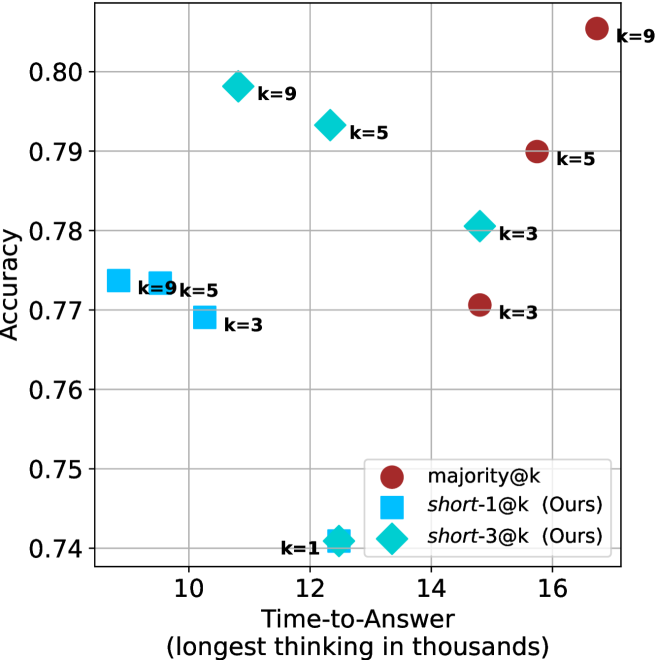
The image is a scatter plot comparing the accuracy of different methods against their time-to-answer (in thousands of units). Three methods are represented: **majority@k** (red dots), **short-1@k** (blue squares), and **short-3@k** (cyan diamonds). The x-axis ranges from 10k to 16k, and the y-axis ranges from 0.74 to 0.80.
---
### Components/Axes
- **Y-axis (Accuracy)**: Labeled "Accuracy" with values from 0.74 to 0.80 in increments of 0.01.
- **X-axis (Time-to-Answer)**: Labeled "Time-to-Answer (longest thinking in thousands)" with values from 10k to 16k in increments of 1k.
- **Legend**:
- **Red dots**: `majority@k`
- **Blue squares**: `short-1@k (Ours)`
- **Cyan diamonds**: `short-3@k (Ours)`
---
### Detailed Analysis
#### Data Points
1. **majority@k (Red Dots)**:
- (16k, 0.80) labeled `k=9`
- (15k, 0.79) labeled `k=5`
- (14k, 0.77) labeled `k=3`
2. **short-1@k (Blue Squares)**:
- (10k, 0.77) labeled `k=9`
- (12k, 0.79) labeled `k=5`
- (10k, 0.77) labeled `k=3`
3. **short-3@k (Cyan Diamonds)**:
- (14k, 0.78) labeled `k=3`
- (12k, 0.79) labeled `k=5`
- (12k, 0.79) labeled `k=9`
---
### Key Observations
1. **majority@k** consistently achieves the highest accuracy (0.77–0.80) but requires the longest time-to-answer (14k–16k).
2. **short-1@k** and **short-3@k** trade lower accuracy (0.77–0.79) for significantly shorter time-to-answer (10k–14k).
3. Overlapping points (e.g., (10k, 0.77) for `k=3` and `k=9` in `short-1@k`) suggest identical performance metrics for different `k` values in some cases.
4. **short-3@k** achieves near-identical accuracy to `short-1@k` at `k=5` and `k=9` but with the same time-to-answer, implying no clear advantage over `short-1@k` for these `k` values.
---
### Interpretation
The data demonstrates a clear **accuracy-time trade-off**:
- **majority@k** prioritizes accuracy by evaluating more options (`k=9` yields 0.80 accuracy) but incurs higher computational cost (16k time).
- **short-1@k** and **short-3@k** optimize for speed, sacrificing marginal accuracy gains. Notably, `short-3@k` does not outperform `short-1@k` in accuracy for `k=5` and `k=9`, suggesting diminishing returns for increasing `k` in this method.
- The overlap in `short-1@k` at (10k, 0.77) for `k=3` and `k=9` raises questions about whether `k` directly influences performance in this method or if other factors (e.g., data distribution) dominate.
This analysis highlights the importance of balancing accuracy and efficiency depending on application requirements. For instance, `majority@k` is ideal for high-stakes scenarios, while `short-1@k` or `short-3@k` suit time-sensitive tasks.