## Diagram: Machine Learning Model Trade-offs (Performance vs. Explainability)
### Overview
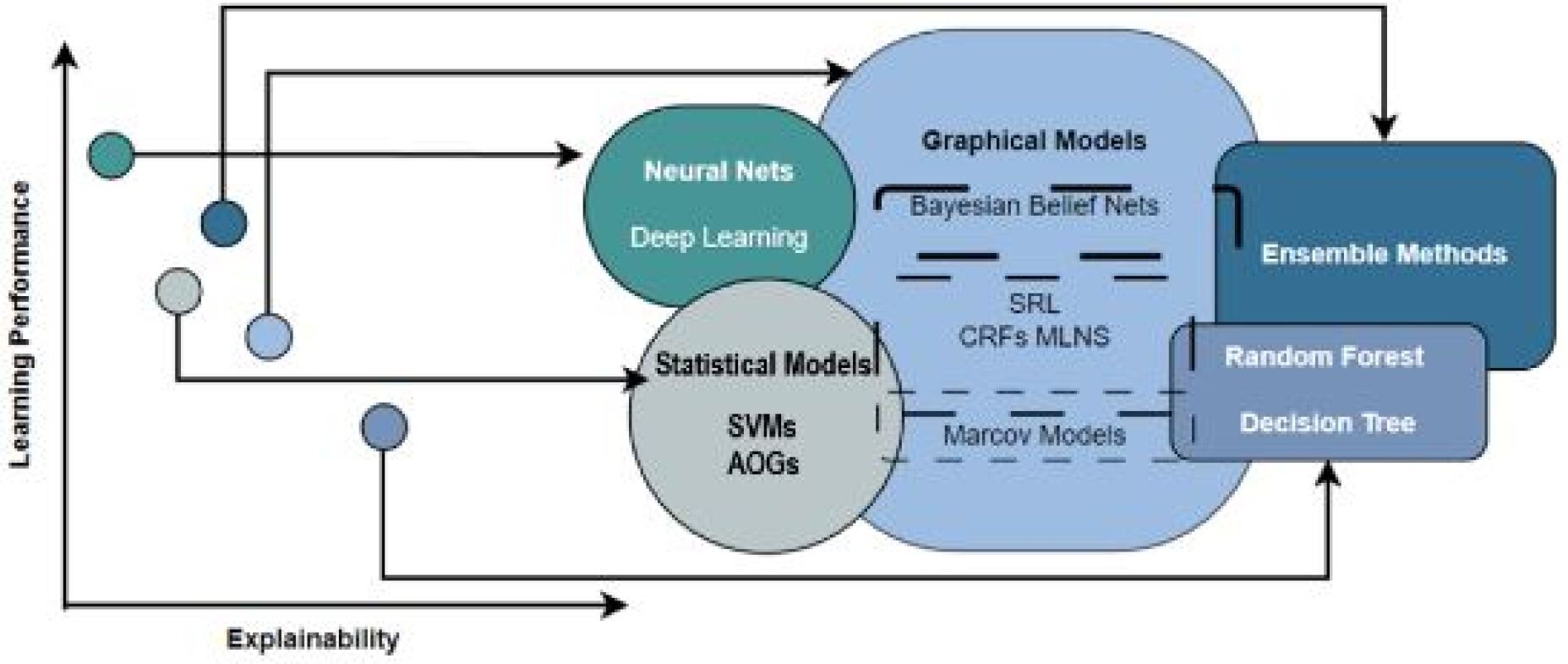
The diagram illustrates a conceptual map of machine learning models positioned along two axes: **Learning Performance** (vertical) and **Explainability** (horizontal). It categorizes models into four groups—Neural Nets/Deep Learning, Statistical Models (SVMs, AOGs), Graphical Models (Bayesian Belief Nets, SRL, CRFs, MLNS, Markov Models), and Ensemble Methods (Random Forest, Decision Tree)—and shows their relationships via directional arrows.
---
### Components/Axes
- **Axes**:
- **Vertical (Y-axis)**: Learning Performance (low to high, bottom to top).
- **Horizontal (X-axis)**: Explainability (low to high, left to right).
- **Key Labels**:
- **Neural Nets / Deep Learning** (green circle, top-left quadrant).
- **Statistical Models** (light blue circle, bottom-center).
- Subcategories: SVMs, AOGs.
- **Graphical Models** (dark blue oval, center-right).
- Subcategories: Bayesian Belief Nets, SRL, CRFs, MLNS, Markov Models.
- **Ensemble Methods** (dark blue rectangle, top-right).
- Subcategories: Random Forest, Decision Tree.
- **Arrows**:
- Indicate relationships (e.g., Neural Nets → Graphical Models → Ensemble Methods).
- Dashed lines suggest weaker or indirect connections.
---
### Detailed Analysis
1. **Neural Nets / Deep Learning**:
- Positioned at the top-left, indicating **high performance** but **low explainability**.
- Connected to Graphical Models via a direct arrow.
2. **Statistical Models (SVMs, AOGs)**:
- Located at the bottom-center, reflecting **moderate performance** and **high explainability**.
- Dashed lines link to Graphical Models, suggesting limited integration.
3. **Graphical Models**:
- Central position (middle-right), balancing **moderate performance** and **moderate explainability**.
- Subcategories (e.g., Bayesian Belief Nets, CRFs) are listed within the oval.
4. **Ensemble Methods (Random Forest, Decision Tree)**:
- Top-right quadrant, showing **high performance** and **high explainability**.
- Connected to Graphical Models via a direct arrow, implying synergy.
---
### Key Observations
- **Trade-off**: Models with higher performance (e.g., Neural Nets) sacrifice explainability, while simpler models (e.g., SVMs) prioritize transparency over performance.
- **Ensemble Methods** occupy the "sweet spot," balancing both axes.
- **Graphical Models** act as a bridge between complex and interpretable models.
- **Directional Arrows** suggest a progression from complex (Neural Nets) to hybrid (Graphical Models) to balanced (Ensemble Methods) approaches.
---
### Interpretation
The diagram highlights the **performance-explainability trade-off** in machine learning. Neural Nets and Deep Learning dominate in performance but are "black boxes," while Statistical Models (e.g., SVMs) are interpretable but less powerful. Graphical Models (e.g., Bayesian Networks) offer a middle ground, and Ensemble Methods (e.g., Random Forests) combine performance with transparency. The arrows imply that combining techniques (e.g., Neural Nets → Graphical Models → Ensemble Methods) could optimize both axes. Notably, no model achieves peak performance **and** peak explainability simultaneously, underscoring the need for context-specific model selection.