## Diagram: Ontology Construction and Refinement using LLM
### Overview
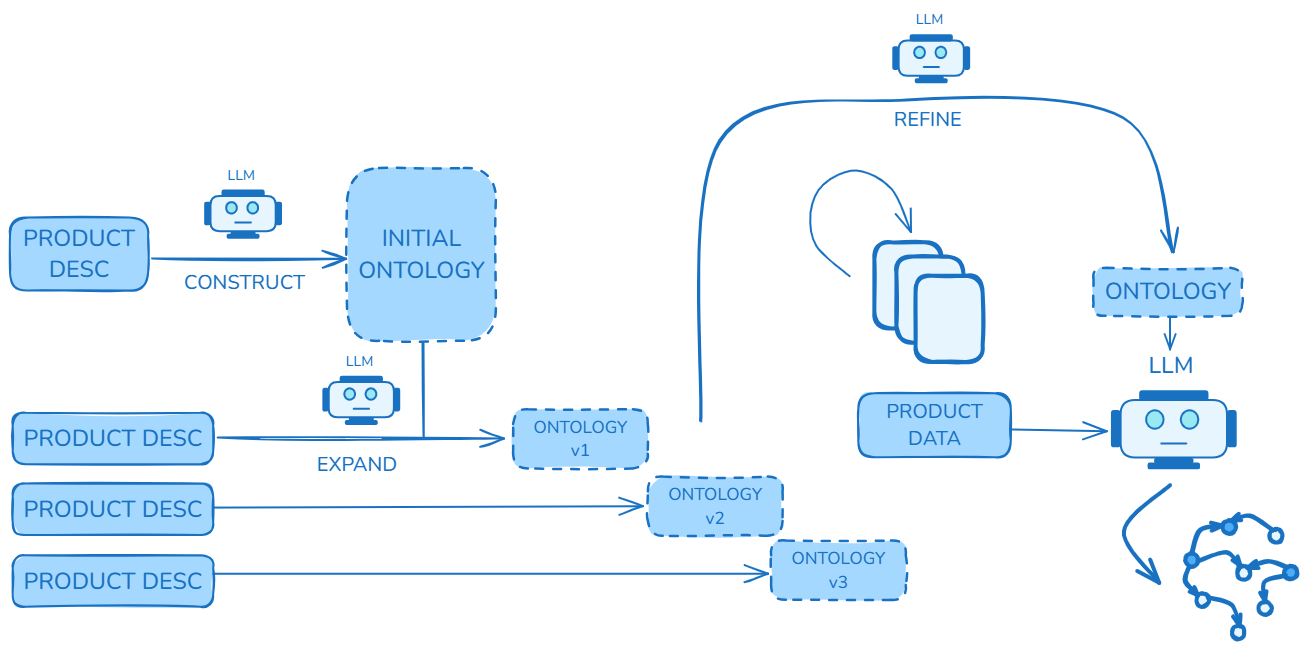
The image is a diagram illustrating a process for constructing and refining ontologies using Large Language Models (LLMs). It shows how product descriptions are used to create initial ontologies, which are then expanded and refined through iterative processes involving product data and LLMs.
### Components/Axes
* **Nodes:**
* PRODUCT DESC (Product Description): Represents input data describing products.
* INITIAL ONTOLOGY: Represents the initial ontology created from product descriptions. The border of this node is dashed.
* ONTOLOGY v1, ONTOLOGY v2, ONTOLOGY v3: Represent different versions of the ontology. The border of these nodes are dashed.
* PRODUCT DATA: Represents product data used for refining the ontology.
* ONTOLOGY: Represents the refined ontology. The border of this node is dashed.
* **Edges/Arrows:** Indicate the flow of data and processes.
* CONSTRUCT: Label on the arrow from PRODUCT DESC to INITIAL ONTOLOGY.
* EXPAND: Label on the arrows from PRODUCT DESC to ONTOLOGY v1, v2, and v3.
* REFINE: Label on the arrow from PRODUCT DATA to ONTOLOGY.
* **Actors:**
* LLM (Large Language Model): Represented by a robot icon, indicating the involvement of an LLM in the process.
* **Other:**
* A circular arrow indicates an iterative process.
* A network graph at the bottom-right represents the final output.
### Detailed Analysis or Content Details
1. **Initial Ontology Construction:**
* A single "PRODUCT DESC" node is connected to an "INITIAL ONTOLOGY" node via an arrow labeled "CONSTRUCT." An LLM robot icon is positioned above the "CONSTRUCT" label, indicating that the LLM is used to construct the initial ontology from the product description.
2. **Ontology Expansion:**
* Three "PRODUCT DESC" nodes are connected to "ONTOLOGY v1," "ONTOLOGY v2," and "ONTOLOGY v3" nodes, respectively, via arrows labeled "EXPAND." An LLM robot icon is positioned above the "EXPAND" label, indicating that the LLM is used to expand the ontologies using the product descriptions.
3. **Ontology Refinement:**
* A set of stacked document icons labeled "PRODUCT DATA" is connected to an "ONTOLOGY" node.
* A large curved arrow labeled "REFINE" connects the "PRODUCT DATA" to the "ONTOLOGY" node. An LLM robot icon is positioned above the "REFINE" label, indicating that the LLM is used to refine the ontology using the product data.
* A circular arrow indicates that the "PRODUCT DATA" is iteratively refined.
4. **Final Output:**
* The "ONTOLOGY" node is connected to a network graph at the bottom-right, representing the final refined ontology. An LLM robot icon is positioned above the network graph, indicating that the LLM is used to generate the final ontology.
### Key Observations
* The diagram highlights the use of LLMs in various stages of ontology construction and refinement.
* The process involves both constructing an initial ontology and expanding existing ontologies.
* The refinement process is iterative, using product data to improve the ontology.
### Interpretation
The diagram illustrates a workflow for leveraging LLMs to create and improve ontologies. The process begins with initial ontology creation from product descriptions, followed by expansion using additional product descriptions. The core of the process is the iterative refinement of the ontology using product data, guided by an LLM. This suggests a system where LLMs are used to automate and enhance the creation and maintenance of ontologies, which are crucial for knowledge representation and reasoning in various applications. The iterative refinement loop emphasizes the importance of continuous improvement and adaptation of the ontology based on new data.