\n
## Diagram: Ontology Refinement Process
### Overview
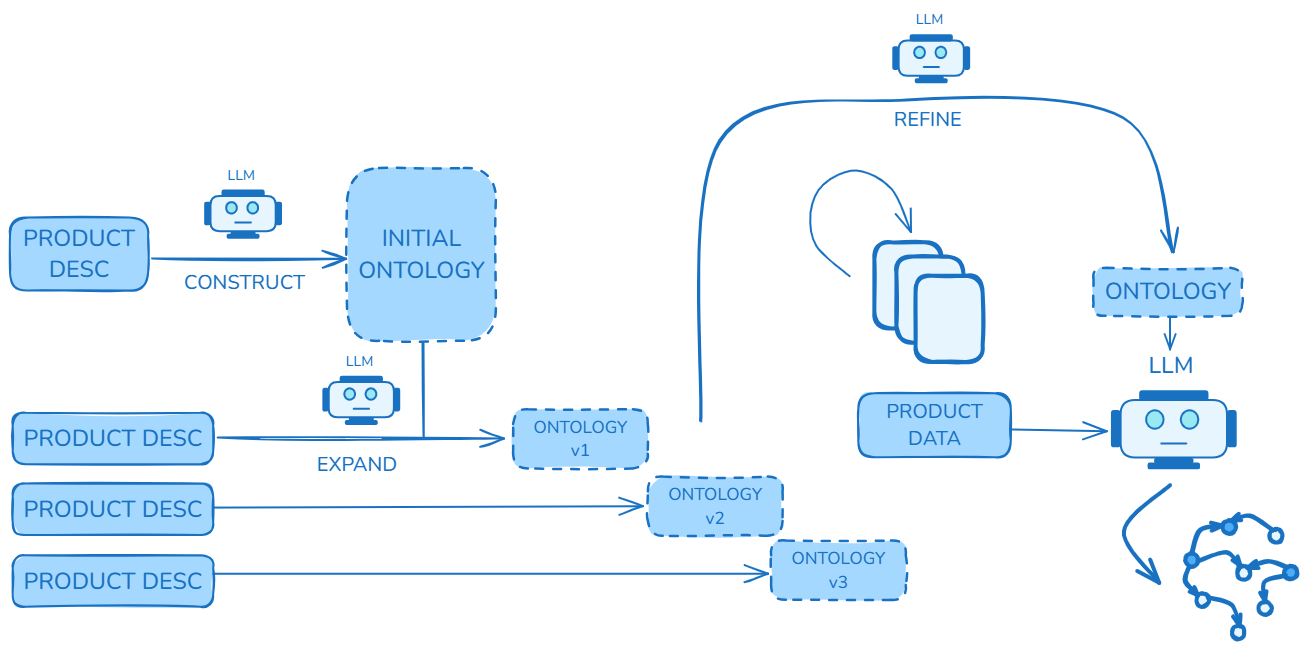
This diagram illustrates a process for refining an ontology using Large Language Models (LLMs) and product descriptions/data. The process begins with constructing an initial ontology from product descriptions, then iteratively expanding and refining it with additional product data and LLM feedback.
### Components/Axes
The diagram consists of several key components:
* **Product Descriptions (PRODUCT DESC):** Represented as light blue rectangles, these are the input data for ontology construction and expansion. There are four instances of "PRODUCT DESC" shown.
* **Large Language Models (LLM):** Represented as stylized brain icons in light blue, these models perform the tasks of ontology construction, expansion, and refinement. There are three LLM icons.
* **Ontology Versions (INITIAL ONTOLOGY, ONTOLOGY v1, ONTOLOGY v2, ONTOLOGY v3):** Represented as light blue rounded rectangles, these represent the evolving ontology at different stages of the process.
* **Product Data (PRODUCT DATA):** Represented as a light blue rectangle, this is used to refine the ontology.
* **Refined Ontology:** Represented as a light blue rounded rectangle labeled "ONTOLOGY".
* **Connections/Arrows:** Indicate the flow of data and control between components. Arrows are labeled with actions like "CONSTRUCT", "EXPAND", and "REFINE".
* **Complex Structure:** Represented as a complex, interconnected structure, this is the final output of the process.
### Detailed Analysis or Content Details
The process unfolds as follows:
1. **Initial Ontology Construction:** The first "PRODUCT DESC" input is fed into an LLM labeled "CONSTRUCT", which generates the "INITIAL ONTOLOGY".
2. **Ontology Expansion:** Three additional "PRODUCT DESC" inputs are fed into separate LLMs labeled "EXPAND". Each LLM generates a new version of the ontology: "ONTOLOGY v1", "ONTOLOGY v2", and "ONTOLOGY v3".
3. **Ontology Refinement:** The "INITIAL ONTOLOGY", "ONTOLOGY v1", "ONTOLOGY v2", and "ONTOLOGY v3" are combined into a stack of rectangles. This stack is then fed into an LLM labeled "REFINE".
4. **Product Data Integration:** "PRODUCT DATA" is also fed into the LLM labeled "REFINE".
5. **Final Ontology Output:** The LLM labeled "REFINE" outputs the "ONTOLOGY", which is then fed into another LLM. This final LLM generates the complex, interconnected structure.
The arrows indicate a unidirectional flow of information. The LLM labeled "REFINE" receives input from multiple sources (ontology versions and product data) and produces a single output (the refined ontology).
### Key Observations
* The process is iterative, with multiple rounds of ontology expansion and refinement.
* The LLMs play a central role in all stages of the process.
* The diagram emphasizes the importance of both product descriptions and product data in building a comprehensive ontology.
* The final output is a complex structure, suggesting a rich and detailed ontology.
### Interpretation
This diagram depicts a pipeline for automated ontology creation and refinement, leveraging the capabilities of LLMs. The process starts with a basic ontology built from product descriptions and progressively improves it by incorporating more descriptions and structured product data. The "REFINE" step is crucial, as it integrates information from multiple sources to create a more accurate and complete ontology. The final complex structure likely represents a knowledge graph or similar representation of the ontology, enabling advanced reasoning and data integration. The diagram suggests a data-driven approach to knowledge representation, where LLMs act as intelligent agents for extracting and organizing information from unstructured and structured data sources. The iterative nature of the process allows for continuous improvement and adaptation of the ontology as new data becomes available.