\n
## Diagram: Sequence of Function Calls
### Overview
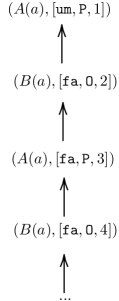
The image depicts a vertical sequence of function calls, represented as pairs of function names with arguments and associated data enclosed in square brackets. Arrows point upwards, indicating the flow of execution. The sequence appears to alternate between functions `A(a)` and `B(a)`.
### Components/Axes
The diagram consists of a series of function call expressions arranged vertically. Each expression has the following structure:
`(Function Name(argument), [data1, data2, data3])`
The functions involved are `A(a)` and `B(a)`.
The data within the square brackets varies for each call.
Arrows indicate the direction of the function call sequence.
### Detailed Analysis or Content Details
The sequence, from bottom to top, is as follows:
1. `(B(a), [fa, 0, 4])`
2. `(A(a), [fa, P, 3])`
3. `(B(a), [fa, 0, 2])`
4. `(A(a), [um, P, 1])`
5. `...` (Indicates the sequence continues beyond the visible portion)
The arguments to the functions are consistently `a`. The data within the brackets consists of strings (`fa`, `um`, `P`) and numbers (0, 1, 2, 3, 4).
### Key Observations
The sequence alternates between calls to `A(a)` and `B(a)`.
The first element within the brackets is frequently `fa`, but also includes `um`.
The second element within the brackets is frequently `P`.
The third element within the brackets is a numerical value that increases and then decreases (4, 3, 2, 1).
### Interpretation
This diagram likely represents a simplified call stack or execution trace of a program. The alternating calls to `A(a)` and `B(a)` suggest a recursive or iterative process where these two functions call each other. The data within the brackets could represent state variables or parameters that are modified during each function call. The `...` at the bottom indicates that the sequence continues, potentially infinitely or until a base case is reached. The changing numerical value (4, 3, 2, 1) might represent a counter or a depth level in a recursive call. The presence of `um` suggests a change in state or a different branch of execution. Without further context, it's difficult to determine the exact purpose of these functions and the meaning of the data they manipulate. However, the diagram clearly illustrates a sequential process with alternating function calls and evolving state information.