## Flowchart: Sequential Process with Alternating Functions A(a) and B(a)
### Overview
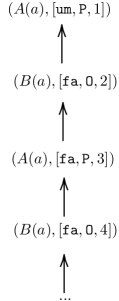
The image depicts a vertical flowchart illustrating a recursive or iterative process involving alternating applications of functions **A(a)** and **B(a)**. Each node contains a tuple with the function name, an identifier ("um" or "fa"), and numerical parameters. Arrows indicate upward progression through the sequence.
---
### Components/Axes
- **Nodes**: Alternating between **A(a)** and **B(a)**, each paired with a bracketed list of parameters.
- **Parameters**:
- First node: `(A(a), [um, P, 1])`
- Second node: `(B(a), [fa, 0, 2])`
- Third node: `(A(a), [fa, P, 3])`
- Fourth node: `(B(a), [fa, 0, 4])`
- Pattern continues with ellipsis (`...`) at the bottom, suggesting indefinite repetition.
- **Arrows**: Unidirectional upward arrows connect nodes, emphasizing sequential execution.
---
### Detailed Analysis
1. **Function Alternation**:
- Functions **A(a)** and **B(a)** alternate strictly, starting with **A(a)** at the top.
- Parameters within brackets vary systematically:
- **A(a)** nodes: `[um, P, 1]` → `[fa, P, 3]` → ...
- **B(a)** nodes: `[fa, 0, 2]` → `[fa, 0, 4]` → ...
- The third parameter (e.g., `1`, `2`, `3`, `4`) increments by 1 at each step, regardless of function.
2. **Parameter Patterns**:
- **First element**: Alternates between `"um"` (only in the first **A(a)** node) and `"fa"` (all subsequent nodes).
- **Second element**: Alternates between `P` (in **A(a)** nodes) and `0` (in **B(a)** nodes).
- **Third element**: Increments by 1 at each step (1 → 2 → 3 → 4 → ...).
3. **Flow Direction**:
- All arrows point upward, indicating a top-down execution flow. No feedback loops or branching paths are present.
---
### Key Observations
- **Strict Alternation**: The sequence enforces a rigid A-B-A-B pattern without deviation.
- **Parameter Evolution**:
- `"um"` appears only once, replaced by `"fa"` in all subsequent nodes.
- `P` and `0` alternate as the second parameter, tied to the function type.
- The third parameter acts as a counter, increasing monotonically.
- **No Termination**: The ellipsis implies the process continues indefinitely unless externally halted.
---
### Interpretation
This flowchart likely models a **stateful iterative algorithm** where:
1. **Function A(a)** and **B(a)** represent distinct computational steps (e.g., data transformation, validation, or state updates).
2. The parameters track:
- A flag (`"um"`/`"fa"`) possibly indicating a mode or context (e.g., initial vs. subsequent iterations).
- A binary toggle (`P`/`0`) that alternates with each function application.
- A counter (`1`, `2`, `3`, ...) to track iteration depth.
3. The absence of termination conditions suggests the process is designed for open-ended execution, common in loops or recursive functions without explicit exit criteria.
The diagram emphasizes **deterministic progression**, with each step’s output directly influencing the next via parameter updates. The use of `"fa"` after the first iteration may signify a transition to a stabilized or recurring state.