## Heatmap: Syllogism Validity Prediction
### Overview
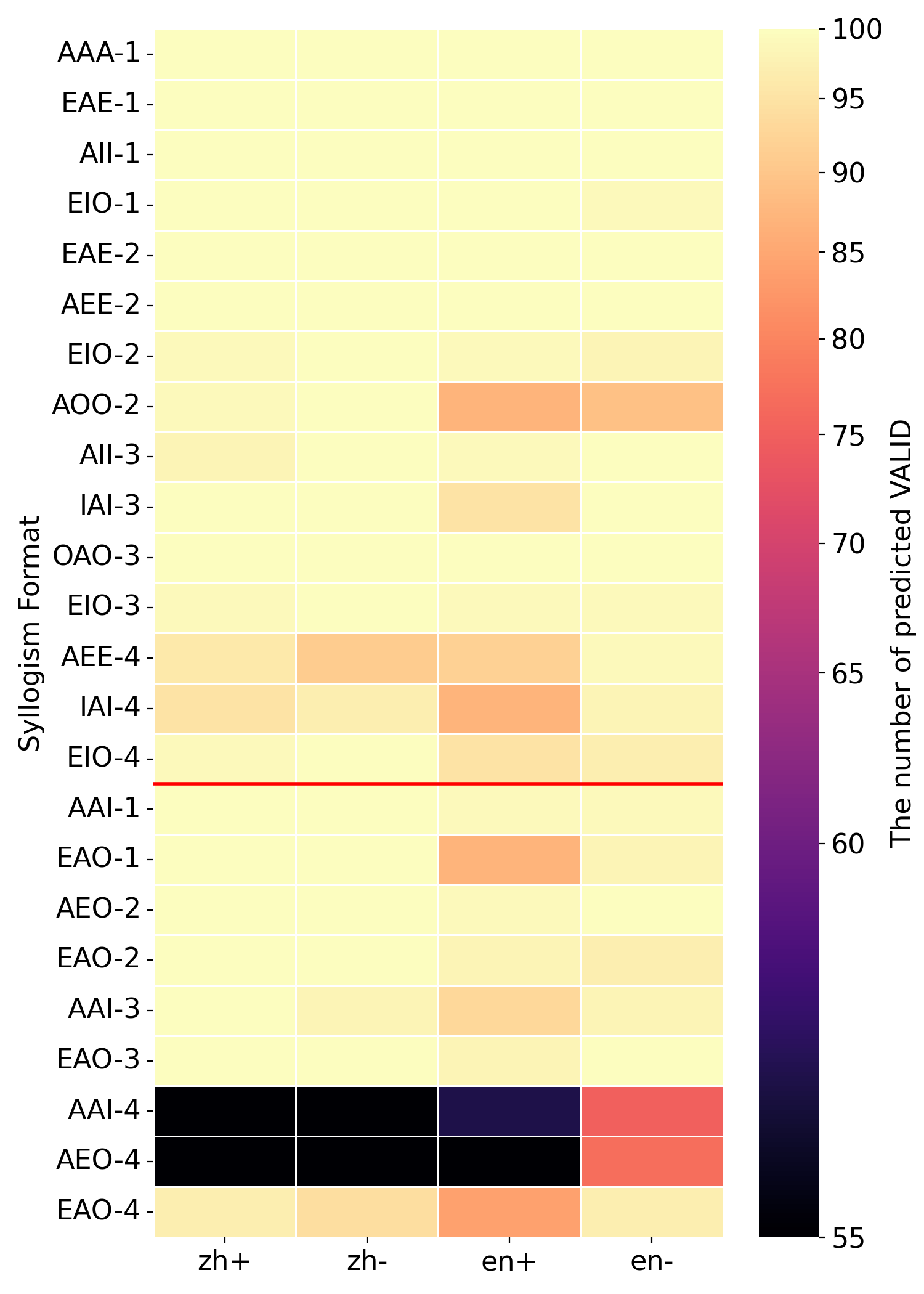
The image is a heatmap visualizing the number of predicted valid syllogisms for different syllogism formats across four conditions: 'zh+' (Chinese positive), 'zh-' (Chinese negative), 'en+' (English positive), and 'en-' (English negative). The heatmap uses a color gradient from dark purple (low values) to light yellow (high values) to represent the number of predicted valid syllogisms, ranging from approximately 55 to 100.
### Components/Axes
* **Y-axis:** "Syllogism Format" lists various syllogism formats such as AAA-1, EAE-1, AII-1, EIO-1, EAE-2, AEE-2, EIO-2, AOO-2, AII-3, IAI-3, OAO-3, EIO-3, AEE-4, IAI-4, EIO-4, AAI-1, EAO-1, AEO-2, EAO-2, AAI-3, EAO-3, AAI-4, AEO-4, and EAO-4.
* **X-axis:** Four conditions are listed: "zh+", "zh-", "en+", and "en-".
* **Color Scale (Legend):** Located on the right side of the heatmap, it represents "The number of predicted VALID" ranging from 55 (dark purple) to 100 (light yellow). The scale has tick marks at 55, 60, 65, 70, 75, 80, 85, 90, 95, and 100.
### Detailed Analysis
The heatmap displays the number of predicted valid syllogisms for each syllogism format under each condition. The color intensity corresponds to the number of predicted valid syllogisms, with lighter colors indicating higher numbers and darker colors indicating lower numbers.
Here's a breakdown of the approximate values for each cell:
| Syllogism Format | zh+ | zh- | en+ | en- |
| :--------------- | :---- | :---- | :---- | :---- |
| AAA-1 | ~98 | ~98 | ~98 | ~98 |
| EAE-1 | ~98 | ~98 | ~98 | ~98 |
| AII-1 | ~98 | ~98 | ~98 | ~98 |
| EIO-1 | ~98 | ~98 | ~98 | ~98 |
| EAE-2 | ~98 | ~98 | ~98 | ~98 |
| AEE-2 | ~98 | ~98 | ~98 | ~98 |
| EIO-2 | ~98 | ~98 | ~98 | ~78 |
| AOO-2 | ~98 | ~98 | ~98 | ~98 |
| AII-3 | ~98 | ~98 | ~98 | ~98 |
| IAI-3 | ~98 | ~98 | ~98 | ~78 |
| OAO-3 | ~98 | ~98 | ~98 | ~98 |
| EIO-3 | ~98 | ~98 | ~98 | ~98 |
| AEE-4 | ~98 | ~98 | ~73 | ~73 |
| IAI-4 | ~98 | ~98 | ~73 | ~98 |
| EIO-4 | ~98 | ~98 | ~98 | ~98 |
| AAI-1 | ~98 | ~98 | ~98 | ~98 |
| EAO-1 | ~98 | ~98 | ~73 | ~98 |
| AEO-2 | ~98 | ~98 | ~98 | ~98 |
| EAO-2 | ~98 | ~98 | ~98 | ~98 |
| AAI-3 | ~98 | ~98 | ~98 | ~98 |
| EAO-3 | ~98 | ~98 | ~98 | ~98 |
| AAI-4 | ~55 | ~55 | ~55 | ~78 |
| AEO-4 | ~55 | ~98 | ~55 | ~98 |
| EAO-4 | ~98 | ~98 | ~98 | ~73 |
* **AAI-1** has a red line across the row.
### Key Observations
* Most syllogism formats have high predicted validity scores (close to 100) across all conditions.
* Syllogism formats AAI-4 and AEO-4 have the lowest predicted validity scores (around 55) for 'zh+' and 'en+' conditions.
* The 'en-' condition shows some variability, with some syllogism formats having lower predicted validity scores compared to other conditions.
* The red line across AAI-1 indicates a specific point of interest or a threshold.
### Interpretation
The heatmap suggests that the model generally predicts high validity for most syllogism formats, especially in the 'zh+' and 'zh-' conditions. The lower scores for AAI-4 and AEO-4 in 'zh+' and 'en+' might indicate a bias or difficulty in processing these specific syllogism formats under those conditions. The variability in the 'en-' condition could be due to the negative framing in English affecting the model's ability to predict validity accurately. The red line on AAI-1 may indicate a baseline or a critical threshold for validity prediction. Further investigation is needed to understand the underlying reasons for these differences and potential biases in the model.